Stock market winners and losers one month into US-Israel war on Iran / Photo: © AFP

The US-Israel strikes against Iran have triggered a series of retaliations and military escalation in the Middle East that have sent shockwaves through global financial markets.
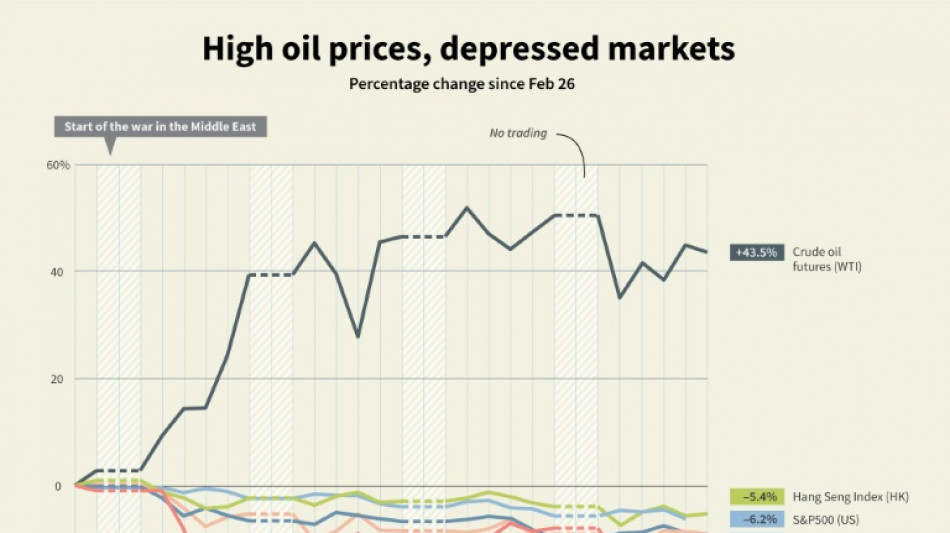
The conflict, now more than a month old, has disrupted trade and energy markets, with stocks around the globe facing diverging effects based on how exposed they are -- or how much they benefit from -- the chaos.
Here are some of the winners and losers from the conflict so far.
- Attracting investors: Oil and gas -
Iran has imposed a virtual blockade on the Strait of Hormuz, through which roughly a fifth of global oil and gas supplies pass, causing energy prices to skyrocket.
The price shock has also lifted the valuations of major energy producers.
These producers' profit margins have increased because as oil prices climb, the costs of extraction has remained relatively steady, said Jose Torres, senior economist at Interactive Brokers.
As a result, investors have poured money into companies that look set to profit from a sustained high-price environment.
"They see the conflict continuing for a while," Torres said. "That means oil prices are going to be structurally higher for the next year or two."
In the European markets, BP led the surge with a gain of 22.3 percent in the one-month period from February 27 -- the last trading day before strikes were launched -- to March 27.
TotalEnergies rose 16.7 percent and Shell climbed 13.3 percent in the same period.
- Pulling back: Defense sector -
Global conflict is usually a boon to defense contractors, and overall, 2026 has seen large gains for weapons makers.
On a shorter timescale, several major defense companies have seen their stock prices slip since the Iran war began, as the market grapples with potential supply chain bottlenecks.
Though munitions are being deployed at a rapid pace, due to long lead-in times for procurement and production, there is a lag until any increased demand can be met.
Investors "don't see a lot of new technology being produced," said Sam Stovall, chief investment strategist at CFRA. "We are in a sense still using up a lot of residual bombs"
German company Rheinmetall saw its shares tumble 17 percent between February 27 and March 27, while Thales dropped 6.7 percent and RTX -- formerly Raytheon Technologies -- fell 6.4 percent.
- Facing headwinds: Aviation -
The airline industry has emerged as one of the hardest-hit sectors, as the war forces mass flight cancellations and significant rerouting around contested airspace.
Compounding the operational difficulties is the surge in jet fuel prices, which has squeezed profit margins across the board.
The increased cost of fuel is the top concern, but far from the only one, said Stovall.
"Close behind is consumer confidence that is being affected by higher prices at the pump for their automobiles, higher prices when attempting to book summertime travel," he told AFP.
Stovall also pointed to the long lines for security checks at US airports, and heightened travel safety concerns, as reasons that many people are cutting down on nonessential travel.
Lufthansa experienced a sharp decline of 19 percent, while International Airlines Group (IAG, which includes British Airways and Iberia) saw its shares fall 15.9 percent.
Low-cost carrier Ryanair was also down 10.2 percent.
- Systemic pressure: Financial sector -
Banking and financial services have also faced downward pressure as the conflict heightens global economic uncertainty, and the effects of rising fuel prices filter through the economy at all levels.
Torres, of Interactive Brokers, noted a pattern in some countries lowering interest rates despite the jump in oil prices.
"I think folks are increasingly worried about an economic slowdown, and they're pricing in now more of the demand destruction effects of higher crude oil prices, as well as how higher interest rates make private credit situations worse," he said.
A recent boom in private credit lending, where non-bank institutions like private equity firms make loans to companies, has sparked concerns that growing rates of default on these loans would have knock-on effects across the economy.
HSBC, which maintains significant exposure to global trade routes and emerging markets, saw its stock price decline by 13.9 percent.
US banks JP Morgan Chase, Goldman Sachs, and Bank of America all saw share prices fall a few percentage points compared to the start of the war, as investors brace for a period of lower lending activity and increased credit risk.
B.Chan--ThChM