The China Mail - OPEC+ raises quotas again as Middle East calms

USD -
AED 3.672503
AFN 64.000129
ALL 82.13669
AMD 367.799411
ANG 1.790403
AOA 917.507781
ARS 1488.262496
AUD 1.442793
AWG 1.8025
AZN 1.710825
BAM 1.709832
BBD 2.015606
BDT 123.389765
BGN 1.69088
BHD 0.377337
BIF 2976.731174
BMD 1
BND 1.291479
BOB 6.930377
BRL 5.168978
BSD 1.000765
BTN 95.340217
BWP 13.497694
BYN 2.903642
BYR 19600
BZD 2.01272
CAD 1.422905
CDF 2246.000447
CHF 0.805575
CLF 0.023412
CLP 921.44031
CNY 6.7891
CNH 6.79508
COP 3346.54
CRC 455.934359
CUC 1
CUP 26.5
CVE 96.399815
CZK 21.15705
DJF 178.209079
DKK 6.54504
DOP 59.284581
DZD 133.21541
EGP 48.901203
ERN 15
ETB 160.478228
EUR 0.87562
FJD 2.24075
FKP 0.748952
GBP 0.749769
GEL 2.634992
GGP 0.748952
GHS 11.368574
GIP 0.748952
GMD 72.480153
GNF 8776.845704
GTQ 7.637499
GYD 209.336382
HKD 7.84275
HNL 26.786034
HRK 6.598505
HTG 130.896438
HUF 309.266019
IDR 18002
ILS 3.006395
IMP 0.748952
INR 95.39825
IQD 1310.97521
IRR 1375950.000078
ISK 126.087821
JEP 0.748952
JMD 158.434973
JOD 0.708998
JPY 162.257022
KES 129.290024
KGS 87.447696
KHR 4007.693653
KMF 431.000113
KPW 900.00035
KRW 1532.905018
KWD 0.31048
KYD 0.834058
KZT 473.271231
LAK 22597.482077
LBP 89618.073011
LKR 335.205739
LRD 181.630619
LSL 16.232733
LTL 2.95274
LVL 0.60489
LYD 6.414443
MAD 9.358851
MDL 17.603525
MGA 4242.781894
MKD 53.970631
MMK 2099.754651
MNT 3582.367601
MOP 8.08442
MRU 39.940374
MUR 47.070069
MVR 15.460059
MWK 1735.405329
MXN 17.478701
MYR 4.080502
MZN 63.910156
NAD 16.232662
NGN 1370.109826
NIO 36.824459
NOK 9.84915
NPR 152.547856
NZD 1.760037
OMR 0.384506
PAB 1.000782
PEN 3.405239
PGK 4.396728
PHP 61.528017
PKR 278.231635
PLN 3.75524
PYG 6084.846895
QAR 3.658323
RON 4.5798
RSD 102.801019
RUB 77.881781
RWF 1465.180328
SAR 3.758562
SBD 8.058541
SCR 14.564114
SDG 600.510419
SEK 9.66995
SGD 1.293502
SHP 0.746601
SLE 24.35031
SLL 20969.503664
SOS 571.978142
SRD 37.566043
STD 20697.981008
STN 21.419735
SVC 8.756737
SYP 110.532098
SZL 16.229755
THB 33.335982
TJS 9.276572
TMT 3.51
TND 2.953586
TOP 2.40776
TRY 46.822099
TTD 6.782536
TWD 32.038498
TZS 2627.482974
UAH 44.570629
UGX 3652.720525
UYU 40.249681
UZS 11988.460025
VES 638.90327
VND 26300
VUV 118.993979
WST 2.773187
XAF 573.514317
XAG 0.016103
XAU 0.000241
XCD 2.70255
XCG 1.803629
XDR 0.713221
XOF 573.476712
XPF 104.261467
YER 237.050197
ZAR 16.22925
ZMK 9001.191204
ZMW 18.388302
ZWL 321.999592
  • CMSD

    -0.0300

    22.15

    -0.14%

  • CMSC

    0.0400

    21.99

    +0.18%

  • RYCEF

    0.5400

    19.68

    +2.74%

  • RBGPF

    2.5400

    68.15

    +3.73%

  • NGG

    2.6700

    82.85

    +3.22%

  • GSK

    2.3600

    53.66

    +4.4%

  • BCE

    0.4000

    21.42

    +1.87%

  • AZN

    11.2900

    195.15

    +5.79%

  • RIO

    1.0700

    94.42

    +1.13%

  • VOD

    0.1400

    13.15

    +1.06%

  • BTI

    1.2100

    61.77

    +1.96%

  • BCC

    0.4500

    75.93

    +0.59%

  • RELX

    0.5500

    31.93

    +1.72%

  • JRI

    0.0600

    13

    +0.46%

  • BP

    1.2500

    37.4

    +3.34%

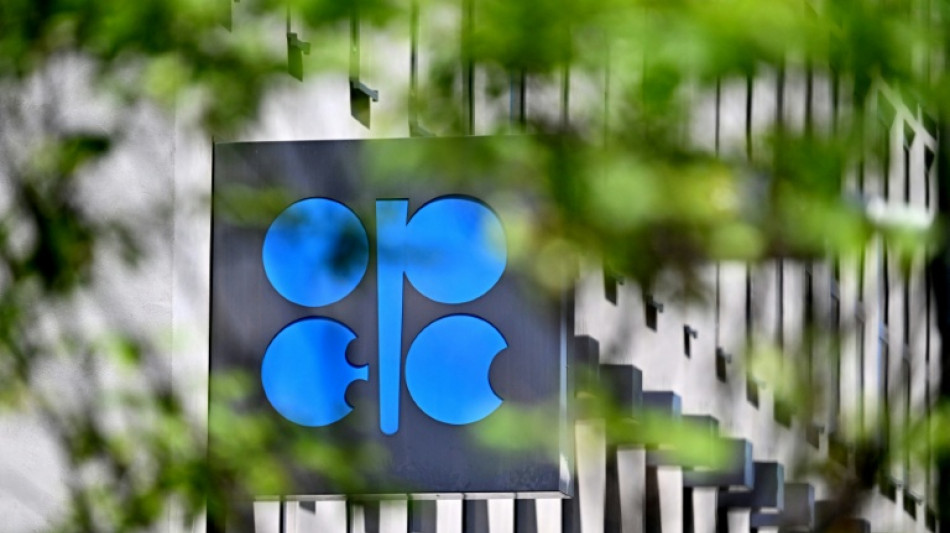
OPEC+ raises quotas again as Middle East calms
OPEC+ raises quotas again as Middle East calms / Photo: © AFP/File

OPEC+ raises quotas again as Middle East calms

Seven OPEC+ members decided on Sunday to again raise oil production quotas as Gulf countries reel from the Middle East war.

Text size:

Ministers from key OPEC+ countries Saudi Arabia, Russia, Iraq, Kuwait, Kazakhstan, Algeria, and Oman met virtually on Sunday and "decided to implement a production adjustment of 188 thousand barrels per day," a statement from the organisation said, adding that "this adjustment will be implemented in August 2026".

Gulf countries had to cut output after the near-paralysis of the Strait of Hormuz orchestrated by Iran during the war in the Middle East, which blocked their oil exports for several months.

Between the first quarter of 2026 and May, combined production by Saudi Arabia, Iraq, and Kuwait -- three of the seven countries raising their quotas -- fell by some six million barrels per day, OPEC data have shown.

But on June 17, Tehran and Washington signed a memorandum of understanding, committing themselves to removing obstacles to maritime traffic in the Strait of Hormuz for the duration of talks following the signature.

Giovanni Staunovo, a commodity analyst at the Swiss bank UBS, told AFP that "for now, production is probably still below" OPEC+'s targets.

- Time-consuming restart -

Since the memorandum of understanding was signed, ship transport in the region has slowly recovered, with oil prices dropping sharply to levels comparable to those seen before the war in anticipation of a gradual return to normal.

Oil supplies through this shipping lane may already have exceeded ten million barrels a day, according to a US official quoted by the Bloomberg agency.

But the oil currently leaving the strait has up to now been sitting in tankers or storage facilities, said Saxo Bank analyst Ole Hansen, adding that "shut-in production takes time to restart".

"Assuming shipping continues to normalise, July will show an improvement with August probably being the month where the pickup accelerates," he told AFP.

- Cohesion at stake -

"For next year, everybody is anticipating a surplus," Jorge Leon, an analyst at Rystad Energy, told AFP.

Rebuilding the inventories that countries tapped during the conflict should help absorb the flows at first, but producers may face a strong downward pressure on prices later on.

And OPEC+, already weakened by the departure of the United Arab Emirates from the group in May, will have to manage sliding prices while members will push for production increases.

Iraq, in particular, has asked the cartel to raise production quotas to make up for the shortfall it incurred during the war in the Middle East, the Iraqi Oil Ministry said in late June.

But Hansen said the need for a higher quota "is not imminent" as production volumes are still far from their pre-conflict levels.

"Iraq's request may become part of the 2027 capacity review, where production baselines will be examined," he added.

At the end of the year, the OPEC+ is indeed due to reassess members' quotas based on their ability to produce more, which could become a thorny issue.

P.Deng--ThChM