The China Mail - Archaeological 'breakthrough' could confirm origins of Paris

USD -
AED 3.672499
AFN 63.000201
ALL 80.450356
AMD 363.439931
ANG 1.790365
AOA 918.000334
ARS 1516.007498
AUD 1.42122
AWG 1.8
AZN 1.697564
BAM 1.712962
BBD 2.013821
BDT 122.932477
BGN 1.683441
BHD 0.37695
BIF 3000
BMD 1
BND 1.277595
BOB 10.867156
BRL 5.1656
BSD 0.99986
BTN 95.678145
BWP 13.595481
BYN 3.027431
BYR 19600
BZD 2.01093
CAD 1.41018
CDF 2309.999886
CHF 0.825095
CLF 0.024397
CLP 963.329736
CNY 6.71135
CNH 6.710397
COP 3288.8
CRC 453.685538
CUC 1
CUP 26.5
CVE 97.249818
CZK 21.448002
DJF 177.720017
DKK 6.56759
DOP 59.450217
DZD 133.939466
EGP 51.423803
ERN 15
ETB 161.000031
EUR 0.87852
FJD 2.24975
FKP 0.750528
GBP 0.755325
GEL 2.614947
GGP 0.750528
GHS 11.58498
GIP 0.750528
GMD 74.000164
GNF 8750.000068
GTQ 7.63211
GYD 209.186734
HKD 7.842705
HNL 26.914995
HRK 6.619295
HTG 130.683635
HUF 320.937502
IDR 17851.95
ILS 3.03393
IMP 0.750528
INR 95.74145
IQD 1310.5
IRR 1374574.999561
ISK 121.23992
JEP 0.750528
JMD 157.538176
JOD 0.708994
JPY 158.313504
KES 129.501538
KGS 87.449803
KHR 4057.50326
KMF 433.000356
KPW 900.000318
KRW 1366.659786
KWD 0.30924
KYD 0.833209
KZT 444.620586
LAK 22425.000038
LBP 89549.999926
LKR 328.955608
LRD 172.824953
LSL 16.359925
LTL 2.95274
LVL 0.60489
LYD 6.375009
MAD 9.60075
MDL 17.695844
MGA 4400.000432
MKD 54.047762
MMK 2099.577364
MNT 3597.923561
MOP 8.077068
MRU 40.06067
MUR 47.880026
MVR 15.449968
MWK 1736.999945
MXN 17.54419
MYR 4.09009
MZN 63.909668
NAD 16.360274
NGN 1324.780094
NIO 36.659962
NOK 9.485825
NPR 153.084711
NZD 1.761945
OMR 0.384502
PAB 0.99986
PEN 3.377496
PGK 4.4485
PHP 62.762497
PKR 277.549959
PLN 3.845185
PYG 5925.912951
QAR 3.643027
RON 4.633794
RSD 103.19594
RUB 84.775004
RWF 1473
SAR 3.755068
SBD 8.000512
SCR 13.883948
SDG 601.501154
SEK 9.918103
SGD 1.280175
SHP 0.755002
SLE 24.649917
SLL 20969.491881
SOS 571.505219
SRD 37.822497
STD 20697.981008
STN 21.675
SVC 8.748774
SYP 13002.000254
SZL 16.360116
THB 33.440988
TJS 9.253737
TMT 3.51
TND 2.948502
TOP 2.40776
TRY 48.859805
TTD 6.795649
TWD 31.803904
TZS 2649.998058
UAH 44.878367
UGX 3889.609025
UYU 40.078651
UZS 11837.479702
VES 852.43145
VND 26010.5
VUV 118.348377
WST 2.752527
XAF 576.271652
XAG 0.015564
XAU 0.000233
XCD 2.70255
XCG 1.801955
XDR 0.707052
XOF 576.271652
XPF 105.204736
YER 236.650203
ZAR 16.366175
ZMK 9001.197068
ZMW 19.472654
ZWL 321.999592
SSP 5712.590503
MXV 1.988392
  • RYCEF

    0.1200

    20

    +0.6%

  • CMSC

    -0.1020

    20.508

    -0.5%

  • GSK

    -1.0100

    49.71

    -2.03%

  • RIO

    -2.2400

    95.25

    -2.35%

  • BTI

    0.1000

    55.85

    +0.18%

  • BP

    1.3900

    44.49

    +3.12%

  • NGG

    -1.6100

    75.25

    -2.14%

  • AZN

    -5.0400

    163.33

    -3.09%

  • BCE

    -0.0900

    21.61

    -0.42%

  • RBGPF

    -2.5300

    64.47

    -3.92%

  • BCC

    -1.2400

    77.76

    -1.59%

  • JRI

    -0.2350

    11.25

    -2.09%

  • RELX

    0.2400

    33.22

    +0.72%

  • VOD

    -0.2700

    16.35

    -1.65%

  • CMSD

    -0.0800

    20.34

    -0.39%

Archaeological 'breakthrough' could confirm origins of Paris
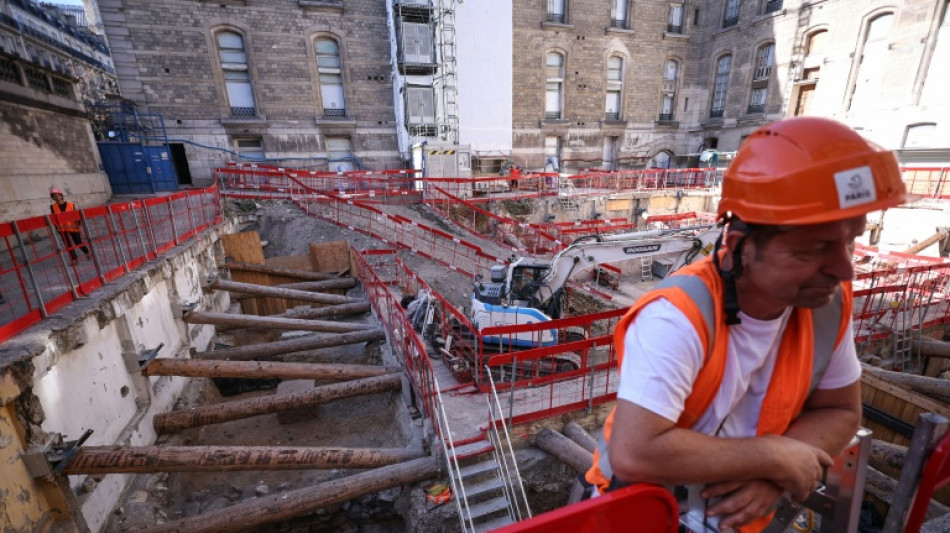
Archaeological 'breakthrough' could confirm origins of Paris / Photo: © AFP

Archaeological 'breakthrough' could confirm origins of Paris

An ancient wall discovered in central Paris was hailed as a "major breakthrough" on Wednesday, as the archaeological find may have settled a long-standing debate about the location of the city's original settlement.

Text size:

A roughly 20-metre (66-foot) wall dating from the Gallo-Roman period was discovered in Paris this summer beneath a hospital on the Ile de la Cite, a stone's throw from Notre Dame Cathedral, the French culture ministry said.

The stone-and-wood find is thought to be a fragment of the ramparts of Lutetia -- the ancient name for Paris -- built by the Gallic Parisii tribe which lived along the river Seine in the Iron Age.

The Ile de la Cite has traditionally been regarded as the centre of Lutetia, but a rival theory, backed by archaeological research, contends that it was actually in Nanterre, a suburb to the west.

"We may be looking at one of the most important remains ever discovered for understanding Gallic Lutetia," Culture Minister Catherine Pegard said in a statement, which described the discovery as "a major breakthrough".

"Scientific caution still requires that we verify its function and its chronology, but the convergence of evidence is particularly remarkable at this stage."

Lutetia was first mentioned in book seven of Roman leader Julius Caesar's "Gallic Wars" series, where it was said to be on an island in the river Seine linked by bridges -- a vague description that has given rise to many theories about its location.

- 'Dizzying' -

The wall, uncovered in the course of excavations beneath the Hotel-Dieu hospital, also bears traces of fire, which may correspond to Caesar's account that the Gauls set fire to their town before the Battle of Lutetia against the Romans.

Through carbon-dating technology, the charred evidence is estimated to date from 10-200 BC, the ministry said in its statement -- a timeframe that includes the Battle of Lutetia in 52 BC.

The Ile de la Cite, home to Notre Dame Cathedral, is the largest island in the river Seine in the Paris region and became the centre of the Roman settlement of Lutetia.

"It's dizzying to find oneself here and to discover what is probably the origin of the city of Paris," Paris mayor, Emmanuel Gregoire, said on Wednesday after examining the wall.

It is barely a metre high and had been buried four metres deep in a courtyard of the Hotel-Dieu hospital, which is the oldest of the capital.

An archaeological dig began there in February.

"All of our predecessors dreamed of finding traces of Gallic presences on the Ile de la Cite," said Dorothee Chaoui-Derieux, coordinator of archaeological operations in Paris for the culture ministry.

"There has been a lot of speculation on the subject. We're fortunate to be in the right place at the right time," she added.

"Beneath our feet, thanks to the trowels of our colleagues, this wall built in the Gallic tradition is gradually revealing its secrets."

B.Chan--ThChM