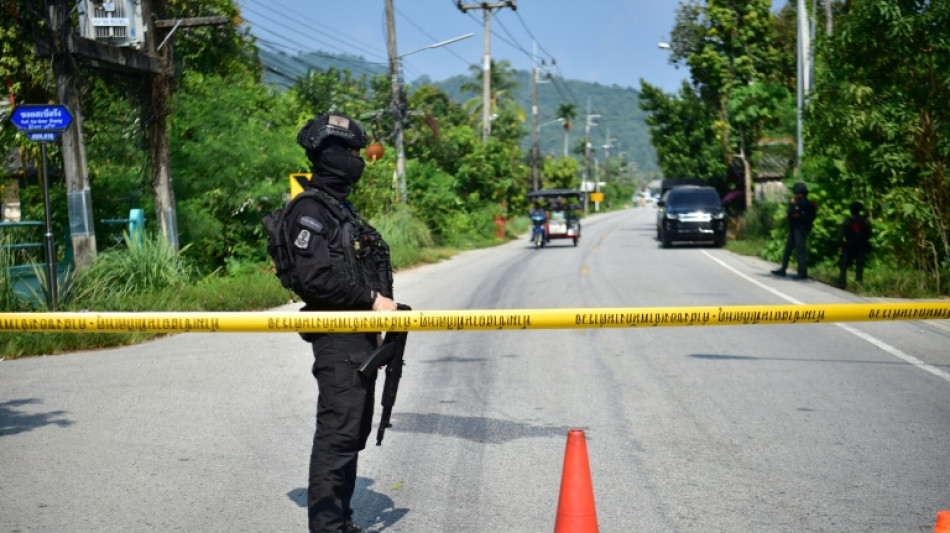
Coordinated attacks: Thailand's southern insurgency flares / Photo: © AFP/File

A surge in attacks across Thailand's south has put a spotlight on the low-level insurgency by Muslim separatists that has killed thousands of people in the last two decades.
Dozens of coordinated night-time attacks across the three southernmost provinces near Malaysia over the weekend injured three people and left government buildings and vehicles burned.
They were followed on Monday by an explosion at a convenience store.
These are the latest incidents of incendiary attacks in the long-running conflict in Thailand's far south.
- How did it start? -
The region concerned used to be part of the former Malay-Muslim Patani sultanate but was annexed in the early 1900s by Buddhist-majority Thailand -- then Siam -- following an agreement with colonial power Britain.
Concerns about cultural identity, political representation and economic development grew.
From the 1960s militants including the main rebel group Barisan Revolusi Nasional (BRN) began fighting for an independent Islamic nation.
The current unrest began in January 2004 when militants raided an army base in Narathiwat province, killing several soldiers and stealing weapons.
In October that year security forces opened fire on protesters outside a police station in the town of Tak Bai, in Narathiwat, killing seven.
Following the shooting 78 people suffocated after they were arrested and stacked on top of each other in the back of Thai military trucks -- a deadly crackdown widely seen as a trigger for the southern unrest.
The "Tak Bai massacre" has long been an emblem of state impunity in the Muslim-majority south, and 20 years later murder charges against seven officials were dismissed when the statute of limitations expired.
Since 2004 around 7,000 people have been killed in the simmering conflict, according to monitor Deep South Watch.
- Are the recent attacks unusual? -
In July assailants killed five soldiers in a shooting and bomb attack at a checkpoint. Six civilians were wounded.
The Thai government warned at the time of a series of violent incidents in the past two to three months that it blamed on a "terrorist network seeking to instil fear among the public and target state officials".
Former Thai MP and human rights advocate Kannavee Suebsang told AFP there was "an increase in the coordination and visibility of the attacks this year".
But Matthew Wheeler, International Crisis Group's senior analyst for Southeast Asia, said it was "business as usual".
Dozens of people are killed every year, with fatalities peaking at more than 200 annually in 2005-2007, figures from the Uppsala Conflict Data Program showed.
Last Saturday night's attacks were "remarkable only in their scale", which attracted media attention, Wheeler said in an email.
"These kinds of attacks have taken place weekly, if not daily, for more than two decades," he said.
- What is the goal? -
The attacks were not claimed, but Wheeler said they were a demonstration of militants' capabilities and continued presence, despite massive deployment of Thai security forces.
Munira Mustaffa, a Malaysia-based counterterrorism and extremism expert, said they were "frustrated signalling" by insurgents intended to "get the government to return to the table".
Thailand first held peace talks with the BRN in 2013 under Malaysian mediation, with the latest round held in December.
But negotiations have stalled repeatedly.
Thailand's head negotiator, Thanat Suwannanon, told local media this week the attacks may be intended to gain the upper hand in the next round of talks.
Thanat, who is also National Intelligence Agency director, said insurgents were also testing the readiness of security forces.
"They focus on symbolic attacks like burning buildings and vehicles of local government offices," he said.
- Where now? -
Thailand has reinforced its military presence in the south and Malaysia has also boosted security on the border.
The Thai government is "using the security apparatus to solve the problem", the rights advocate Kannavee said.
"But in fact this is a political problem."
BRN has asked for self-governance and a power-sharing mechanism with Bangkok, but the Thai side has only offered a seat at the table of a southern development agency, security analyst Don Pathan said.
Participation of local people, including landowners and community representatives, in the peace dialogue was crucial to making the process productive, Kannavee added.
The Thai negotiator Thanat said talks were expected to be held in late October, after discussions scheduled for September were postponed following the soldiers' deaths.
R.Yeung--ThChM