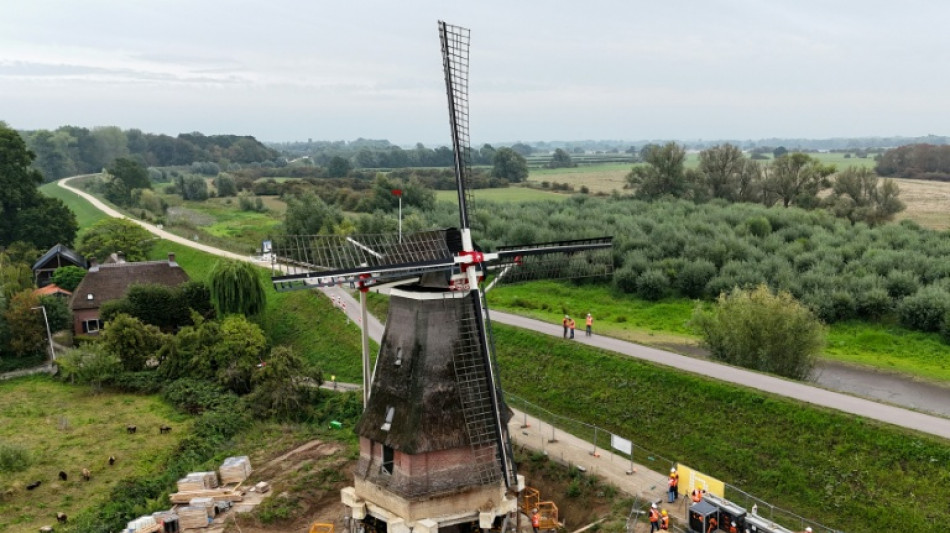
Windmills of change: Dutch raise mill in rare operation / Photo: © AFP

"It has a right to the wind," says Dutchman Koen van der Kroon, supervising from his vantage point on a dyke as a centuries-old windmill is lifted painstakingly inch-by-inch.
The Waardenburg windmill -- a rare hexagonal mill still grinding grain today -- has graced the banks of the Waal on the Rhine delta for 250 years and is a listed monument in the Netherlands.
But a nearby dyke has been raised to protect against flood risks, choking the wind supply to the windmill and threatening to render it obsolete.
The solution: deploy hydraulic jacks to raise the windmill 80 centimetres (31 inches), at the snail's pace of 10 centimetres per hour.
"The Waal's water level is often very high, which is why the residents living behind the dyke want, above all, to be safe," said project manager van der Kroon.
"To guarantee safety in this area, the dyke must be raised. So the windmill has to be raised as well," he told AFP.
It is a dilemma becoming increasingly common with climate change in the Netherlands, where one third of the land lies below sea level.
As waters rise and flooding becomes more regular, authorities have to bolster the country's ingenious system of dykes, with unintended consequences for windmills.
Raising dykes "has a major impact on iconic monuments," said van der Kroon, 44.
"We are ensuring that these magnificent windmills, which make the Netherlands famous, can continue to operate," he added.
- 'Feat of engineering' -
This is the second time the windmill has been raised, after a similar operation in the 1990s.
The fact it needs to be lifted even higher shows the difficult faced by Dutch authorities in juggling the safety of the population from flooding and preserving the country's heritage.
"We first displaced the old foundations. Then we put jacks underneath which allow us to lift the windmill by about 10 centimetres an hour," said project manager van der Kroon.
"Then, we will install new piles for the windmill to rest on. After that, all that remains is careful backfilling," he added.
Once the mill is stable on its new base, it should receive enough wind to turn its sails, continuing a tradition that has endured for centuries in the Dutch countryside.
"It's a feat of engineering that we do not carry out every day and we are proud of the team effort," said Marcel de Kroon, from the company that owns the windmill.
"It's great that we are taking the trouble to keep this windmill in its historical context," he told AFP.
"It's magnificent to see."
I.Taylor--ThChM--ThChM