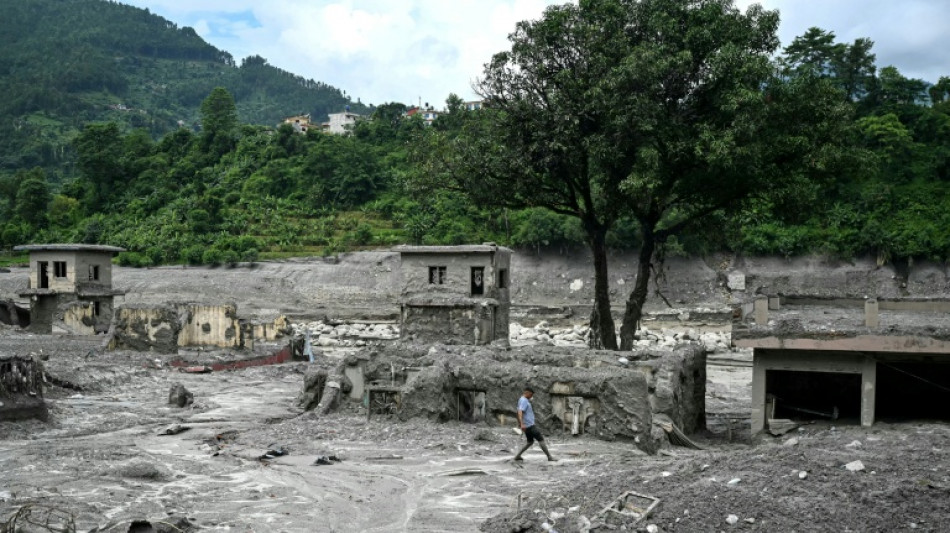
Nepal rescuers advance towards trapped tunnel workers / Photo: © AFP

Nepali rescuers drilled, dug and used explosives on Sunday in a bid to reach dozens of hydropower workers believed trapped in tunnels swamped by flood debris, racing against time to find survivors.
Rescue operations entered their fifth day since the floods hit the Nepal-China border. Teams battled rain, rising rivers and treacherous conditions at the disaster sites.
Nepal's government says more than 100 workers may still be trapped alive inside multiple tunnels at hydropower projects, with key rescue efforts focused on the Trishuli 3A and 3B sites in a Himalayan valley.
"Efforts to rescue people trapped inside the tunnel of the Upper Trishuli 3A Hydropower Project in Nuwakot have been intensified, including attempts by engineers from the Nepali Army to carry out blasting operations," Nepal's energy ministry said on Sunday.
They are among 933 hydropower workers missing since a wall of mud and debris swept down on Wednesday morning, according to the National Disaster Risk Reduction and Management Authority.
The team, comprising around 90 army and police personnel, first broke through into the upper part of a mud-swamped 3A tunnel on Saturday night, pumping air inside and sending in a camera.
Using heavy equipment including "drilling machines, excavators, hydraulic cutters, and other equipment" on Sunday, they drilled four holes before rescuers descended by rope into the crater.
"After descending through the opening using ropes and calling out to those inside, no response was received," the prime minister's office said in a statement.
"To make the rescue operation easier and faster, the teams are simultaneously using heavy equipment, carrying out blasting, and widening the opening."
Photographs shared by the disaster office showed workers wading through churned mud and navigating vast boulders left by the floods.
Work continues to "clear the entrance", the energy ministry said, which it said is approximately 180 metres (590 feet) from the "working space".
"... preparations are being made to send rescuers equipped with oxygen into the tunnel," once the opening is cleared, the energy ministry said.
"A camera will also be sent in with the rescuers, allowing the actual conditions inside the tunnel to be monitored from outside," it said.
"Once the working space is reached, more clear information will be available about the actual condition, location, and safety status of the people trapped inside."
- 'Submerged with slush' -
The US Geological Survey said the disaster was caused by a glacial collapse.
Specialised Indian, Chinese and South Korean tunnel-rescue teams have also joined the efforts.
Nepal's expert mountain rescue teams -- who regularly aid climbers on the world's highest peaks, including Everest -- are also joining the search for missing people at another damaged hydropower site.
Flood survivors from other hydropower sites described a terrifying rush of water that had engulfed them within minutes.
Hydropower worker Surendra Dowluri, 33, from India's Andhra Pradesh state, described how raging water swamped the Upper Trishuli-1 site, where he was working.
"We heard a very loud sound... and saw that the turbine floor was submerged with slush, and six workers were stuck in that," Dowluri told AFP in Kathmandu on Sunday after being rescued the day before.
"We managed to rescue five of them, but one person lost his life," he said, describing how some workers reached higher ground or construction areas out of reach of the torrent.
That represents about 10 percent of Nepal's installed electricity generation capacity, according to the authority.
Another 15 power projects under construction, with a combined planned capacity of 470 megawatts, have also been damaged.
R.Yeung--ThChM