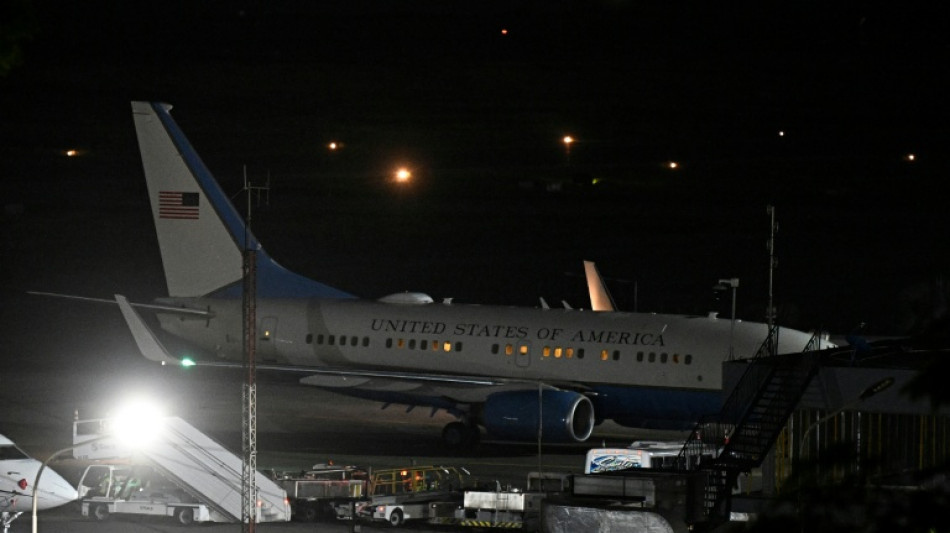
US energy secretary arrives in Venezuela to discuss oil deal / Photo: © AFP

US Energy Secretary Chris Wright arrived in Venezuela on Tuesday to finalize an oil deal granting the United States control of about one-fifth of the country's reserves.
Wright's visit comes after Venezuela's government-dominated National Assembly approved the agreement.
US President Donald Trump had announced the deal -- which would give the US majority control of 65 billion barrels of proven petroleum reserves -- last week.
"Several deals" will be announced on Wednesday, Wright told reporters upon his arrival.
He said those deals would lead to a "more than doubling of Venezuelan oil production in the next few years."
"These investment deals in Venezuela are to bring peace, opportunity and prosperity to the people of Venezuela and to the people of the United States," Wright said.
Oil giant Chevron is also expected to announce a major expansion in Venezuela on the same day.
US officials have defended the deal, saying it would lower oil prices for Americans and counter Russian and Chinese influence on Washington's doorstep.
But there have been major questions about the agreement, which comes as Washington maintains an unprecedented grip on the government in Caracas after toppling Venezuelan president Nicolas Maduro in January.
In a Spanish-language interview posted to YouTube on Tuesday, Secretary of State Marco Rubio told US-based Venezuelan journalist Sergio Novelli that a private company is working with the United States to "normalize the Venezuelan economy."
"Essentially, this is now an agreement with the US government -- specifically involving the Defense Department, which holds a special account allowing it to take possession of a certain percentage of these assets," Rubio said.
"Now, we have a system where this company will increase production. With US support, it will be able to attract the private investment needed to develop the productive capacity of these fields," Rubio said, adding that the "vast majority" of the 17 fields were "in Chinese and Russian hands" until now.
- Under US control -
In Caracas, some opposition lawmakers abstained from the show-of-hands vote to approve the US deal, arguing they should first be able to view the written terms.
"We need and are obliged to know what is written in the fine print," opposition lawmaker Luis Emilio Rondon said.
But National Assembly chief Jorge Rodriguez said the money from the deal would help Venezuelans.
"Who benefits from this oil if it stays underground?" said Rodriguez.
Venezuela's Defense Minister Gustavo Gonzalez Lopez gave the deal full military backing, describing it as "prosperity and well-being for the country."
"Turning a political difference into an economic cooperation agreement is simply a decision to choose peace; it is not subordination," he said.
The deal granting the US preferential access to 17 oil fields will notably see the takeover of facilities previously run by Russian and Chinese companies.
One of the most controversial aspects is the involvement of Alejandro Betancourt, a Venezuelan businessman linked to shady dealings under the late Hugo Chavez's socialist administration.
Betancourt runs North American Blue Energy Partners (NABEP), Venezuela's second-largest private oil company, in which the US government is taking a 35 percent stake under the deal.
He was accused of involvement in a corruption scheme at Venezuela's state-run PDVSA oil company.
But a US official said Betancourt was a "proven operator," while acknowledging that geopolitics sometimes involved dealing with "imperfect" characters.
"I'm not nominating anyone for sainthood here. What I am telling you is that this is a person that, in the past, has been helpful to the United States government," the official added.
Under the deal, NABEP will grant Washington the right to buy 20 percent of the oil pumped by the firm at production cost, the White House said.
US citizens must constitute a majority of the firm's board of directors, giving Washington effective control, and the US government will have veto power over its members.
The official said US control would end corruption in the run-down Venezuelan oil industry, while stopping Caracas from giving much of its supplies away to its ally Cuba.
"It was used as a personal piggy bank" by Maduro's government, the official said.
Cheaper oil is a priority for the Trump administration ahead of crucial US midterm elections in November, in which his Republican Party could lose control of Congress.
Y.Su--ThChM