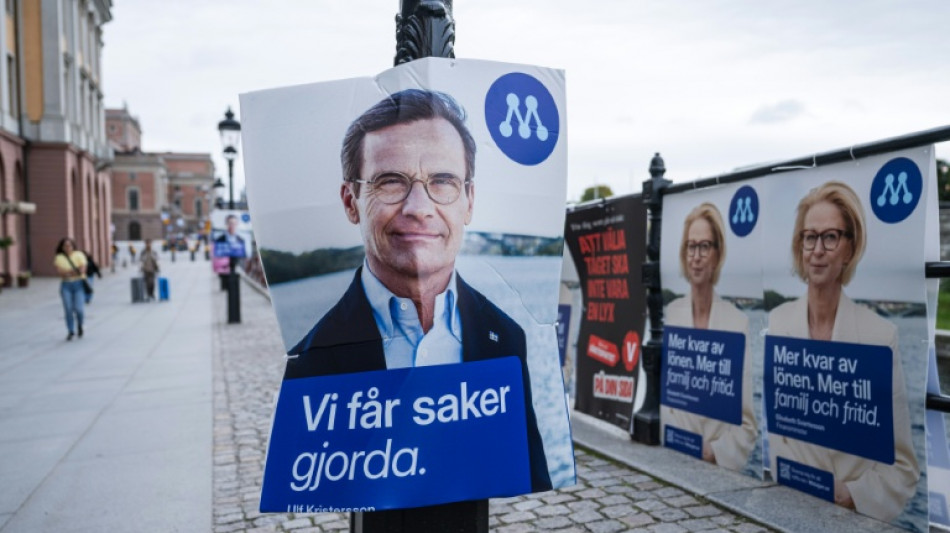
Sweden heads to the polls in close election race / Photo: © AFP/File

Sweden votes Sunday in a tight general election that could see the left-wing opposition oust the government after a campaign dominated by concerns over healthcare and the welfare state amid fears over Europe's security.
Opinion polls have pointed to a victory for the centre-left opposition headed by the Social Democrats.
But Prime Minister Ulf Kristersson's centre-right coalition and its parliamentary ally, the anti-immigration Sweden Democrats, have narrowed the gap in the final weeks of campaigning and the election could go down to the wire, experts say.
"There's still a bit of suspense. But all the polls have for a long time shown a very large lead and it's usually difficult to make up that much ground," Stockholm University political scientist Jan Teorell told AFP.
Three polls in the past week credited the four parties on the left with around 50 percent, and the four on the right with around 47 percent.
The right-wing bloc has vowed to pursue its crackdown on crime and immigration, after years of shootings and bombings linked to organised crime networks.
But the bloc has failed to muster the momentum that swept it to power four years ago.
"It came to power very much on a programme to bring down crime and energy prices. And crime and petrol prices have come down, so those issues no longer top voters' agendas," Teorell said.
Filip Lundin, a 35-year-old businessman, told AFP the government had done "a really good job", with "less shootings, better control of where society is going (and) our economy is growing."
- Far right in government? -
The left has vowed to raise taxes on banks and high incomes to invest in healthcare and schools, and help struggling households face rising costs amid growing economic inequality.
That appeals to 46-year-old Hanna Justine Hallbo who works in fashion.
"Healthcare and the social security system must be improved. That has gone down in the last couple of years."
Opposition leader Magdalena Andersson of the Social Democrats, Sweden's biggest party, told AFP the election was "about what country Sweden should be."
Voters were faced with the choice of "a Sweden that is more like Sweden, where people have a job and where we can improve our welfare", or "a completely different country with a government dominated by Sweden Democrats, a far-right party founded by neo-Nazis."
The far right, the second-biggest party with around 20 percent of votes, is hoping to enter government for the first time.
The populist party has promised Swedes the lowest gas prices and migration in Europe, and dental care reform.
Kristersson became prime minister in 2022 after his minority coalition reached an unprecedented agreement with the Sweden Democrats, giving the former political pariahs significant influence over government policy, especially crime and immigration, in exchange for its support.
Kristersson has promised the far right cabinet posts, including the migration portfolio, if re-elected.
Sweden Democrats leader Jimmie Akesson insists his party should hold several key portfolios, but he is not vying for Kristersson's job -- yet.
"There will be more elections to come, so I'd like to aim for the post of prime minister in 2030 or later," he told AFP in August.
- Security -
Just over a week before the election, extremism watchdog Expo revealed that a Sweden Democrat civil servant in parliament had shared pro-Russian propaganda for years.
Kristersson, dogged by scandals during his term, reacted sharply.
"We are in the middle of a European war," he told daily Aftonbladet.
"You can't have people who spread pro-Russian narratives working in parliament."
Since Russia's invasion of Ukraine in 2022, Sweden has joined NATO and is massively rearming and boosting civil preparedness.
It has blamed Moscow for cyberattacks, disinformation and intelligence operations, as well as drone and jet incidents over the Baltic.
There is broad consensus between the government and opposition on NATO and defence issues, and no major policy changes are expected if Sweden pivots to a left-wing government, Teorell predicted.
"But there would be higher taxes and more investment in the welfare system," Teorell said.
Leading industrialist Jacob Wallenberg told the Financial Times he was "deeply concerned" about what that would mean for the thriving tech sector.
With the right-wing bloc trailing in the polls and the four left-wing parties splintered ideologically, thorny negotiations may be needed to form a government.
J.Liv--ThChM