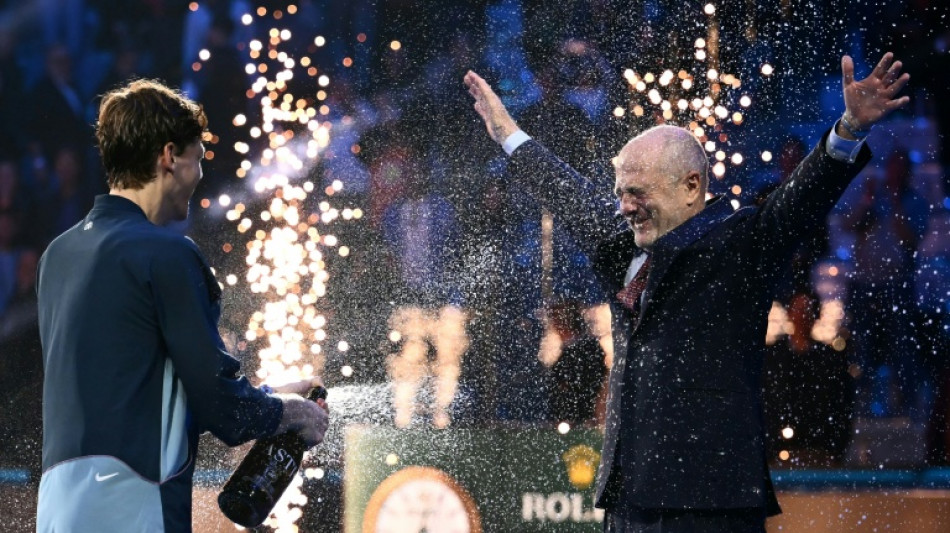
Italy's tennis chief wants to break Grand Slam 'monopoly' with new major / Photo: © AFP/File

Angelo Binaghi has dragged Italian tennis from the doldrums to a golden age since taking charge of the country's federation (FITP) a quarter of a century ago, with Jannik Sinner just the very best of some of the world's top players.
But the organiser of the Italian Open, which runs in Rome until May 17, has an even bigger goal -- breaking what he calls the Grand Slam monopoly and hosting a fifth major tournament in his home nation.
"The monopoly is scandalous and is a big handicap for tennis," Binaghi said in an interview with AFP and the Associated Press.
"It's a scandal that there is no meritocratic system, instead the system protects those who don't do as much as they could for tennis.
"There are four countries in the world that have a mountain of money to invest in tennis that other nations don't have. I'm trying to break that monopoly."
Binaghi insists that Italy is the place to host a fifth Slam given the explosion in popularity of the sport in recent years, pushed by the likes of Sinner and Jasmine Paolini, reigning women's champion here in Rome.
The 65-year-old said he was willing to organise the eventual tournament "anywhere in Italy and on any surface", but he was vague on the practicalities of creating a new Slam.
"Tennis is experiencing the sort of boom that will be difficult to replicate in the future, right at the time when our national football team is going through a disastrous period," he said.
"That makes our successes all the more important for our country."
- Fifth Slam? -
Binaghi suggested that his proposed tournament wouldn't be held at the Foro Italico where the Italian Open has blossomed into one of the tennis calendar's most prestigious events.
The centre court in the Italian capital is set to have a retractable roof and an increased capacity of 12,500 by 2028.
But Binaghi said that the area around the grounds, which also houses the Stadio Olimpico where football clubs Roma and Lazio play their home matches, presents challenges for a Grand Slam.
"The existing site poses a number of problems: there is no metro stop, barely any buses, and it's difficult to find taxis," said Binaghi
"It's the most beautiful place to play tennis in the world, but it generates a mountain of extra costs. Every single structure apart from the centre court, has to be put up and then dismantled, and that weighs on the budget.
"When I took over the FITP, the Italian Open was dead (...) tennis was the tenth or twelfth sport in Italy, we had no money, we had no players, we had nothing.
"It has been a hundred times more difficult to make the Italian Open what it is today than it would be to complete the final step needed to get a Grand Slam. As long as I am in charge, I will try to achieve it... And if we don't succeed, tennis will miss a unique opportunity that no-one else will have for the next 100 years."
N.Lo--ThChM