'Great to have a race at home': Fans celebrate F1's Madrid return / Photo: © AFP

Forty-five years after Formula 1 last roared around Madrid, the Spanish capital is celebrating its return this weekend with a brand-new circuit, accessible from the city centre via only a metro ride.
In Valdebebas, north of the capital and just a few steps from Real Madrid's training ground, a vast construction site sprung up in recent months while a hybrid circuit was built from scratch between Barajas airport, the M11 motorway and the IFEMA exhibition centre.
Now the constant rumble of construction machinery has been replaced by a steady stream of vans and golf carts ferrying people to and from the paddock for this weekend's races.
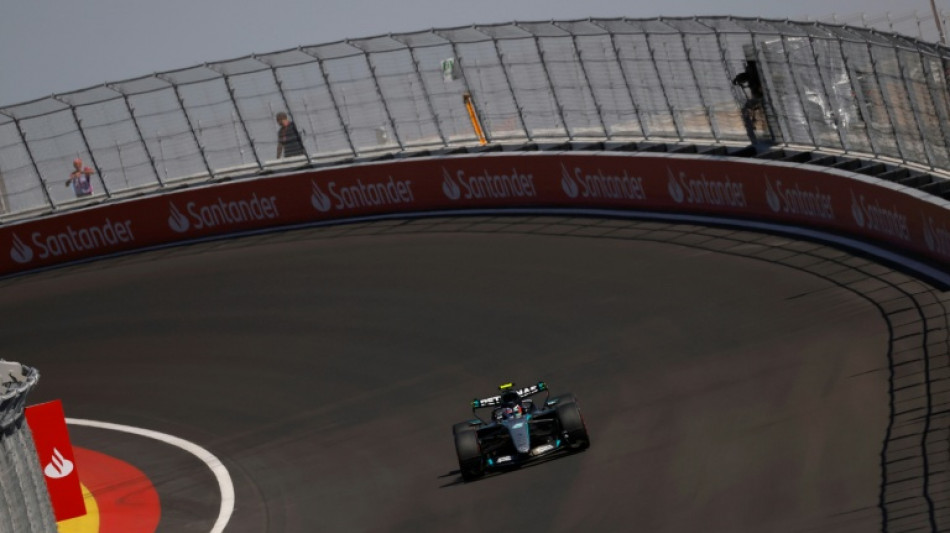
The new circuit, known as the 'Madring', is a demanding 5.4-kilometre track with 22 corners, including its headline feature, a 24-percent-banked turn nicknamed "La Monumental".
It is a far more modern and accessible proposition than the old Jarama circuit, around 30 kilometres north of the city, which hosted the Spanish Grand Prix between 1968 and 1981.
"For us Formula 1 fans, it's really great to have a race at home!" says Rodrigo Gil, a 30-year-old engineer from Madrid, as he watches free practice from a grandstand at Turn 8.
"For people from Madrid, and even for Spaniards in general, I think this is a much easier race to get to," he continues.
"You've got all the roads and public transport nearby, so it's easier to come here than to Barcelona, Andalusia or Galicia, for example. Here you've got trains, planes, everything."
His friend Javier, a PhD engineering student, barely takes his eyes off the track.
"I usually watch the races on TV. And actually, I think you see them much better on TV than you do here," he says.
"It's different because you see the drivers for real, but they go by so fast, and you only see a tiny fraction of the race.
"Basically, we come more for the experience than the race itself," he admits, showing his hospitality pass, offering him access to grandstand seats, unlimited food and drink and high-end F1 simulators.
"I think that's the main reason for where the circuit is located -- being able to offer a bit more in terms of services," Rodrigo says.
"At Jarama there aren't as many facilities. They would have had to build them, and in Barcelona there are fewer areas like these."
– 'Once in our lives' –
Those without invitations from race partners have had to spend several hundred, and in some cases several thousand, euros to attend the three-day event, covering practice, qualifying and the Grand Prix.
"I don't consider myself a fan. I didn't think I'd ever go to a race, but we told ourselves that maybe it's something we should do once in our lives, so we bought tickets at the last minute," says Teresa Herrero, 34, who has come to discover F1 with her husband.
A few seats away, 30-year-old human resources manager Julia Garcia has done the same.
"Honestly, it's incredible to see F1 in real life. It's my first time, and even just free practice is really spectacular," she says.
Her husband, 29-year-old IT specialist Guzman Lopez, says he follows "almost every race, every weekend".
"It's a dream to be able to attend a race in person. I never thought I'd do it here, in Madrid," he says.
"I've checked several times about going to the Grand Prix in Barcelona, but between the travel, the hotel, etc., I never went through with it. Here we're lucky, it's much more accessible."
For now, Madrid's arrival does not mean Barcelona is leaving the Formula 1 calendar.
In 2028 and 2030, the two Spanish venues will share the calendar, with the Catalan Grand Prix continuing alongside Madrid.
However Madrid has made no secret of its longer-term ambition -- to become Spain's sole Formula 1 destination and, as the city council puts it, establish itself as the "world capital of sport".
P.Deng--ThChM