The China Mail - AI tool helps researchers treat child epilepsy

USD -
AED 3.6725
AFN 66.087001
ALL 81.825228
AMD 381.17665
ANG 1.790403
AOA 917.000311
ARS 1450.501516
AUD 1.489902
AWG 1.80025
AZN 1.705037
BAM 1.656664
BBD 2.012426
BDT 122.094082
BGN 1.65844
BHD 0.377021
BIF 2947.99524
BMD 1
BND 1.283877
BOB 6.928886
BRL 5.522201
BSD 0.999183
BTN 89.619713
BWP 13.15133
BYN 2.898742
BYR 19600
BZD 2.009546
CAD 1.367895
CDF 2200.000235
CHF 0.786955
CLF 0.023109
CLP 906.569845
CNY 7.0285
CNH 7.01158
COP 3756.08
CRC 494.085459
CUC 1
CUP 26.5
CVE 93.400985
CZK 20.590099
DJF 177.923282
DKK 6.32977
DOP 62.351501
DZD 129.435013
EGP 47.556702
ERN 15
ETB 155.671225
EUR 0.84742
FJD 2.269197
FKP 0.743131
GBP 0.739625
GEL 2.685045
GGP 0.743131
GHS 11.315768
GIP 0.743131
GMD 74.503203
GNF 8732.259554
GTQ 7.654874
GYD 209.035504
HKD 7.774395
HNL 26.337389
HRK 6.385197
HTG 130.93786
HUF 331.304992
IDR 16757
ILS 3.184645
IMP 0.743131
INR 89.798045
IQD 1308.864823
IRR 42124.999677
ISK 125.419874
JEP 0.743131
JMD 159.779428
JOD 0.708994
JPY 155.702494
KES 128.891035
KGS 87.449791
KHR 4004.015027
KMF 418.000206
KPW 899.961009
KRW 1454.364975
KWD 0.307199
KYD 0.832652
KZT 508.976634
LAK 21642.315674
LBP 89468.428408
LKR 309.301055
LRD 176.849024
LSL 16.677678
LTL 2.95274
LVL 0.60489
LYD 5.406733
MAD 9.113179
MDL 16.814467
MGA 4562.222326
MKD 52.163486
MMK 2099.845274
MNT 3553.409727
MOP 8.004642
MRU 39.846175
MUR 45.969996
MVR 15.450098
MWK 1732.560257
MXN 17.896299
MYR 4.0545
MZN 63.909994
NAD 16.678878
NGN 1453.685566
NIO 36.770529
NOK 10.022805
NPR 143.390665
NZD 1.71114
OMR 0.384504
PAB 0.999183
PEN 3.363135
PGK 4.313189
PHP 58.699182
PKR 279.890137
PLN 3.57822
PYG 6807.757303
QAR 3.652011
RON 4.313972
RSD 99.490974
RUB 77.999356
RWF 1455.320122
SAR 3.750779
SBD 8.153391
SCR 13.904023
SDG 601.502799
SEK 9.160465
SGD 1.282715
SHP 0.750259
SLE 24.075018
SLL 20969.503664
SOS 569.981323
SRD 38.320372
STD 20697.981008
STN 20.752775
SVC 8.742424
SYP 11056.89543
SZL 16.676761
THB 31.041991
TJS 9.192371
TMT 3.51
TND 2.915832
TOP 2.40776
TRY 42.84917
TTD 6.796746
TWD 31.425977
TZS 2468.447049
UAH 42.073075
UGX 3610.135825
UYU 39.024018
UZS 12045.08011
VES 288.088835
VND 26310.5
VUV 121.541444
WST 2.783984
XAF 555.62972
XAG 0.01386
XAU 0.000223
XCD 2.70255
XCG 1.800748
XDR 0.691025
XOF 555.62972
XPF 101.019427
YER 238.449836
ZAR 16.66887
ZMK 9001.196569
ZMW 22.580713
ZWL 321.999592
  • SCS

    0.0200

    16.14

    +0.12%

  • JRI

    0.0400

    13.41

    +0.3%

  • BCC

    -1.0000

    73.23

    -1.37%

  • CMSC

    -0.1100

    23.01

    -0.48%

  • RBGPF

    1.0400

    81.26

    +1.28%

  • NGG

    0.8300

    77.24

    +1.07%

  • GSK

    0.2600

    48.85

    +0.53%

  • RIO

    0.8700

    80.97

    +1.07%

  • BCE

    0.0000

    22.73

    0%

  • BTI

    0.2700

    57.04

    +0.47%

  • AZN

    0.5900

    92.14

    +0.64%

  • BP

    0.4400

    34.58

    +1.27%

  • CMSD

    -0.1800

    23.02

    -0.78%

  • RYCEF

    0.2000

    15.56

    +1.29%

  • VOD

    0.1800

    13.06

    +1.38%

  • RELX

    0.1500

    41.13

    +0.36%

AI tool helps researchers treat child epilepsy
AI tool helps researchers treat child epilepsy / Photo: © AFP

AI tool helps researchers treat child epilepsy

An artificial intelligence tool that can detect tiny, hard-to-spot brain malformations in children with epilepsy could help patients access life-changing surgery quicker, Australian researchers said on Wednesday.

Text size:

It is the latest example of how AI, which can crunch vast amounts of data, is changing healthcare by assisting doctors with diagnoses.

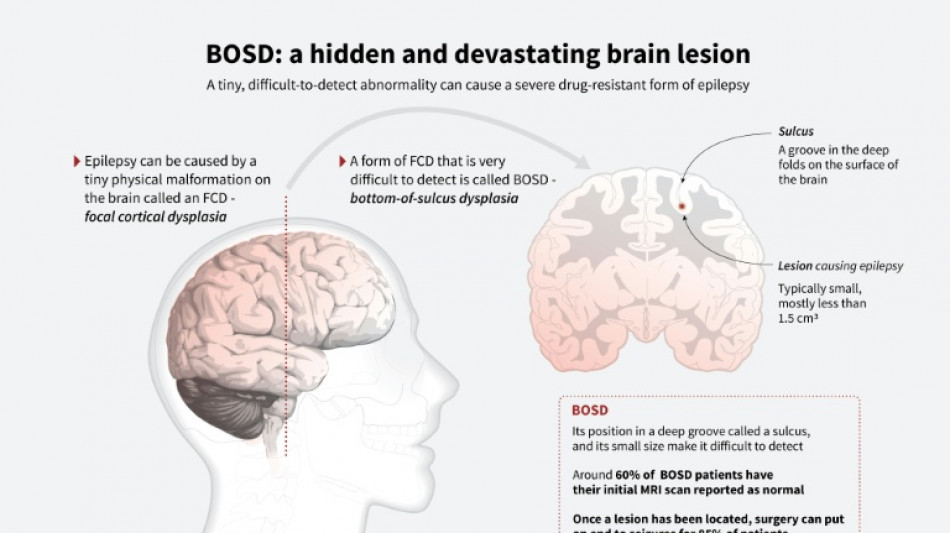
Epilepsy has several different causes, and overall around three in 10 cases are down to structural abnormalities in the brain, experts say.

These are often missed on MRI scans -- especially the smallest lesions, sometimes hidden at the bottom of a brain fold.

A team led by Emma Macdonald-Laurs, a paediatric neurologist at the Royal Children's Hospital in Melbourne, trained an AI tool on child brain images to find lesions the size of a blueberry or smaller.

"They're frequently missed and many children are not considered as surgical candidates," Macdonald-Laurs told a briefing ahead of the publication of her team's study in the journal Epilepsia.

"The tool doesn't replace radiologists or epilepsy doctors, but it's like a detective that helps us put the puzzle pieces together quicker so we can offer potentially life-changing surgery," she said.

Of the patients who took part, with conditions known as cortical dysplasia and focal epilepsy, 80 percent had previously had an MRI scan come back as normal.

When the researchers used the AI tool to analyse both MRI and another type of medical scan called a PET, its success rate was 94 percent for one test group and 91 percent for another.

Out of 17 children in the first group, 12 had surgery to remove their brain lesions, and 11 are now seizure-free, said Macdonald-Laurs's team at the Murdoch Children's Research Institute.

"Our next plans are to test this detector in more real-life hospital settings on new undiagnosed patients," she said.

Epilepsy, which causes recurrent seizures, affects about one in 200 children, and about a third of cases are drug-resistent.

"This work is really exciting" as a proof of concept and the results are "really impressive", Konrad Wagstyl, a biomedical computing expert at King's College London (KCL), told AFP.

Similar research published in February by a KCL team using AI on MRI data spotted 64 percent of epilepsy-linked brain lesions that were missed by radiologists.

The Australian researchers used MRI with PET, "but some caveats are that PET is expensive, it's not as widely available as MRI, and there is a dose of radiation like a CT scan or an X-ray associated with it," Wagstyl noted.

Q.Yam--ThChM