The China Mail - NASA details plans to bring back Mars rock samples

USD -
AED 3.673029
AFN 64.502737
ALL 81.549737
AMD 361.429673
ANG 1.789785
AOA 918.000046
ARS 1513.235699
AUD 1.436039
AWG 1.8
AZN 1.702791
BAM 1.747405
BBD 2.013572
BDT 123.421934
BGN 1.747831
BHD 0.37766
BIF 2995
BMD 1
BND 1.282034
BOB 11.711836
BRL 5.030698
BSD 0.999772
BTN 95.182957
BWP 13.733399
BYN 3.020865
BYR 19600
BZD 2.010641
CAD 1.425385
CDF 2312.493234
CHF 0.83596
CLF 0.02505
CLP 985.889563
CNY 6.69275
CNH 6.696855
COP 3194.05
CRC 455.660238
CUC 1
CUP 23.993531
CVE 99.406631
CZK 21.87535
DJF 177.720249
DKK 6.709915
DOP 61.249943
DZD 134.782004
EGP 53.076602
ERN 15
ETB 161.130196
EUR 0.89765
FJD 2.263011
FKP 0.754659
GBP 0.759273
GEL 2.600208
GGP 0.754659
GHS 11.664978
GIP 0.754659
GMD 73.999897
GNF 8799.999839
GTQ 7.639869
GYD 209.069102
HKD 7.84845
HNL 26.950336
HRK 6.764596
HTG 130.910423
HUF 326.761501
IDR 17955.5
ILS 3.097604
IMP 0.754659
INR 95.11975
IQD 1310.5
IRR 1790499.999792
ISK 122.43966
JEP 0.754659
JMD 158.765613
JOD 0.708985
JPY 158.503503
KES 129.750213
KGS 87.449765
KHR 4070.999675
KMF 439.999529
KPW 899.999961
KRW 1341.150047
KWD 0.31191
KYD 0.833099
KZT 451.695332
LAK 22500.000346
LBP 89549.999831
LKR 330.891222
LRD 170.750014
LSL 16.490191
LTL 2.95274
LVL 0.604891
LYD 6.429567
MAD 9.747013
MDL 17.89398
MGA 4500.000238
MKD 55.018986
MMK 2100.02843
MNT 3599.679138
MOP 8.081626
MRU 40.220585
MUR 47.609715
MVR 15.460123
MWK 1741.999931
MXN 18.489255
MYR 4.086404
MZN 63.910271
NAD 16.489895
NGN 1329.749756
NIO 36.849767
NOK 9.53474
NPR 152.293053
NZD 1.790785
OMR 0.384492
PAB 0.999736
PEN 3.430504
PGK 4.45175
PHP 62.946998
PKR 277.035009
PLN 3.923635
PYG 5704.585558
QAR 3.639922
RON 4.787899
RSD 105.395997
RUB 83.627224
RWF 1475
SAR 3.74237
SBD 8.078071
SCR 13.908337
SDG 601.507696
SEK 10.044115
SGD 1.28546
SHP 0.754518
SLE 24.669713
SLL 20969.504398
SOS 571.507636
SRD 37.711973
STD 20697.981008
STN 21.975
SVC 8.747783
SYP 13001.999685
SZL 16.489919
THB 33.650952
TJS 9.227237
TMT 3.5
TND 3.303498
TOP 2.40776
TRY 49.392165
TTD 6.799166
TWD 32.145498
TZS 2630.012971
UAH 44.933885
UGX 4039.293995
UYU 40.187267
UZS 11951.501691
VES 875.7016
VND 25897
VUV 119.372685
WST 2.788609
XAF 588.819703
XAG 0.018005
XAU 0.000244778567
XCD 2.70255
XCG 1.801832
XDR 0.707052
XOF 588.819703
XPF 106.874981
YER 236.200507
ZAR 16.61896
ZMK 9001.199204
ZMW 19.868757
ZWL 321.999592
SSP 5748.524006
MXV 2.087868
  • RYCEF

    0.4000

    19.71

    +2.03%

  • CMSC

    0.0000

    20.4

    0%

  • BTI

    0.4200

    56.05

    +0.75%

  • BP

    0.2800

    44.43

    +0.63%

  • RBGPF

    1.6000

    67

    +2.39%

  • RIO

    -0.1500

    94.41

    -0.16%

  • AZN

    -0.4300

    166.15

    -0.26%

  • GSK

    0.4600

    49.7

    +0.93%

  • BCE

    -0.4100

    20.56

    -1.99%

  • NGG

    -0.2500

    75.24

    -0.33%

  • VOD

    -0.0400

    16.58

    -0.24%

  • RELX

    -0.4500

    33.07

    -1.36%

  • BCC

    -0.5500

    76.59

    -0.72%

  • CMSD

    -0.0300

    20.27

    -0.15%

  • JRI

    -0.2500

    10.77

    -2.32%

NASA details plans to bring back Mars rock samples
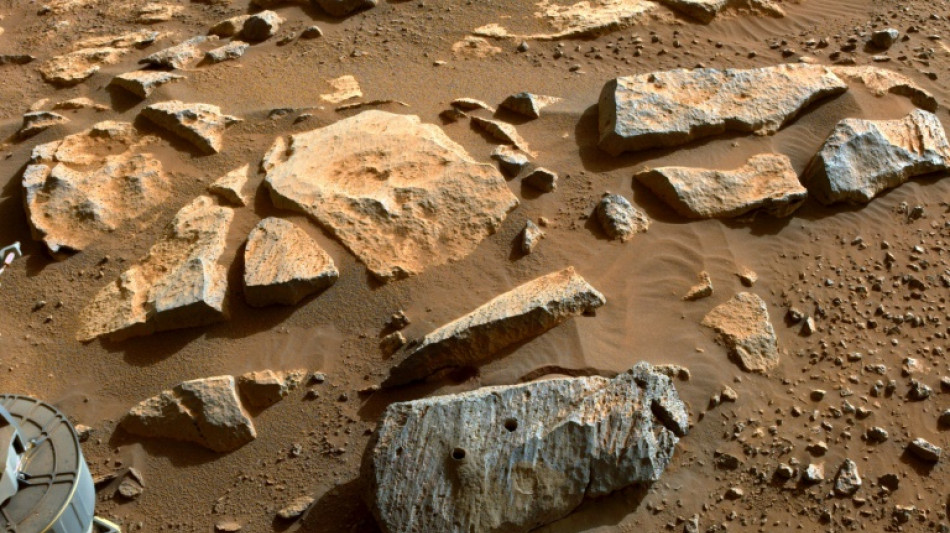
NASA details plans to bring back Mars rock samples / Photo: © NASA/AFP/File

NASA details plans to bring back Mars rock samples

NASA plans to bring 30 Martian rock samples back to Earth in 2033, the agency said Wednesday -- and is sending two small helicopters to help the mission.

Text size:

The Perseverance rover, which landed on Mars in February 2021, has so far collected 11 samples as part of its hunt for signatures of ancient life.

But bringing them back for detailed lab study on Earth is proving to be a highly complex task.

Up until now, NASA was planning on sending another rover to Mars to pick up the samples from Perseverance then bring them to a robotic lander equipped with its own rocket, called the Mars Ascent Vehicle.

This in turn would fire the samples into orbit where they would be collected by a European spaceship.

Now, however, the second "Sample Fetch Rover" has been scrapped and Perseverance itself will deliver the precious cargo directly to the lander, which will use a robot arm to extract it.

But since NASA always plans for contingencies, it has a backup plan in case Perseverance becomes immobilized.

The lander, which should launch from Earth in 2028 and land on Mars in mid-2030, will also carry two mini helicopters.

Perseverance brought with it its own helicopter, called Ingenuity, which carried out the first powered flight on another world, and has now made a total of 29 sorties.

The two new helicopters will be a little heavier, equipped with wheels to be able to move on the ground as well, and come with a small arm allowing them to recover the samples.

In this scenario, Perseverance would first drop the samples on the ground, the helicopters would pick them up, then place them next to the ascent vehicle.

The orbiter would be set to return to Earth in the Utah desert in 2033.

G.Fung--ThChM