The China Mail - Japan's busiest rail station tests robot bins

USD -
AED 3.672498
AFN 64.999991
ALL 79.955
AMD 362.980675
ANG 1.790365
AOA 917.999694
ARS 1510.004205
AUD 1.403391
AWG 1.8025
AZN 1.701015
BAM 1.703666
BBD 2.01385
BDT 122.787991
BGN 1.683441
BHD 0.376916
BIF 3008.101045
BMD 1
BND 1.275784
BOB 10.173389
BRL 5.129098
BSD 0.999826
BTN 95.870627
BWP 13.559233
BYN 3.039547
BYR 19600
BZD 2.010976
CAD 1.400305
CDF 2310.999952
CHF 0.824555
CLF 0.024327
CLP 960.57992
CNY 6.70755
CNH 6.696298
COP 3168.76
CRC 447.299652
CUC 1
CUP 26.5
CVE 96.05007
CZK 21.18945
DJF 178.04878
DKK 6.51026
DOP 59.224739
DZD 133.786743
EGP 52.1204
ERN 15
ETB 160.975031
EUR 0.87087
FJD 2.216396
FKP 0.749304
GBP 0.747995
GEL 2.600677
GGP 0.749304
GHS 11.508761
GIP 0.749304
GMD 73.503879
GNF 8774.999954
GTQ 7.628953
GYD 209.155963
HKD 7.84506
HNL 26.919825
HRK 6.562498
HTG 130.679443
HUF 316.529411
IDR 17737
ILS 3.03095
IMP 0.749304
INR 95.90015
IQD 1310.5
IRR 1374599.999625
ISK 121.397068
JEP 0.749304
JMD 157.787456
JOD 0.708977
JPY 157.772992
KES 129.500761
KGS 87.449854
KHR 4052.999981
KMF 428.000332
KPW 900.000318
KRW 1384.23036
KWD 0.30833
KYD 0.833275
KZT 445.391986
LAK 22375.000465
LBP 89549.999735
LKR 331.62892
LRD 174.562923
LSL 16.24006
LTL 2.95274
LVL 0.60489
LYD 6.344981
MAD 9.523996
MDL 17.553136
MGA 4390.000107
MKD 53.593439
MMK 2099.69268
MNT 3599.361607
MOP 8.079878
MRU 40.050284
MUR 47.570314
MVR 15.450233
MWK 1736.999858
MXN 17.141102
MYR 4.080991
MZN 63.910189
NAD 16.240239
NGN 1332.130221
NIO 36.670292
NOK 9.434305
NPR 153.391986
NZD 1.74766
OMR 0.384505
PAB 0.99983
PEN 3.374496
PGK 4.445038
PHP 62.779005
PKR 277.174972
PLN 3.79743
PYG 5914.634146
QAR 3.64501
RON 4.583702
RSD 102.238988
RUB 84.249283
RWF 1471
SAR 3.713396
SBD 8.000512
SCR 13.855713
SDG 601.489005
SEK 9.813725
SGD 1.276805
SHP 0.747524
SLE 24.649782
SLL 20969.491881
SOS 571.00023
SRD 37.746502
STD 20697.981008
STN 21.6
SVC 8.749129
SYP 13002.000254
SZL 16.315003
THB 33.291032
TJS 9.223821
TMT 3.51
TND 2.9125
TOP 2.40776
TRY 48.78458
TTD 6.788328
TWD 31.792497
TZS 2651.607958
UAH 44.680662
UGX 3929.459623
UYU 40.200524
UZS 11825.000048
VES 847.485101
VND 26015
VUV 118.29149
WST 2.754822
XAF 571.253001
XAG 0.014858
XAU 0.000227
XCD 2.70255
XCG 1.802003
XDR 0.707052
XOF 571.253001
XPF 104.000144
YER 236.550031
ZAR 16.25044
ZMK 9001.20123
ZMW 19.622822
ZWL 321.999592
SSP 5664.022588
MXV 1.943321
  • CMSC

    0.1900

    20.67

    +0.92%

  • RBGPF

    0.0000

    69.99

    0%

  • NGG

    1.5700

    77.6

    +2.02%

  • JRI

    0.1100

    11.61

    +0.95%

  • RYCEF

    0.5200

    19.81

    +2.62%

  • RIO

    2.2500

    98.04

    +2.29%

  • BCC

    0.2200

    75.53

    +0.29%

  • BCE

    -0.2200

    22.28

    -0.99%

  • RELX

    0.1100

    34.38

    +0.32%

  • VOD

    0.0600

    17.52

    +0.34%

  • CMSD

    0.1600

    20.45

    +0.78%

  • GSK

    0.7700

    51.06

    +1.51%

  • BP

    0.0400

    45.42

    +0.09%

  • BTI

    -0.0700

    56.02

    -0.12%

  • AZN

    3.2500

    166.14

    +1.96%

Japan's busiest rail station tests robot bins
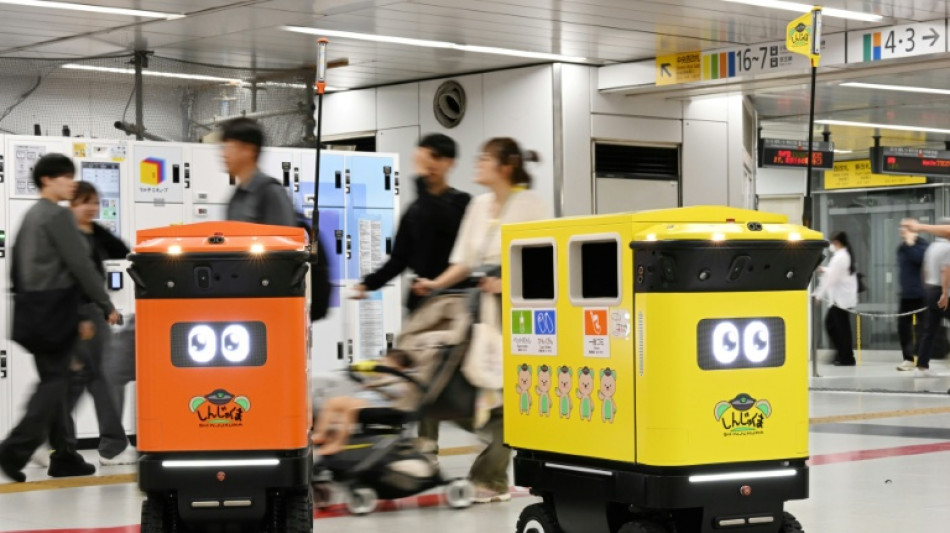
Japan's busiest rail station tests robot bins / Photo: © AFP

Japan's busiest rail station tests robot bins

The world's busiest railway station, located at the heart of Tokyo in Japan, is testing whether mobile robotic rubbish bins can ease the workload of sanitation workers, a rail operator representative said on Friday.

Text size:

Shinjuku Station is a sprawling transport complex with multiple rail firms that serve more than 2.7 million passengers every day, and holds the Guinness World Record for the world's busiest rail station.

In a part of the station operated by East Japan Railway, the bins are emptied manually more than 10 times a day -- though the number of wastebaskets has been reduced in recent years for cleanliness and security reasons.

JR East is testing three automated bins, each standing just over one metre (three feet) tall and moving at a cautious 20 centimetres (eight inches) per second.

"We wanted to test how well something like this can operate automatically and safely in an environment like Shinjuku Station," Shinya Kawamichi, a JR East research official, told AFP.

"We want to see how much of a difference mobile trash bins that collect garbage make, and whether people are actually willing to throw their trash into them," he said.

The trial project, which runs until late November, will put the robots up against the station's always-hectic underground concourse, where they are meant to bring trash to human workers.

Kawamichi said the robots are designed to be "slow so that people can put trash in them and so (they) can stop at any moment".

The company also wanted to test if the robots can navigate busy crowds and be accepted by commuters -- with an eye to expanding the future uses of this technology.

The bulky, googly-eyed devices have become a hit among tourists, many of whom stopped to snap photos.

"The eyes are very cute," said German train driver Chris Genseliein, 30, adding that he had a tough time finding bins in Japanese train stations.

Despite being an enormous complex with two above-ground floors and a massive underground section, JR East's section of Shinjuku Station only has seven sets of bins and recycling boxes.

Some Japanese passengers said stations are kept clean because people take their trash home.

But others welcomed the added convenience.

"It's just easier if you could throw things away while walking," said university student Ryunosuke Noguchi, 22.

K.Leung--ThChM