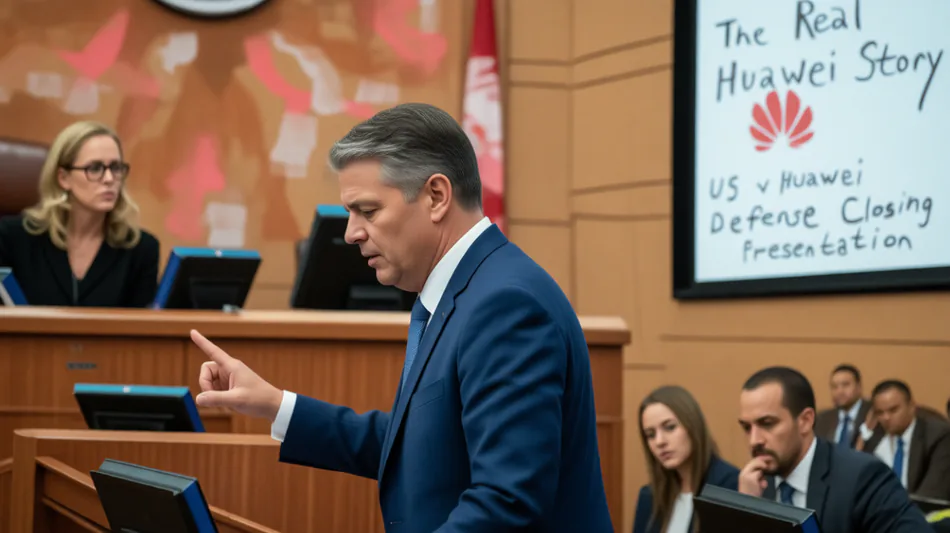
Huawei Found Guilty of Trade Secret Theft in Landmark US Case

Huawei has been found guilty of conspiring to steal U.S. trade secrets, violating sanctions, and misleading banks regarding its business in Iran and North Korea. The verdict marks a significant legal milestone for the Chinese technology giant, though it was acquitted of more serious racketeering charges that prosecutors had initially pursued.
A federal jury in the United States has found Huawei guilty of conspiring to steal U.S. trade secrets, violating American sanctions, and misleading financial institutions about its business dealings in Iran and North Korea. The verdict concludes an 11-week trial that prosecutors described as a landmark case against one of China’s largest technology companies.
Huawei was convicted on 10 of the 12 counts brought against it. However, the jury acquitted the company of the more severe charges of racketeering conspiracy and obstruction of justice. The acquittal on the racketeering charge is particularly significant, as prosecutors had used this typically organized-crime allegation to argue that Huawei operated as a criminal enterprise engaged in a systemic pattern of intellectual property theft.
Brian Heberlig, an attorney for Huawei, stated that the company would appeal the verdict. He emphasized that the acquittal on the racketeering conspiracy charge confirmed the lack of factual basis for those allegations and vindicated the firm’s position over the past eight years. Heberlig described the outcome as a profound rejection of the government’s narrative that the company was corrupt from top to bottom and maintained a corporate culture defined by cheating, stealing, and lying.
U.S. Attorney Joseph Nocella condemned the verdict in a statement, asserting that Huawei engaged in a decades-long pattern of endangering U.S. national security and violating the sanctity of U.S. commerce. Nocella noted that few crimes are as serious as impeding the enforcement of U.S. laws.
The Justice Department’s case relied on testimony that Huawei and its subsidiaries assisted the Iranian government in developing its core internet infrastructure and expanding mobile network access. According to the department, Huawei also helped Tehran and Zaeim, a component of Iran’s intelligence apparatus, monitor and censor users’ internet access. The department added that testimony established Huawei supplied surveillance cameras that enabled Iranian authorities to monitor protest activity.
U.S. Attorney General Todd Blanche stated that Huawei had conducted its business in the United States on the basis of lies and theft for decades. He credited the FBI and federal prosecutors with ensuring accountability for these criminal activities.
During the trial, jurors were presented with evidence involving specific victim companies, including Cisco Systems, Motorola Solutions, T-Mobile, Quintel USA, and Fujitsu. Prosecutors showed a video they claimed captured a Huawei employee slipping a component of a T-Mobile testing robot into his backpack. They also heard testimony about a Huawei engineer sneaking into a Fujitsu booth at a trade show to photograph a device.
The defense argued that banks such as HSBC were aware of Huawei’s business in Iran and were actively competing for the company’s business. Huawei’s defense team maintained that the firm’s expansion into 170 countries and its workforce growth to more than 200,000 employees were the results of hard work and innovation, not criminal enterprise.
The legal proceedings against Huawei began in 2019, following the arrest of senior executive Meng Wanzhou in Canada in 2018. Meng, the company’s chief financial officer and daughter of its founder, was held for three years before being released and returning to China through a deal with U.S. prosecutors. She had been secretly indicted on charges that she misled an HSBC banker about Huawei’s business in Iran, facilitating transactions that violated American sanctions.
Meng did not testify at the trial, though an HSBC banker she met with in 2013 did provide testimony. The case has had lasting consequences for the company, which has been barred from selling equipment to U.S. carriers for years due to security concerns and has been blacklisted by other Western allies, including Canada and Britain.
The conviction marks a rare criminal prosecution of a foreign corporation in the United States. Prosecutors first announced charges against Huawei in 2019 and subsequently expanded the allegations as the investigation progressed. The verdict leaves the company facing significant legal and reputational challenges as it prepares for the appeals process.
H.Ng--ThChM