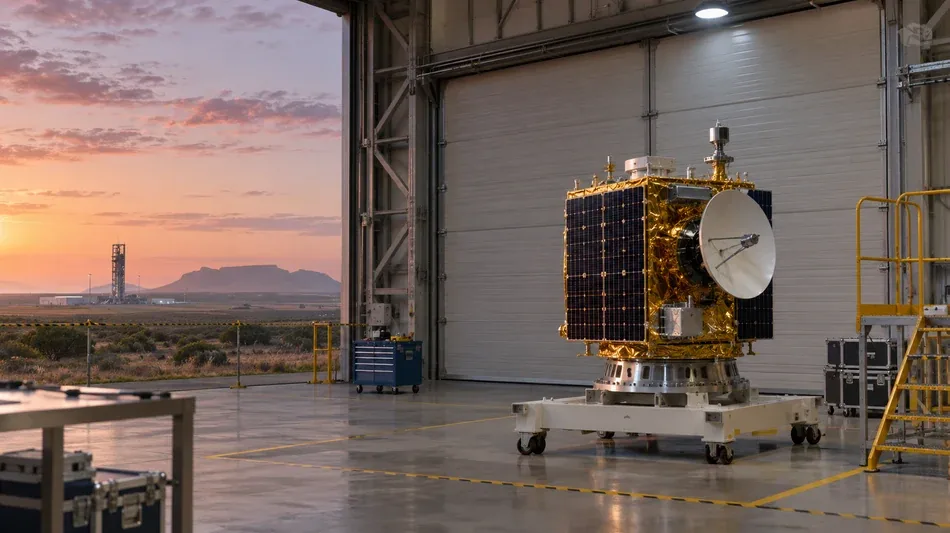
South Africa’s sovereign satellite plan remains stalled despite higher cost

South Africa’s proposed sovereign communications satellite has still not been tabled in cabinet despite a revised estimated cost of R6.5 billion and years of planning.
South Africa’s plan to put its own communications satellite into orbit now carries a R6.5-billion price tag, but the strategy behind it has still not been tabled before cabinet, and no firm funding has been secured.
The cost keeps rising. DA MP S’bongiseni Vilakazi observed that R5.2-billion had been mentioned in November 2024 and about R6-billion in April 2025.
That was the picture presented to a joint sitting of parliament’s communications and science committees on Tuesday, as reported by the Parliamentary Monitoring Group’s record of the meeting. It is two years since the departments told the same committees they were finalising and presenting the strategy to cabinet, and more than 18 months since officials stated it would go to cabinet soon.
Sentech CEO Tebogo Leshope told MPs the programme, covering satellite manufacturing, launch, ground infrastructure, service platforms and spectrum coordination, had been costed at R6.5-billion. The state-owned signal distributor has applied to national treasury’s budget facility for infrastructure for that amount and hopes for an outcome in the first quarter of 2027.
Other options include a public-private partnership, debt from the Development Bank of Southern Africa, Industrial Development Corporation and New Development Bank, or a mix. Memoranda of understanding and non-disclosure agreements have been signed with the lenders, but none has committed funding. Leshope stated the project was at an initial interest stage.
Communications director-general Nonkqubela Jordan-Dyani stated the cabinet memorandum remained with the office of communications minister Solly Malatsi, who had wanted to consult the finance minister first. A response has since been received, she stated, and the finance ministry supports the project in principle.
She added that a 2016 cabinet direction for South Africa to develop its own capabilities was not approval of the strategy.
Once cabinet approves it, the strategy must be gazetted for 30 working days of public comment and return to cabinet for final approval. Leshope estimated about five years from approval to launch, though he stated other prospective technology providers had indicated this could be shortened significantly.
Jordan-Dyani stated the initial timeframe had been set around 2028 partly because several existing contracts with foreign satellite providers end around then. She stated the investment was expected to generate a return, with profit margins anticipated within four to five years.
Sentech puts the amount flowing to foreign satellite providers at R300-million to R400-million a year. Jordan-Dyani stated South Africa collectively spends more than R30-billion a year on foreign satellite capacity. The two figures appear to measure different things.
Sentech subsidiary InfoSat is meant to implement the project. Private equity could participate, Leshope stated, but the state would retain majority control. Two unnamed partners have been brought on board to provide low-Earth orbit services.
Government has argued that a domestic system would strengthen sovereign capabilities required by the defence and security clusters. Science deputy minister Nomalungelo Gina warned that further delays could undermine the confidence stakeholders had already placed in the project.
MPs across party lines were scathing. Communications committee chair Khusela Diko stated the approach seemed to be “we will get to it when we get to it”. She observed that the committees were supposed to meet quarterly on the strategy but had last done so in April 2025. Science committee chair Lusizo Makhubela stated there were no clear lines of accountability.
Vilakazi called the report wholly inadequate for a project of this scale, while DA colleague Tumelo Ramongalo warned that when everyone was responsible, nobody was held accountable. The MK party’s Adil Nchabeleng stated the document was not a strategy and did not even have an inclination of one. The EFF’s Suzan Thembekwayo asked why treasury was not being compelled to fund a sovereign satellite directly. ANC MPs pressed officials on local manufacturing, deadlines and how much had been spent to date.
The committees called for a single implementation plan and an accountability matrix setting out who is responsible for what. Jordan-Dyani undertook to make the full strategy available to MPs.
The satellite joins another long-delayed Sentech project: its merger with Broadband Infraco, whose implementation has been pushed out to the 2028/2029 financial year.
R.Lin--ThChM