The China Mail - Rescued condors spread wings in Chilean Andes

USD -
AED 3.672501
AFN 66.503528
ALL 82.428929
AMD 365.569665
AOA 917.000096
ARS 1497.128345
AUD 1.43472
AWG 1.8
AZN 1.699811
BAM 1.718705
BBD 2.014763
BDT 123.38855
BHD 0.377257
BIF 2988.444132
BMD 1
BND 1.291269
BOB 11.108572
BRL 5.0835
BSD 1.000308
BTN 96.544664
BWP 13.81783
BYN 2.869195
BYR 19600
BZD 2.011863
CAD 1.41005
CDF 2260.00011
CHF 0.818574
CLF 0.024025
CLP 945.568786
CNY 6.772099
CNH 6.77171
COP 3201.019377
CRC 455.204534
CUC 1
CUP 26.5
CVE 96.89793
CZK 21.236497
DJF 178.127334
DKK 6.574302
DOP 58.253878
DZD 133.399534
EGP 51.365789
ERN 15
ETB 161.454897
EUR 0.878978
FJD 2.251305
FKP 0.7506
GBP 0.750779
GEL 2.625028
GGP 0.7506
GHS 11.6332
GIP 0.7506
GMD 73.999882
GNF 8776.308274
GTQ 7.631267
GYD 209.279845
HKD 7.84215
HNL 26.792917
HRK 6.626297
HTG 130.78782
HUF 317.550272
IDR 17922
ILS 3.04635
IMP 0.7506
INR 96.5675
IQD 1310.426644
IRR 1375000.000303
ISK 125.803093
JEP 0.7506
JMD 158.662507
JOD 0.709017
JPY 163.864997
KES 129.539962
KGS 87.450226
KHR 4044.99319
KMF 433.999749
KRW 1459.510296
KWD 0.31008
KYD 0.833604
KZT 475.618437
LAK 22650.380069
LBP 89577.573707
LKR 336.157125
LRD 181.053649
LSL 16.895558
LTL 2.95274
LVL 0.60489
LYD 6.400984
MAD 9.367723
MDL 17.680039
MGA 4432.532185
MKD 54.110462
MMK 2099.999271
MNT 3593.996389
MOP 8.080056
MRU 39.924426
MUR 47.420326
MVR 15.449752
MWK 1734.522606
MXN 17.484698
MYR 4.0914
MZN 63.902912
NAD 16.895558
NGN 1365.498117
NIO 36.811811
NOK 9.5791
NPR 154.471638
NZD 1.732952
OMR 0.384665
PAB 1.000308
PEN 3.404192
PGK 4.474713
PHP 61.685006
PKR 277.860451
PLN 3.79675
PYG 6047.717387
QAR 3.636539
RON 4.58725
RSD 103.15919
RUB 78.175667
RWF 1473.966343
SAR 3.762502
SBD 8.081105
SCR 13.48599
SDG 600.496371
SEK 9.718896
SGD 1.29065
SLE 24.225028
SOS 571.641988
SRD 37.792498
STD 20697.981008
STN 21.529944
SVC 8.752581
SZL 16.893537
THB 33.705014
TJS 9.227822
TMT 3.5
TND 2.964981
TRY 47.342503
TTD 6.796432
TWD 32.360383
TZS 2640.801441
UAH 44.82921
UGX 3770.815941
UYU 40.168724
UZS 12105.980052
VES 741.301401
VND 26320
VUV 118.673107
WST 2.75632
XAF 576.437453
XAG 0.017161
XAU 0.000247
XCD 2.70255
XCG 1.802803
XDR 0.716903
XOF 576.437453
XPF 104.802496
YER 238.549817
ZAR 16.83418
ZMK 9001.202191
ZMW 18.530691
ZWL 321.999592
  • CMSC

    -0.0650

    21.725

    -0.3%

  • RIO

    -0.2900

    91.22

    -0.32%

  • RELX

    1.5500

    34.41

    +4.5%

  • RBGPF

    -0.7300

    66

    -1.11%

  • RYCEF

    -0.1900

    18.17

    -1.05%

  • BCE

    0.0900

    21.3

    +0.42%

  • GSK

    0.6100

    51.35

    +1.19%

  • BTI

    1.1200

    60.96

    +1.84%

  • NGG

    -0.0700

    82.3

    -0.09%

  • AZN

    0.9900

    169.26

    +0.58%

  • CMSD

    -0.0200

    21.98

    -0.09%

  • JRI

    0.1600

    13.06

    +1.23%

  • BCC

    1.3800

    77.84

    +1.77%

  • VOD

    -0.1000

    15.15

    -0.66%

  • BP

    -0.1100

    43.82

    -0.25%

Rescued condors spread wings in Chilean Andes


Rescued condors spread wings in Chilean Andes

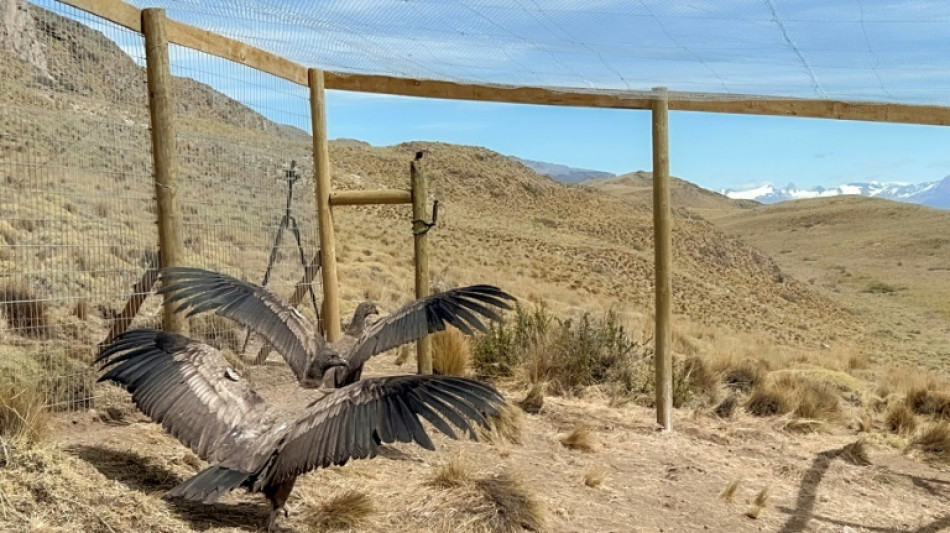
Pumalin and Liquine, two juvenile condors rescued from certain death, have been released back into the wild in a much-needed boost for a dwindling species emblematic of the Chilean Andes.

Text size:

After 14 months of rehabilitation, the pair of scavengers were freed last week in the Patagonian National Park in Chile's extreme south, where every individual counts for a species listed by the International Union for Conservation of Nature (IUCN) as "vulnerable" to extinction.

From a vast cage perched on the edge of a cliff overlooking the Patagonian valley, the pair spread their massive wings, waddled to the ledge, and took the leap of freedom, soaring away graciously.

"Today we have witnessed a milestone," Christian Saucedo of the Rewilding Chile Foundation told AFP.

"It is a very complex process... but it means returning individuals who would otherwise be condemned to live in captivity," he said.

According to the IUCN, the Andean condor -- a type of scavenging vulture -- is a declining species, with fewer than 7,000 left in the wild.

- Human 'persecution' -

The main threat is "direct and indirect persecution by humans," it states.

Dominic Duran, the executive director of the Manku Project for condor conservation, told AFP "the biggest threat is toxic baits set by humans to poison... pumas or wild dogs eating their livestock."

When the condors feed on these carcasses, up to 30 at a time, they get poisoned in turn.

The first to eat, he added, are usually the breeding males and females, and "when condors are killed by toxic bait, all the reproductive individuals at the top of the chain die."

Other threats are hunting by humans, intoxication from poorly-managed landfills and dwindling numbers of the wild animals that make up their diet.

The foundation that rescued Pumalin and Liquine is a legacy of US philanthropist Douglas Tompkins, who in 1990 donated 8,000 square kilometers (3,088 square miles) of land to Chile and Argentina for conservation.

The Patagonia National Park now housed there holds an estimated 70 percent of Chile's Andean condors -- the largest population in South America.

Pumalin, a male, was found over a year ago unable to fly after getting caught in a heavy storm, and Liquine, a female, was rescued struggling to make it in the wild after an earlier attempt to rehabilitate her.

They will now go back to "learning the codes of condor society," said Saucedo.

The pair's progress will be monitored with radio transmitters implanted in their wings.

C.Mak--ThChM