The China Mail - Our bad fashion habits -- and how we might change them -- in numbers

USD -
AED 3.672501
AFN 63.99991
ALL 81.218818
AMD 360.139994
ANG 1.789785
AOA 917.999991
ARS 1536.337501
AUD 1.422696
AWG 1.8025
AZN 1.689986
BAM 1.747092
BBD 2.014338
BDT 124.158076
BGN 1.747831
BHD 0.377606
BIF 3001.375712
BMD 1
BND 1.27771
BOB 12.126707
BRL 5.41355
BSD 1.000156
BTN 94.912544
BWP 13.81787
BYN 2.946066
BYR 19600
BZD 2.011399
CAD 1.39657
CDF 2314.999761
CHF 0.825455
CLF 0.025073
CLP 990.119988
CNY 6.661098
CNH 6.652475
COP 3176.09
CRC 454.787056
CUC 1
CUP 24.001751
CVE 98.497943
CZK 21.840298
DJF 178.090635
DKK 6.708085
DOP 60.620679
DZD 135.903569
EGP 56.000702
ERN 15
ETB 161.461739
EUR 0.89757
FJD 2.243698
FKP 0.747647
GBP 0.7473
GEL 2.598748
GGP 0.747647
GHS 11.651465
GIP 0.747647
GMD 73.99979
GNF 8851.589159
GTQ 7.645651
GYD 209.633474
HKD 7.845255
HNL 26.880818
HRK 6.76901
HTG 131.032142
HUF 328.230952
IDR 18164
ILS 3.13655
IMP 0.747647
INR 94.959002
IQD 1516.088114
IRR 1868415.000088
ISK 122.000193
JEP 0.747647
JMD 158.924129
JOD 0.709027
JPY 157.348503
KES 129.950336
KGS 87.448694
KHR 4080.593508
KMF 440.999774
KPW 899.999961
KRW 1334.390289
KWD 0.31118
KYD 0.833434
KZT 453.459704
LAK 22517.911061
LBP 89559.597295
LKR 332.651457
LRD 170.008263
LSL 16.666696
LTL 2.95274
LVL 0.60489
LYD 6.428964
MAD 9.833447
MDL 17.902128
MGA 4523.771239
MKD 55.008665
MMK 2099.909661
MNT 3597.883233
MOP 8.081288
MRU 40.55493
MUR 47.280181
MVR 15.449954
MWK 1733.828824
MXN 18.81377
MYR 4.058296
MZN 63.910181
NAD 16.666696
NGN 1346.119805
NIO 36.803459
NOK 9.228735
NPR 151.859892
NZD 1.776089
OMR 0.384494
PAB 1.00025
PEN 3.46149
PGK 4.551281
PHP 63.690989
PKR 276.672235
PLN 3.948775
PYG 5859.074911
QAR 3.645686
RON 4.793981
RSD 105.483974
RUB 80.757293
RWF 1476.317024
SAR 3.7544
SBD 8.058206
SCR 13.74931
SDG 601.503764
SEK 9.84828
SGD 1.278675
SHP 0.748335
SLE 22.895409
SLL 20969.504398
SOS 571.533215
SRD 37.619501
STD 20697.981008
STN 21.886236
SVC 8.750648
SYP 13001.999685
SZL 16.6622
THB 33.758497
TJS 9.205654
TMT 3.5
TND 2.990728
TOP 2.40776
TRY 49.946602
TTD 6.780948
TWD 32.616993
TZS 2641.229874
UAH 45.361884
UGX 4250.396409
UYU 40.208322
UZS 11995.497668
VES 887.479805
VND 25803.5
VUV 119.217464
WST 2.773901
XAF 588.767481
XAG 0.020193
XAU 0.000255559048
XCD 2.70255
XCG 1.802387
XDR 0.707052
XOF 588.767481
XPF 106.533507
YER 236.202449
ZAR 16.69621
ZMK 9001.19855
ZMW 20.167407
ZWL 321.999592
SSP 5745.199062
MXV 2.120415
  • RYCEF

    0.4000

    19.71

    +2.03%

  • CMSC

    0.0000

    20.4

    0%

  • BTI

    0.4200

    56.05

    +0.75%

  • BP

    0.2800

    44.43

    +0.63%

  • RBGPF

    1.6000

    67

    +2.39%

  • RIO

    -0.1500

    94.41

    -0.16%

  • AZN

    -0.4300

    166.15

    -0.26%

  • GSK

    0.4600

    49.7

    +0.93%

  • BCE

    -0.4100

    20.56

    -1.99%

  • NGG

    -0.2500

    75.24

    -0.33%

  • VOD

    -0.0400

    16.58

    -0.24%

  • RELX

    -0.4500

    33.07

    -1.36%

  • BCC

    -0.5500

    76.59

    -0.72%

  • CMSD

    -0.0300

    20.27

    -0.15%

  • JRI

    -0.2500

    10.77

    -2.32%

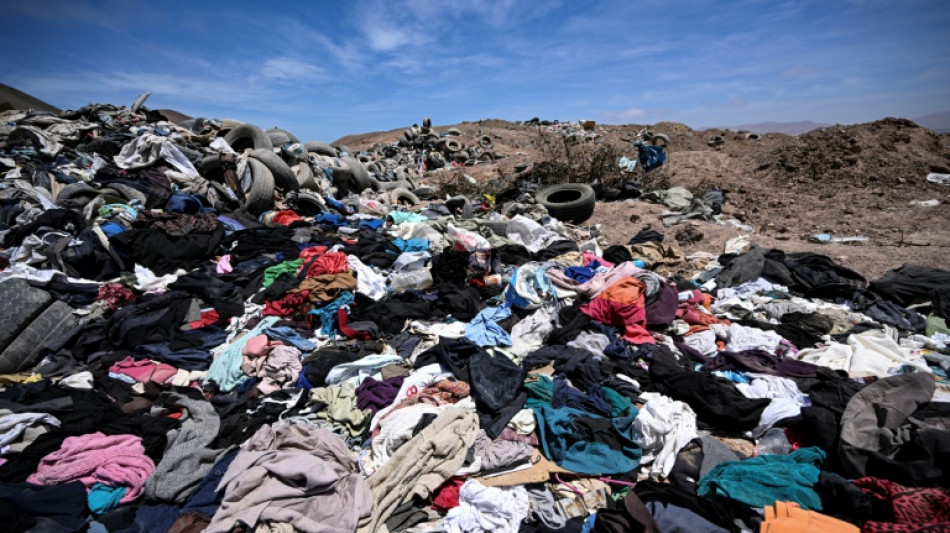
Our bad fashion habits -- and how we might change them -- in numbers
Our bad fashion habits -- and how we might change them -- in numbers / Photo: © AFP/File

Our bad fashion habits -- and how we might change them -- in numbers

The fashion industry is estimated to contribute upwards of two percent of global greenhouse gas emissions, and is on track to get even worse if there isn't major change.

Text size:

Here are some key figures on how fashion is affecting the planet and how consumers can make a difference.

- 7 to 10 -

The average number of times a garment is worn before it is discarded, according to the Ellen Macarthur Foundation.

- 5 -

The maximum number of new items we should be buying every year if we are to reach the 1.5 degree Celsius global warming limit set out by the UN, according to the Hot or Cool institute think tank.

- Around 30 percent -

The percentage of donated clothes that ends up in landfills or incinerators abroad, according to Hot or Cool. They can also end up undercutting local vendors if they flood the market.

- 1 second -

The equivalent of a lorry load of clothes is incinerated or buried in a landfill every second, the Ellen Macarthur Foundation reckons.

- 100 billion -

The number of new clothing items produced each year, according to the Clean Clothes Campaign.

- 1 percent -

Less than one percent of the material used to produce clothing is actually recycled into new clothing, according to the United Nations Environment Programme (UNEP).

Many fast fashion firms say they can recycle old garments into new, but the reality is the fabric quality is mostly not fit to make garments that can be sold.

- 30 degrees Celsius -

The recommended temperature at which clothes should be washed in order to increase their lifespan.

- 20 / 20 / 20 -

On average, the fashion consumption of the richest 20 percent of the world's population causes 20 times higher emissions than that of the poorest 20 percent, say Hot or Cool.

- 2023 -

This year France will pass a decree requiring every item of clothing sold in the country to carry a label detailing its precise climate impact. The EU is expected to follow suit.

- 8 times -

The secondhand clothing market is growing eight times faster than the overall apparel market, according to online consignment shop thredUP.

- Double -

In the last 15 years, clothing production has roughly doubled, the Ellen Macarthur Foundation estimated, but over the same period we used those clothes almost 40 percent less.

- 40 percent -

The percentage of global consumers that belong to Gen-Z -- those born between 1997 and 2012 -- according to McKinsey & Company. Gen-Z is both a part of the problem and solution when it comes to fast fashion: they make up a huge portion of consumers, but are also calling for more sustainable fashion.

C.Smith--ThChM