The China Mail - 'Duck run' pest control catching on in S.Africa's winelands

USD -
AED 3.672498
AFN 65.999644
ALL 79.067423
AMD 363.68607
ANG 1.789783
AOA 917.999677
ARS 1497.205205
AUD 1.39519
AWG 1.8
AZN 1.699746
BAM 1.670881
BBD 2.013326
BDT 122.154359
BGN 1.696366
BHD 0.376922
BIF 2975.173427
BMD 1
BND 1.268571
BOB 11.546857
BRL 5.17298
BSD 0.999718
BTN 95.674944
BWP 13.395641
BYN 2.990697
BYR 19600
BZD 2.010619
CAD 1.373915
CDF 2275.000006
CHF 0.799425
CLF 0.023375
CLP 919.989747
CNY 6.72325
CNH 6.719165
COP 3076.28
CRC 454.922129
CUC 1
CUP 26.5
CVE 94.19971
CZK 20.613202
DJF 178.021922
DKK 6.38994
DOP 58.572258
DZD 132.819972
EGP 50.874397
ERN 15
ETB 161.682051
EUR 0.85475
FJD 2.1916
FKP 0.733283
GBP 0.732268
GEL 2.604981
GGP 0.733283
GHS 11.12141
GIP 0.733283
GMD 72.99967
GNF 8783.154658
GTQ 7.62899
GYD 209.153119
HKD 7.84055
HNL 26.809452
HRK 6.439201
HTG 130.788026
HUF 310.090217
IDR 17657
ILS 2.98455
IMP 0.733283
INR 95.660303
IQD 1309.674333
IRR 1374575.00058
ISK 121.049564
JEP 0.733283
JMD 158.661136
JOD 0.708983
JPY 158.694503
KES 129.450069
KGS 87.450178
KHR 4035.778664
KMF 421.999624
KPW 900.000294
KRW 1384.460214
KWD 0.30828
KYD 0.833127
KZT 460.282609
LAK 22518.762788
LBP 89527.950894
LKR 329.105922
LRD 181.44772
LSL 16.030789
LTL 2.95274
LVL 0.60489
LYD 6.353451
MAD 9.23322
MDL 17.210153
MGA 4274.968284
MKD 52.552001
MMK 2099.534779
MNT 3596.854666
MOP 8.07301
MRU 39.836145
MUR 46.599873
MVR 15.459497
MWK 1733.488249
MXN 16.897503
MYR 4.038502
MZN 63.905021
NAD 16.030995
NGN 1347.139706
NIO 36.786598
NOK 9.289335
NPR 153.078119
NZD 1.670265
OMR 0.384495
PAB 0.999714
PEN 3.35163
PGK 4.430415
PHP 61.651006
PKR 277.39555
PLN 3.681975
PYG 6022.109832
QAR 3.634282
RON 4.4924
RSD 100.316939
RUB 82.8046
RWF 1473.093385
SAR 3.759877
SBD 8.025811
SCR 13.704484
SDG 601.478575
SEK 9.455655
SGD 1.26843
SHP 0.740866
SLE 24.650111
SLL 20969.499227
SOS 571.369989
SRD 37.689923
STD 20697.981008
STN 20.93069
SVC 8.746423
SYP 13001.999906
SZL 16.020025
THB 32.673013
TJS 9.222404
TMT 3.51
TND 2.907682
TOP 2.40776
TRY 48.065402
TTD 6.78066
TWD 31.807005
TZS 2645.502982
UAH 44.670645
UGX 3718.447017
UYU 40.212038
UZS 11851.744273
VES 778.977298
VND 26124.5
VUV 118.205514
WST 2.716674
XAF 560.393155
XAG 0.01438
XAU 0.000218
XCD 2.702549
XCG 1.801763
XDR 0.707052
XOF 560.385974
XPF 101.875027
YER 237.097598
ZAR 16.005703
ZMK 9001.202218
ZMW 18.969958
ZWL 321.999592
  • CMSC

    0.0510

    21.331

    +0.24%

  • BCC

    0.9500

    82.72

    +1.15%

  • AZN

    2.0700

    166.56

    +1.24%

  • CMSD

    -0.0210

    21.099

    -0.1%

  • NGG

    -0.5200

    80.1

    -0.65%

  • RIO

    2.3390

    104.509

    +2.24%

  • GSK

    0.2700

    52.23

    +0.52%

  • BTI

    -0.4650

    56.235

    -0.83%

  • BCE

    0.0000

    23.78

    0%

  • BP

    -0.2900

    44.85

    -0.65%

  • RBGPF

    -0.7900

    68.56

    -1.15%

  • VOD

    -0.0650

    15.945

    -0.41%

  • RYCEF

    0.4100

    20.83

    +1.97%

  • RELX

    0.5050

    35.885

    +1.41%

  • JRI

    0.0080

    12.418

    +0.06%

'Duck run' pest control catching on in S.Africa's winelands
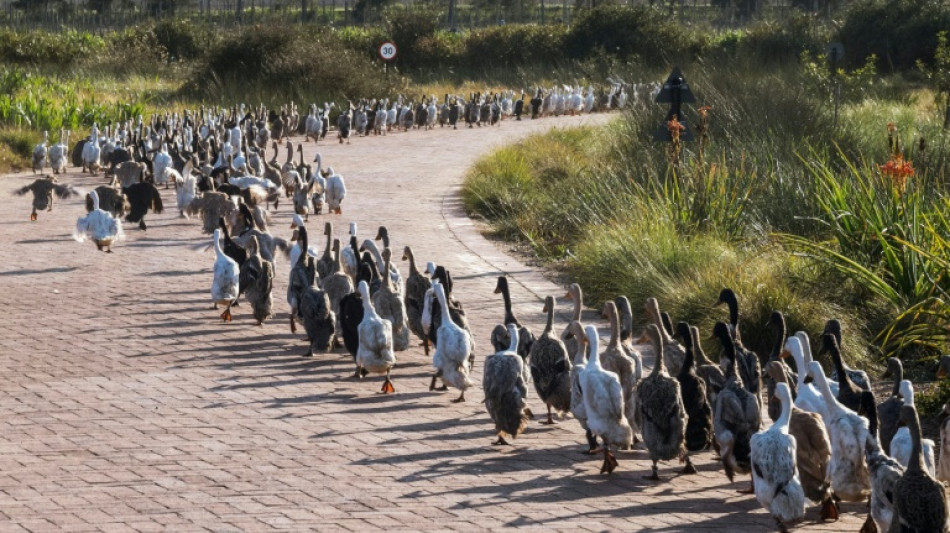
'Duck run' pest control catching on in S.Africa's winelands / Photo: © AFP

'Duck run' pest control catching on in S.Africa's winelands

Every morning, around 1,000 long-necked ducks are let loose on a South African wine farm to gobble up insects in an environmentally friendly method of pest control that is gaining popularity.

Text size:

At 9:00 am the upright and flightless Indian Runner ducks charge out of their pens on a farm near the Stellenbosch wine-producing area outside Cape Town and head to work.

After a rapid but brief forage for aphids, worms and snails near the homestead and restaurant, they move into the vineyards for the rest of the day.

"Using the ducks instead of pesticides is obviously better for the ecology," said Vergenoegd Low Wine Estate and farm manager, Christiaan Cloete.

"When you use chemicals, you sometimes kill a lot of beneficial insects. We are trying to create a more biodiverse ecology in the vineyards," Cloete told AFP.

The farm introduced the practice around 40 years ago.

"It's beginning to pick up in popularity," he said, as farmers seek more sustainable and biologically friendly methods, including "regenerative farming" which aims to restore degraded soil.

Now between five and 10 surrounding farms purchase ducks from the farm, Cloete said.

- Looking after the soil -

There are around 890 ducks on the property with 400 hatchlings expected over the breeding season from mid-July to the end of October, Cloete said.

Half will be sold and the rest will replace the more senior ducks on the farm's own fleet.

Indian Runner ducks were originally bred in Indonesia to control pests in rice paddies, said the farm's ecology ranger, Milan Germishuizen.

Their long necks allow them to reach pests on the raised, trellised vines.

They are also handy in breaking down the manure of the 220 sheep and nearly 100 cattle that graze in the vineyard, another regenerative farming practice that leaves the soil nutrient-rich.

"The more pesticides and artificial fertilisers you put onto your soil, eventually your soil will degenerate," he said.

"So by using natural methods ... we are really looking after our soils, which eventually does give us a much better product at the end of the day."

When there are grapes on the vines, the ducks are kept away to avoid them being tempted by the fruit, and diverted to the four irrigation dams.

As they forage there, their droppings enrich the water in a process called "fertigation", Germishuizen said.

"A lot of our neighbours have gotten on board with regenerative farming," said Tessa Kleynhans, the commercial manager of the on-site hotel.

The impressive daily duck run has also become a draw for visitors, she told AFP.

"We're trying to set the precedent for regenerative farming. We are trying to make a use case that, if you invest the capital in the beginning, even though it's a long, tedious process, it is worth it in the end," she said.

V.Liu--ThChM