The China Mail - Penguins bring forward breeding season as Antarctica warms: study

USD -
AED 3.6725
AFN 65.494813
ALL 82.873877
AMD 378.215671
ANG 1.79008
AOA 915.999664
ARS 1436.006198
AUD 1.484263
AWG 1.8
AZN 1.699211
BAM 1.679634
BBD 2.011302
BDT 122.146648
BGN 1.67937
BHD 0.376995
BIF 2956.334297
BMD 1
BND 1.283563
BOB 6.925336
BRL 5.370968
BSD 0.998609
BTN 90.703057
BWP 13.380911
BYN 2.874478
BYR 19600
BZD 2.008382
CAD 1.38505
CDF 2174.999997
CHF 0.79626
CLF 0.022484
CLP 887.790253
CNY 6.96885
CNH 6.953898
COP 3677.25
CRC 486.680064
CUC 1
CUP 26.5
CVE 94.69562
CZK 20.837404
DJF 177.822435
DKK 6.404715
DOP 63.550952
DZD 130.041198
EGP 47.427104
ERN 15
ETB 155.838529
EUR 0.85731
FJD 2.272803
FKP 0.744714
GBP 0.743895
GEL 2.690279
GGP 0.744714
GHS 10.789921
GIP 0.744714
GMD 74.000298
GNF 8742.58748
GTQ 7.657064
GYD 208.919462
HKD 7.79766
HNL 26.335858
HRK 6.459296
HTG 130.769528
HUF 330.493502
IDR 16969
ILS 3.16036
IMP 0.744714
INR 91.0242
IQD 1308.204943
IRR 42125.000158
ISK 125.339876
JEP 0.744714
JMD 157.589863
JOD 0.708986
JPY 158.156976
KES 128.820101
KGS 87.449994
KHR 4021.762001
KMF 425.000135
KPW 899.989233
KRW 1477.459889
KWD 0.30797
KYD 0.832174
KZT 507.961045
LAK 21594.441868
LBP 89424.434482
LKR 309.312791
LRD 180.74312
LSL 16.454887
LTL 2.95274
LVL 0.60489
LYD 5.426736
MAD 9.205098
MDL 17.055702
MGA 4527.575961
MKD 52.755872
MMK 2100.036036
MNT 3563.553506
MOP 8.020474
MRU 39.863623
MUR 46.189941
MVR 15.459686
MWK 1731.591694
MXN 17.585161
MYR 4.052497
MZN 63.894475
NAD 16.454887
NGN 1417.530174
NIO 36.748067
NOK 10.04471
NPR 145.124611
NZD 1.71452
OMR 0.384497
PAB 0.998609
PEN 3.354202
PGK 4.26652
PHP 59.486033
PKR 279.432679
PLN 3.62115
PYG 6657.391663
QAR 3.65076
RON 4.366296
RSD 100.586997
RUB 77.497032
RWF 1456.4395
SAR 3.749979
SBD 8.123611
SCR 13.337737
SDG 601.498782
SEK 9.196099
SGD 1.284885
SHP 0.750259
SLE 24.149622
SLL 20969.499267
SOS 569.728147
SRD 38.291496
STD 20697.981008
STN 21.040608
SVC 8.737397
SYP 11059.574895
SZL 16.449391
THB 31.095264
TJS 9.306991
TMT 3.51
TND 2.925246
TOP 2.40776
TRY 43.278498
TTD 6.777623
TWD 31.629016
TZS 2524.056991
UAH 43.213703
UGX 3479.844043
UYU 38.560135
UZS 11945.912754
VES 341.315304
VND 26265
VUV 121.154373
WST 2.793285
XAF 563.336096
XAG 0.010604
XAU 0.000212
XCD 2.70255
XCG 1.799694
XDR 0.700606
XOF 563.333677
XPF 102.420529
YER 238.475004
ZAR 16.371805
ZMK 9001.197757
ZMW 19.99708
ZWL 321.999592
  • SCS

    0.0200

    16.14

    +0.12%

  • JRI

    0.1600

    13.7

    +1.17%

  • BCE

    -0.1000

    24.14

    -0.41%

  • RBGPF

    0.0000

    84.04

    0%

  • RELX

    -0.2200

    41.63

    -0.53%

  • RYCEF

    0.0500

    17.08

    +0.29%

  • CMSC

    -0.0700

    23.48

    -0.3%

  • NGG

    1.5300

    80.89

    +1.89%

  • VOD

    0.0200

    13.47

    +0.15%

  • RIO

    -1.2200

    85.13

    -1.43%

  • CMSD

    -0.0600

    23.92

    -0.25%

  • GSK

    -0.9000

    48.22

    -1.87%

  • AZN

    0.4740

    94.427

    +0.5%

  • BTI

    0.1400

    58.22

    +0.24%

  • BCC

    -0.7600

    85.51

    -0.89%

  • BP

    0.2300

    35.38

    +0.65%

Penguins bring forward breeding season as Antarctica warms: study
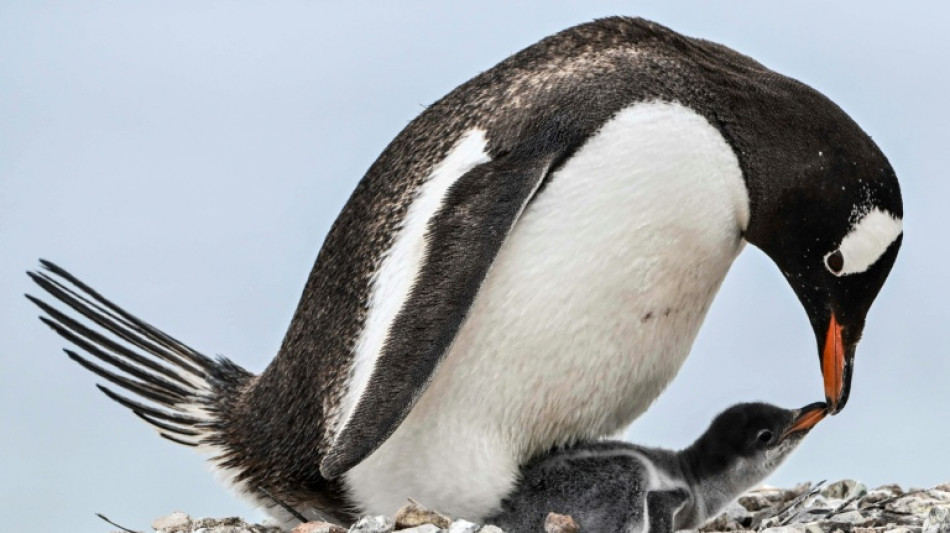
Penguins bring forward breeding season as Antarctica warms: study / Photo: © AFP/File

Penguins bring forward breeding season as Antarctica warms: study

Penguins are bringing forward their breeding season at record rates as Antarctica rapidly warms due to climate change, according to research published by a global team of scientists on Tuesday.

Text size:

The unprecedented shift observed over a decade in penguin breeding patterns was "highly correlated" with rising temperatures on the frozen continent, said the study's lead author Ignacio Juarez Martinez.

Penguin breeding is closely linked to food availability, and less sea ice has meant hunting grounds and nesting sites are more available during the year.

Scientists observing penguin populations in Antarctica had expected breeding to occur a little earlier but were "very surprised both by the scale and the speed of the advance", Martinez told AFP.

"The scale is so great that penguins in most areas are now breeding earlier than in any historical records," said Martinez, a scientist from the University of Oxford and Oxford Brookes University.

For this study, scientists observed nesting zones of Gentoo, Chinstrap and Adelie penguins between 2012 and 2022 using dozens of time-lapse cameras placed at colonies across Antarctica.

Gentoo penguins demonstrated the greatest change with the timing of their breeding season brought forward 13 days over the decade -- and up to 24 days in some colonies.

This is the fastest change in breeding season observed in any bird -- and possibly vertebrate -- to date, the scientists said.

Adelie and Chinstrap penguins also advanced their breeding season by an average of 10 days.

The findings were published in the Journal of Animal Ecology.

- Winners and losers -

Antarctica is one of the fastest-warming regions in the world and annual average temperatures there reached record highs last year, the EU climate monitor Copernicus said this month.

The exact mechanisms by which rising temperatures affect penguin behaviour are not yet fully understood by scientists.

The three species traditionally staggered their breeding seasons but the earlier timing was likely causing an overlap, increasing competition for food and snow-free nesting space.

This was better news for Gentoos -- natural foragers suited to more temperate conditions -- and less so for Chinstrap and Adelie penguins.

"We have already seen Gentoos take nests that were previously occupied by Adelies or Chinstraps," said Martinez.

Gentoo numbers are already expanding in a milder Antarctica while Chinstrap and Adelie penguins, more dependent on krill -- tiny shrimp-like creatures on which they feed -- and specific ice conditions, are declining.

"As penguins are considered 'a bellwether of climate change', the results of this study have implications for species across the planet," Fiona Jones, a co-author of the study from Oxford University, said in a statement.

Martinez said it was "too early to tell" if this adaptation was beneficial or if penguins were being forced to make drastic changes that could affect their breeding success.

"We are now studying their ability to raise chicks of each species. If they maintain a high number of chicks, that will mean this is a good news and they are indeed adapting to climate change," he said.

M.Zhou--ThChM