Swiss glaciers facing drastic loss from heatwave: expert / Photo: © AFP/File

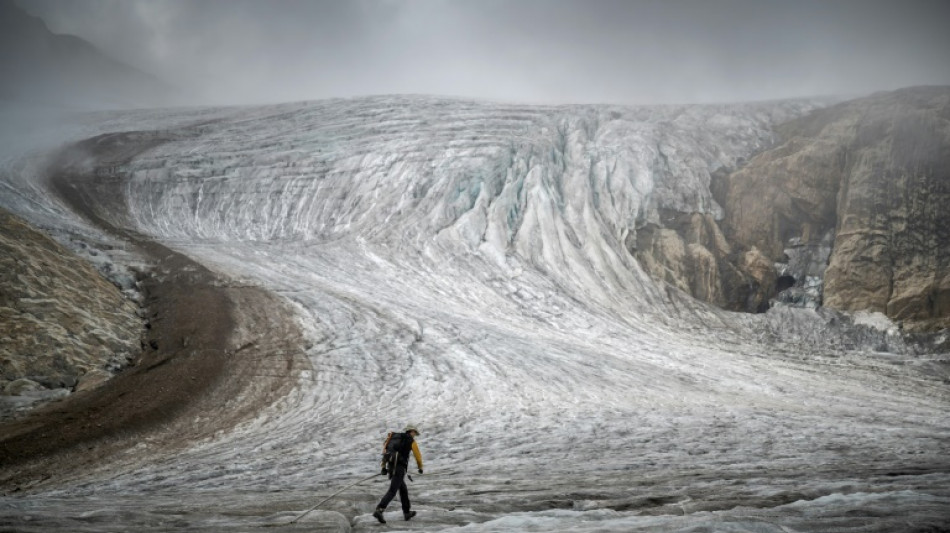
Swiss glaciers are set to lose an enormous amount of ice due to the heatwave battering Europe, the head of Glacier Monitoring in Switzerland (GLAMOS) told AFP.
The snow and ice accumulated last winter by Switzerland's glaciers is expected to have all melted away by Monday, marking the alarming second-earliest arrival on record of the tipping point known as glacier loss day.
All further melting between now and October will see the size of glaciers in the Swiss Alps shrink.
In data going back to 2000, the only time that the tipping point arrived even earlier was in 2022, when it came on June 26.
The grim scenario is driven by the current heatwave, as well as the one in May -- both coming on the back of another winter with poor snowfall.
"We're just seeing enormous ablation, ice melt rates and snow melt rates all over the Alps," GLAMOS network chief Matthias Huss told AFP on Friday, as multiple Swiss weather stations registered new all-time records.
"We are three months too early compared to a healthy state."
This century, the tipping point, on average, has been reached in mid-August -- itself already bad news for the nation's glaciers, which are shrinking at a staggering rate.
- Glaciers in 'very bad state' -
Much of the water that flows into the Rhine and the Rhone, two of Europe's major rivers, comes from the Alpine glaciers.
Huss said he had just returned from the Rhone Glacier, and in the 10 days since his previous visit, "there was one metre of ice melted in the vertical direction -- one metre of melting within just the last 10 days".
"It's very impressive to see, and this is just the effect of the heatwave."
But, said Huss, "one heatwave alone is not a big problem for glaciers".
"The problem is rather that we have very high temperatures that last for a very long time.
"The more days that are added that are very high temperatures, not even mattering whether it's 35C or 40C, this is just very bad for the glaciers."
Huss said the "very bad state of the glaciers at the moment" was down to a "combination of bad circumstances", including less snowfall, and the arrival of dust from the Sahara Desert in March.
He said 2026 was "surprisingly similar" to 2022, which for glaciers was "by far the most extreme year ever recorded in the Alps, with melt rates shattering everything we had seen before".
- Melting away -
He said this year had seen 25 percent less snow replenishing the surface of the glaciers compared to the 2010-2020 figures.
Meanwhile May was warm, causing the snowpack to disappear earlier.
Once the reflective white snow coverage from winter is gone from the top of the glacier, the darker, more absorbent grey surface of the bare ice is exposed.
This absorbs radiation more quickly, meaning extreme melting produces an accelerating feedback effect, worsening the situation even further.
While the full scale of this year's damage will be measured in September, "it is clear already now that we will have very strong ice loss also this year".
Glaciers in the Swiss Alps began to retreat about 170 years ago.
The retreat was initially modest but in recent decades, melting has accelerated significantly as the climate warms.
The volume of Swiss glaciers shrank by 38 percent between 2000 and 2024.
Huss said Switzerland had already lost 1,200 glaciers in the past 50 years, and there now only 1,300 left.
"Those lost were small glaciers, but they were still relevant in peripheral regions of the Alps," the glaciologist said.
"If warming continues as it did over the last decades, by 2100 we will only be left with some little remnants of ice."
O.Tse--ThChM