South Korea issues first emergency heatwave warning under new rating system / Photo: © AFP

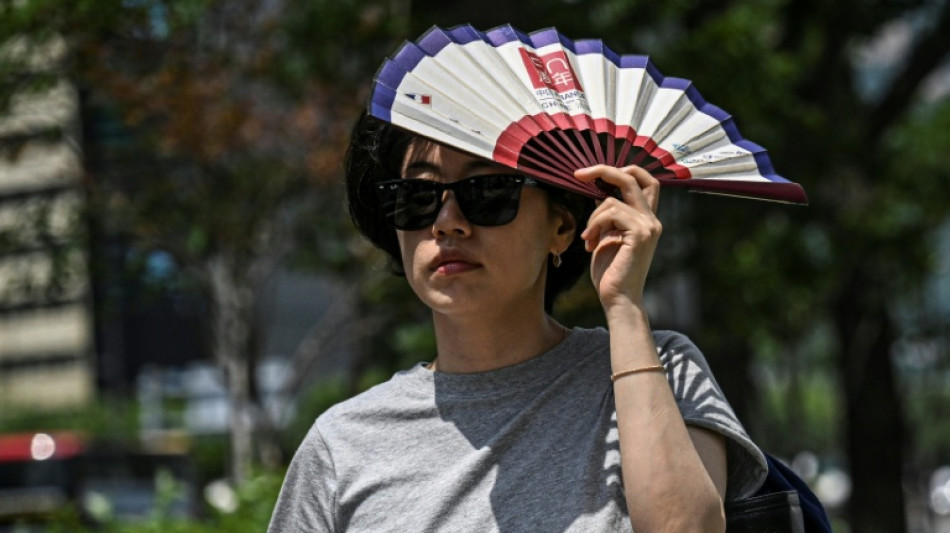
South Korea issued its first-ever emergency heatwave alert on Sunday under a new warning system launched this year, advising people to halt outdoor activities and keep cool.
The new warning system was introduced to better deal with a rising number of heatwaves in South Korea, which have become longer and more intense, officials said.
An emergency alert is issued when areas experiencing a heatwave are forecast to hit perceived temperatures of 38C or an actual temperature of 39C for one day.
"The Korea Meteorological Administration issued an Emergency Heatwave Warning at 10 am today (GMT 0100) for two cities in southern North Gyeongsang Province -- Gyeongsan and Pohang," said agency chief Lee Mi-seon at a press briefing.
"This marks the first time it has been issued since the system took effect," she added.
The affected areas saw temperatures reach the emergency criteria over the weekend.
"An emergency heatwave warning does not simply mean the weather is extremely hot," Lee said.
"It indicates conditions in which even healthy people face a significantly elevated risk of serious harm, including heat-related illness and death."
People engaged in outdoor activities should stop immediately and move to a cool place, and no one, including children or pets, should be left inside a vehicle, she added.
Much of the country -- including parts of Seoul -- remained under heatwave warnings, which are issued when the perceived temperature is expected to stay at 35C or higher for two consecutive days.
Such warnings take both temperature and humidity into account, according to the KMA.
- Longer heatwaves -
Children tried to cool off from the heat on Sunday by running through the water jets at Gwanghwamun Square in central Seoul, an AFP reporter saw.
People also sought refuge in air-conditioned shopping malls.
KMA data show the average annual number of heatwave days in the country has more than doubled to 19 over the past five years, from eight in the 1970s.
The average annual number of tropical nights has also jumped from four to 14 over the same period.
A heatwave day is defined as one with a maximum temperature of at least 33C, while a tropical night is one when the overnight low remains 25C or above.
The new system comes as Europe endures a scorching summer, after a June heatwave shattered temperature records across the continent.
Scientists warn that extreme weather events such as heatwaves are becoming more frequent and intense as a result of human-induced climate change.
France recorded more than 2,000 excess deaths during the June heatwave, and 300 during the high temperatures in late May, according to official figures.
The Eiffel Tower and other Paris landmarks closed early over the weekend, and cycling's Tour de France shortened a stage for the first time in its history.
All-time temperature records have been broken in Germany, Poland, the Czech Republic, Slovakia and Hungary, as well as for the month of June in the UK and Switzerland.
Oceans have experienced their hottest June on record and could set fresh highs in the months ahead, the European Union's Copernicus Marine Service said this month.
Adding to the mix is the return this year of El Nino, a natural climate phenomenon that warms Pacific Ocean surface temperatures and typically occurs every two to seven years.
M.Zhou--ThChM