What scientists know so far about Nepal's deadly floods / Photo: © AFP

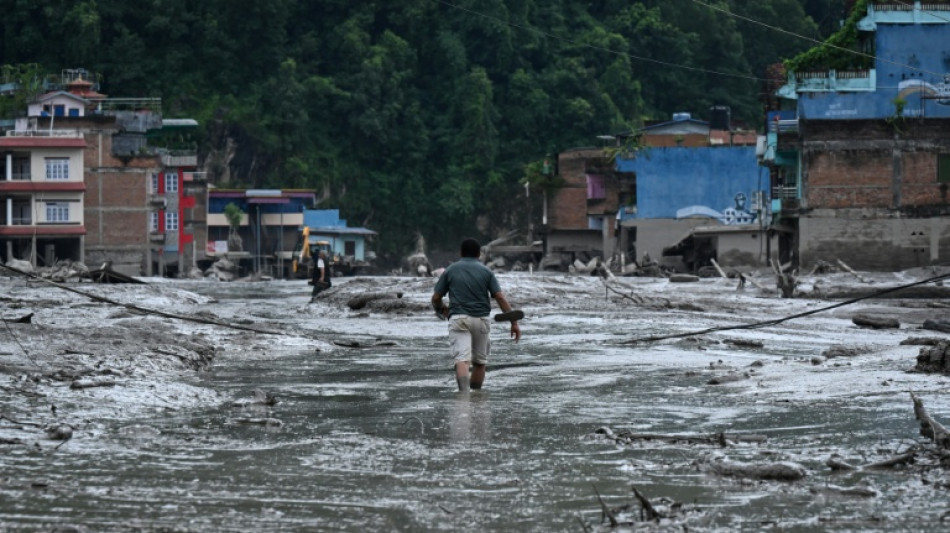
Lethal surges of mud and water that hit "like liquid concrete" are nearly impossible to predict and can't be outrun.
The cause of the deadly landslide and flood along the Nepal-Tibet border isn't yet certain, but experts say the risk of such events is compounded by the extreme topography of the Himalayas.
At least 160 were killed and hundreds are missing in the wake of the disaster Wednesday morning.
Video from the Chinese side shows a raging wall of mud and debris crashing over a building several stories high, engulfing it and sweeping away buses and cars like they are toys.
It is too soon to draw any firm links to climate change, but there are well-documented trends in the "Roof of the World" that have increased the likelihood of such hazards.
- Landslide, then tremors, says USGS -
Nepal's Foreign Minister Shishir Khanal said an earthquake likely triggered a landslide that in turn blocked a river, sending water gushing downstream after it eventually breached the obstruction.
But in a new note, the US Geological Survey said that while the event was initially reported as a magnitude 4.4 earthquake, "additional analysis of long period seismic waves indicate that the seismic energy was instead generated by a landslide."
A preliminary assessment by the Kathmandu-based International Centre for Integrated Mountain Development (ICIMOD) found "no anomalies" from the Chinese side of the border.
"We believe a rock-ice avalanche occurred in Nepal, blocking the Lhende river and causing the cascading flood event," Sarthak Shrestha, a remote sensing and geo information analyst with the intergovernmental institute, told AFP.
Hatim Sharif, a hydrologist at the University of Texas San Antonio, told AFP one thing that struck him was the lack of rainfall beforehand.
"That defeats essentially every operational flood warning system in the world," he said.
- Running won't help -
By the time you see the mud flow coming, it's too late, said Sharif.
"Running will not help," nor will trying to flee by vehicle, Sharif added, because the mud and water moving at high speed form a lethal combination "like liquid concrete."
The only solution is to climb up a hill, at least 20 feet (six meters), he estimates.
One possible long-term remedy might be river level gauges that relay changes to authorities in real-time, giving residents 20-30 minutes of warning, he said.
Dorothy Heinrich, a researcher at the UK's University of Reading, told AFP: "In these mountain environments, the rivers can be quite narrow in areas."
Anything that blocks them, be it an avalanche or landslide, will lead to a "big accumulation of water, then it creates these incredibly fast floods."
Qianggong Zhang, head of climate and environmental risks at ICIMOD, warned of the potential for a second flood because of an ongoing blockage upstream.
- Climate change trends -
Nepal is also prone to glacial lake outburst flood (GLOF) -- the sudden and catastrophic release of vast volumes of water from melting glacier-fed lakes.
One such catastrophe in July 2025 originated in China's Gyirong County, then surged into Nepal's Rasuwa District, though authorities have not yet said a GLOF was responsible for this event.
In the coming days and weeks scientists around the world will be investigating potential climate links through what are known as attribution studies, which analyze how likely an event was in the fossil-fuel-warmed climate of today, versus the pre-industrial era.
"We do know what climate change trends look like in the Himalayas. The high confidence of more heat waves, glacial retreat, permafrost reduction, these sorts of things that can drive things like landslides and glacial outburst floods," said Heinrich.
She stressed, however, that a firm link could only be made through an event attribution study.
U.Chen--ThChM