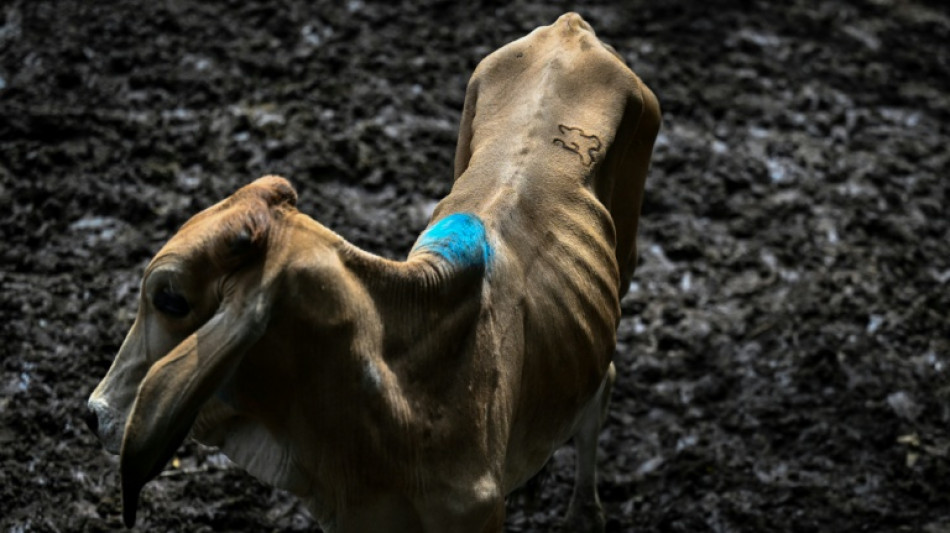
Few buyers for starving cattle in El Nino parched El Salvador / Photo: © AFP

Death stalks a livestock market in El Salvador, where starving cows with protruding ribs are on sale for cheap due to a severe drought fueled by El Nino.
Haggling begins early at Sensuntepeque market, 80 kilometers (49 miles) from the capital San Salvador in the Central American Dry Corridor, an arid zone stretching from Mexico to Panama.
The owners of the cattle are desperate to get some money for their animals before they die of hunger.
"Imagine how thin this little animal is! Why? Because of a lack of grass," Antonio Aguilar, a 54-year-old cattle rancher, told AFP, pointing to a cow reduced to skin and bones.
The Salvadoran Cattle Ranchers Association told AFP that around 60 percent of the sector is battling a severe drought as an Super El Nino powers record global heat.
The impact is most keenly felt in the Dry Corridor, which is highly vulnerable both to climate change and El Nino, a natural climate disrupter that is particularly extreme this year.
In the absence of grass, farmers have to fork out significant amounts of money on feed to keep their animals alive.
The demand for food supplements has pushed up prices: a year ago, a load of corn weighing about 1.5 tons for cattle cost about $500, but now is around $900, one rancher said.
"Some have simply sold their animals because they can't afford to keep them," said Aguilar.
The cost of feeding the cattle has eroded their value.
A thin cow, which under normal circumstances might cost about $500, is now worth half that because of how difficult and expensive it will be for the new owner to maintain it, Misael Novoa, a cattle dealer, explained.
Novoa just sold a scrawny cow and her calf, which is still nursing from an udder that produces very little milk for $900.
When he bought the cow, "she was thinner," he said.
For a month he tried to revive her with feed and vitamins, but eventually decided to stop funneling money into her upkeep and sold her at a small profit.
The new owner, Jose Escobar, 48, who has been in the business for 12 years, decided to "take a chance" and invest in her.
He estimated that she will need one to two months of feed and vitamins to "recover" before he can sell her for a higher price, although he acknowledged that his profit may shrink if the drought worsens and he has to spend more on her upkeep.
In the last days of September, sporadic rains fell in Sensuntepeque, but it was insufficient to revive the sunburnt pastures and parched cornfields.
And the forecast for the coming months is not good.
The UN warned that El Nino will continue to intensify before reaching its peak in December.
In the meantime, the ranchers celebrate every drop of rain.
"The hope is that it keeps raining," Novoa says.
B.Carter--ThChM