The China Mail - Nicole weakens to Tropical Storm, threatens NASA launch

USD -
AED 3.672982
AFN 65.999773
ALL 82.398957
AMD 381.501466
ANG 1.790403
AOA 917.000253
ARS 1451.762402
AUD 1.50263
AWG 1.8025
AZN 1.726387
BAM 1.666503
BBD 2.013642
BDT 122.171618
BGN 1.663698
BHD 0.377007
BIF 2960
BMD 1
BND 1.290015
BOB 6.92273
BRL 5.601196
BSD 0.999749
BTN 89.631315
BWP 13.185989
BYN 2.907816
BYR 19600
BZD 2.010685
CAD 1.37391
CDF 2260.000344
CHF 0.792305
CLF 0.023196
CLP 909.979902
CNY 7.04095
CNH 7.031755
COP 3806.3
CRC 498.36831
CUC 1
CUP 26.5
CVE 94.449864
CZK 20.70195
DJF 177.719968
DKK 6.354801
DOP 62.599594
DZD 129.703053
EGP 47.455201
ERN 15
ETB 155.349934
EUR 0.85091
FJD 2.289502
FKP 0.750114
GBP 0.742855
GEL 2.68499
GGP 0.750114
GHS 11.480017
GIP 0.750114
GMD 73.500185
GNF 8685.999704
GTQ 7.660619
GYD 209.163024
HKD 7.77985
HNL 26.349802
HRK 6.406699
HTG 130.901562
HUF 330.670496
IDR 16772.65
ILS 3.200198
IMP 0.750114
INR 89.629503
IQD 1310
IRR 42100.00025
ISK 125.870426
JEP 0.750114
JMD 159.578049
JOD 0.709026
JPY 156.930993
KES 128.902706
KGS 87.449794
KHR 4010.999985
KMF 418.999977
KPW 899.999969
KRW 1478.420212
KWD 0.307301
KYD 0.833142
KZT 515.528744
LAK 21635.000287
LBP 89600.000229
LKR 309.526853
LRD 177.502199
LSL 16.75963
LTL 2.95274
LVL 0.60489
LYD 5.424997
MAD 9.13875
MDL 16.926118
MGA 4547.509247
MKD 52.349809
MMK 2100.312258
MNT 3551.223311
MOP 8.011554
MRU 39.760473
MUR 46.15009
MVR 15.459721
MWK 1737.000062
MXN 17.981235
MYR 4.077797
MZN 63.898309
NAD 16.760224
NGN 1460.210219
NIO 36.699323
NOK 10.116765
NPR 143.404875
NZD 1.725225
OMR 0.3845
PAB 0.99977
PEN 3.365991
PGK 4.25025
PHP 58.809502
PKR 280.300677
PLN 3.586545
PYG 6755.311671
QAR 3.640984
RON 4.329702
RSD 99.920073
RUB 78.79999
RWF 1452
SAR 3.750101
SBD 8.146749
SCR 14.01211
SDG 601.504736
SEK 9.23419
SGD 1.28857
SHP 0.750259
SLE 24.050362
SLL 20969.503664
SOS 571.498
SRD 38.406502
STD 20697.981008
STN 21.3
SVC 8.748333
SYP 11058.38145
SZL 16.759962
THB 31.140236
TJS 9.197788
TMT 3.5
TND 2.914934
TOP 2.40776
TRY 42.813845
TTD 6.796861
TWD 31.489498
TZS 2485.981009
UAH 42.082661
UGX 3602.605669
UYU 39.187284
UZS 12002.503331
VES 282.15965
VND 26340
VUV 120.603378
WST 2.787816
XAF 558.912945
XAG 0.014588
XAU 0.000225
XCD 2.70255
XCG 1.801846
XDR 0.695829
XOF 558.502172
XPF 102.250112
YER 238.4008
ZAR 16.72425
ZMK 9001.201156
ZMW 22.594085
ZWL 321.999592
  • RIO

    1.5750

    79.895

    +1.97%

  • BTI

    0.1700

    56.62

    +0.3%

  • CMSC

    -0.0100

    23.16

    -0.04%

  • SCS

    0.0200

    16.14

    +0.12%

  • BP

    0.2700

    34.21

    +0.79%

  • BCE

    -0.2750

    22.565

    -1.22%

  • CMSD

    -0.0500

    23.2

    -0.22%

  • AZN

    0.1350

    91.495

    +0.15%

  • GSK

    -0.0800

    48.53

    -0.16%

  • NGG

    0.0850

    76.195

    +0.11%

  • RYCEF

    -0.1100

    15.5

    -0.71%

  • RBGPF

    0.7800

    81

    +0.96%

  • JRI

    0.0100

    13.39

    +0.07%

  • VOD

    0.0050

    12.845

    +0.04%

  • BCC

    -0.5600

    74.21

    -0.75%

  • RELX

    0.2400

    40.97

    +0.59%

Nicole weakens to Tropical Storm, threatens NASA launch
Nicole weakens to Tropical Storm, threatens NASA launch / Photo: © AFP

Nicole weakens to Tropical Storm, threatens NASA launch

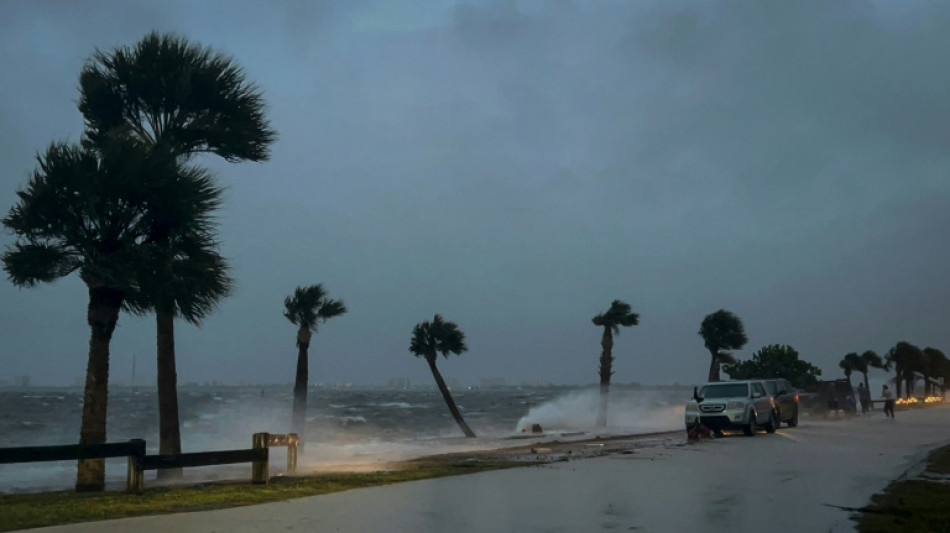
Tropical Storm Nicole slowed after making landfall in the US state of Florida, meteorologists said Thursday, with high winds raising concerns that a long-delayed NASA rocket launch could be disrupted.

Text size:

The storm, a rare occurrence this late in the year, sparked mandatory evacuation orders just weeks after Florida was battered by Hurricane Ian.

But just an hour after Nicole made landfall as a Category 1 hurricane it was downgraded to a Tropical Storm, the US-based National Hurricane Center (NHC) said in a statement Thursday.

The NHC said Nicole was packing sustained maximum winds of up to 70 miles (110 kilometers) per hour and heading towards Georgia and South Carolina, which would also be affected.

The storm could also possibly hit Ohio, Pennsylvania and New York later in the week, it said.

Nicole passed over the Bahamas on Wednesday, with the level of destruction not immediately clear.

A tropical storm warning was issued for Florida's eastern coast from the city of Boca Raton to the boundary between Flagler and Volusia counties, the NHC said.

"Strong winds, dangerous storm surge and waves, and heavy rains continue over a large area," it said.

Forty-five of the state's 67 counties were under a state of emergency, Governor Ron DeSantis said, while four counties were under mandatory evacuation orders, according to the state's Division of Emergency Management.

More than 100,000 customers in the affected areas were without electricity, according to PowerOutage.us.

In preparation for the storm's impact, DeSantis said 16,000 people had been recruited to respond to power outages and 600 national guardsmen had been activated.

The death toll from Ian, one of the most powerful storms ever to hit the United States, stands at more than 100 in Florida alone.

- NASA launch delay -

Nicole has also raised concerns that a long-delayed NASA rocket launch could be disrupted again.

The storm is heading towards NASA's Kennedy Space Center, located near Florida's eastern city of Orlando, having already disrupted plans to launch the agency's most powerful rocket next week.

The Artemis 1 mission had been due to launch on November 14, but NASA said on Tuesday it would be delayed to November 16.

A backup launch date has been set for November 19.

NASA said it would leave the giant 322-foot (98-meter) SLS rocket on the launch pad, where it had been placed several days before.

Experts have voiced concern that the rocket, which is estimated to cost several billion dollars, could be damaged by debris from the hurricane if it remains exposed.

After two launch attempts were scrubbed this summer because of technical problems, the rocket had to be returned to the Vehicle Assembly Building to protect it from Hurricane Ian.

The uncrewed mission aims to bring the United States a step closer to returning astronauts to the Moon five decades after humans last walked on its surface.

F.Jackson--ThChM