Contaminated soil landslide threatens Danish village / Photo: © AFP

A small hamlet in the west of Denmark is facing an unusual existential threat: a landslide of contaminated waste that is bearing down on the community and a nearby river.
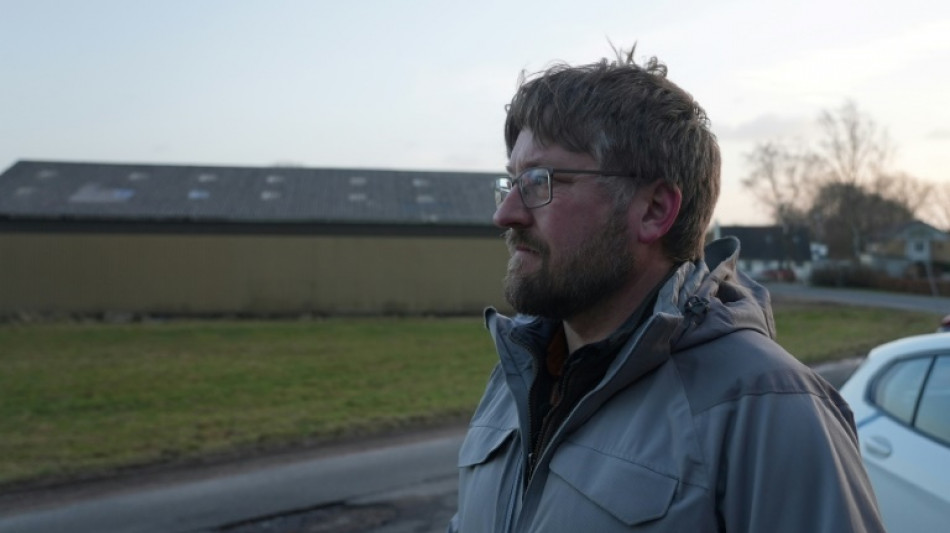
"It's three to six million cubic metres of soil, clay, and polluted dirt coming down from that hill, and it's all placed there by the company that was there," fumes Jan Kristian Jensen, a 47-year-old resident of Olst.
The woes began on December 11 for the village, a close-knit community of 45 tidy brick homes.
That's when Nordic Waste, which specialises in cleaning up contaminated soil, said the land was sliding at its hillside facility near the Alling river.
The company blamed heavy rainfall after the wettest year on record in Denmark.
The site's waste comes mainly from Denmark's mink farms, which were ordered to shut down during the Covid-19 pandemic, as well as some imported waste from Norway.
The problems rapidly escalated.
With the soil initially advancing by nine to 10 metres (30 to 33 feet) a day, pressure from the moving ground caused a secondary road to give way.
All of Nordic Waste's buildings but one then collapsed, as the mud flowed freely.
A square-kilometre perimeter was erected around the site and the road was closed to traffic.
Eight days after its announcement, Nordic Waste abandoned its efforts to contain the mess.
The nearby municipality of Randers swiftly jumped in to take over.
"We had to tell contractors to keep working with their big machines at the site to avoid everything being contaminated," the mayor of Randers, Torben Hansen, told AFP.
His top priorities were to protect the local river from being polluted and prevent Olst from being wiped off the map.
So far he seems to have succeeded, with daily soil and water samples showing no signs of pollution.
- Who will pay? -
But the area now resembles an enormous construction site, and several large basins have been created to collect rainwater.
The mayor is furious with Nordic Waste, and the Randers municipality does not want to finance the cleanup.
"In the first weeks, the municipality spent 100 million kroner ($14.4 million) and now we want the company to pay," Hansen said.
The company, which was declared bankrupt on January 22, is a subsidiary of the USTC holding company owned by billionaire Torben Ostergaard-Nielsen, one of Denmark's richest men.
"Everything was carefully controlled, and we never operated without the required authorisations," said Nina Ostergaard Borris, the head of USTC.
An engineering service consultancy, Cowi, has estimated the cleanup cost at 2.2 billion kroner, insisting on the importance of ongoing work to build dykes to protect the village from an "avalanche of mud".
The Danish parliament has already allocated 205 million kroner.
"If nothing was done, within one to two years our whole city ... would be covered by five to 10 metres of dirt," said Jensen, citing a Cowi report. "It took us a few days to digest that."
Neither Jensen nor his neighbours imagined they would ever be affected by such a catastrophe.
- 'Could have been prevented' -
According to geologist Kristian Svennevig of the Geological Survey of Denmark and Greenland (GEUS), "this type of landslide is completely unique in Denmark" -- and totally the result of human activities.
"In the public discourse the landslide was caused by this very wet 2023. But we can see that it started way back in 2021," a "relatively dry" period, he said.
"It's not caused by climatic factors. It is in fact caused by the landfill itself, that the soil is being put in this old clay pit," he said.
At the onset, the land movements were small and went unreported.
"Had the decision-makers working with it had the level of knowledge that we have now, we could have prevented it by not putting the landfill there," Svennevig said.
"As the landslide was progressing, mitigation could have been initiated to stop it."
At the end of January, Jensen and his neighbours were allowed to visit the site.
"Our understanding is... that we will not be covered" in waste, he said, relieved.
But questions remain.
"Is it safe to stay here? What is in the dirt?" Jensen asked.
The government has opened an inquiry to determine responsibility.
B.Chan--ThChM