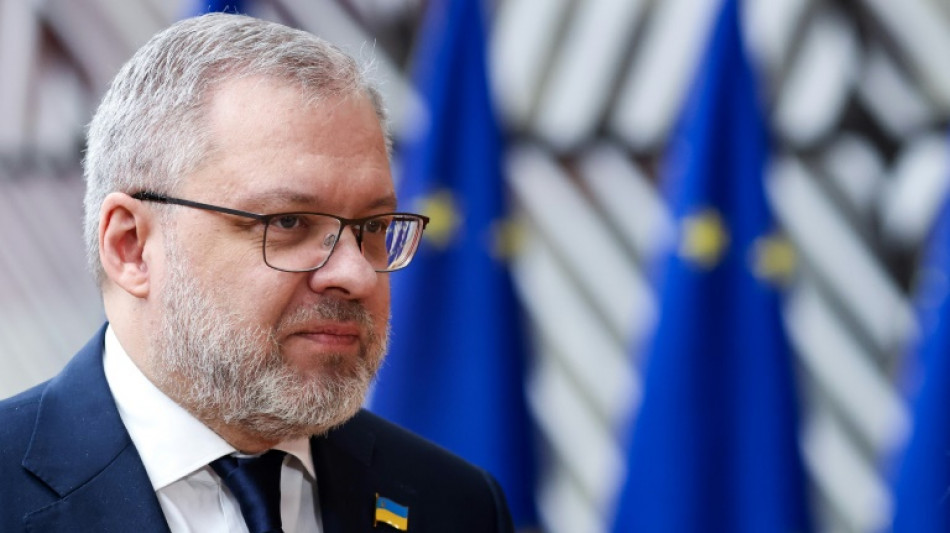
Russian invasion catalyst for renewables in Ukraine: minister / Photo: © AFP/File

The wartime destruction of its coalmines and several of its power plants are proving a catalyst for Ukraine's renewable energy transition, said the country's Energy Minister German Galushchenko.
Ukraine is also looking to replace some of its lost nuclear energy production, he added.
The minister said moves towards wind and solar power, coupled with the war's impact on classic energy infrastructure, means that "the green transition should be implemented faster than we expected."
Russian forces have destroyed 11 coalmines, which they did to weaken Kyiv's capacity to produce energy, Galushchenko told AFP on the sidelines of an IEE energy summit this week in Paris.
"Of course we would never restart the operations, that's obvious," said Galushchenko. "We understand that we will never repair" the destroyed facilities.
Ukraine has eight power plants in non-occupied territory that can run on coal or natural gas, of which three have been knocked out of action.
"We want to phase out coal of course" for climate protection reasons said Galushchenko.
"Transition will happen faster that expected due to war," he added.
The immediate focus is on wind and solar farms.
Galushchenko said last year Ukraine constructed around 200 megawatts of wind and around 150 megawatts of solar power capacity.
Even if "it's not a big amount, I can say that this is due to the war," he said.
Ukraine is also looking to rebuild nuclear power to compensate for production it lost from Zaporizhzhia, Europe's largest nuclear power plant, since Russian forces occupied the facility in 2022.
That would, Galushchenko said, involve buying two Russian VVER-1000 reactors stored in Bulgaria, initially earmarked for the Belene nuclear power plant decommissioned as a precondition for Bulgaria joining the European Union.
Two AP-1000 type pressurised water reactors would also, he said, come from US nuclear power company Westinghouse for deployment at Khmelnytskyi, in western Ukraine.
Yet some experts are sceptical as to whether that project is viable as new reactors would take at least a decade to come on stream while there are worries the reactors in Bulgaria may prove to be too old.
Galushchenko said expanding nuclear production would also open up possibilities for Ukraine to supply Europe with green hydrogen.
Hydrogen is being looked at as a fuel that could help decarbonise industry and transport as it produces no carbon dioxide when burned, and is green provided it is produced using renewable or nuclear power.
Ukraine has "calculated it will be able to produce three to five million tonnes of hydrogen per year," Galushchenko said.
"The one question is how to transport this hydrogen … that is the most difficult question."
Galushchenko said Ukraine's electricity network was faring better this winter than last year.
"It's not the same as it was before the previous winter... when we were under almost constant restrictions. Generally, we do not have restrictions in supply of electricity," he said.
Ukraine can produce up to 18 gigawatts of electricity, he said, which is enough to handle even peak hours of consumption.
And even if Kyiv has had at times to import electricity, international support has enabled it to get by more or less.
With the end of winter approaching they may get through the most demanding season without major restrictions for consumers.
"It's great news, and due to this we also have a growth in the economy," said the minister.
U.Chen--ThChM