Wind-powered Dutch ship sets sail for greener future / Photo: © AFP

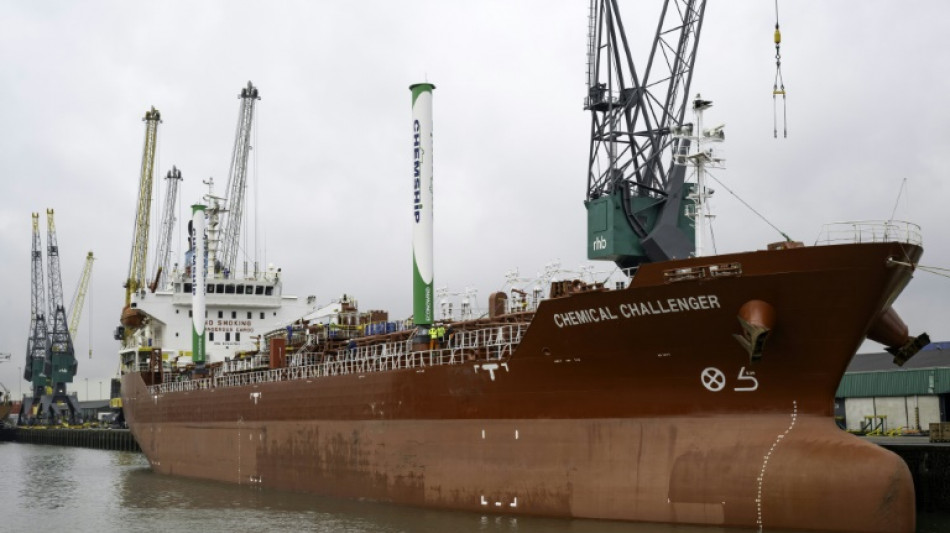
The world's first chemical tanker ship fitted with massive rigid aluminium "sails" has left Rotterdam, its owner hoping to plot a route to bringing down the shipping industry's huge carbon footprint.
The MT Chemical Challenger, a 16,000-tonne chemicals transporter set sail from Antwerp for Istanbul on Friday, and will undergo sea trials along the way.
Built in Japan and kitted out with four giant 16-metre-high (52 foot, 6 inch) sails similar to aircraft wings, the tanker's owners hope to cut fuel consumption by 10 to 20 percent as the sails will allow the ship's captain to throttle back on the engine.
"As an avid sailor myself, I have been thinking for a long time how we can make our industry more sustainable," said Niels Grotz, chief executive of Chemship, which operates a fleet of chemical tanker vessels mainly between US ports in the Gulf of Mexico and the eastern Mediterranean.
"Today we launch our first wind-assisted chemical tanker, which we hope will serve as an example to the rest of the world," Grotz told AFP at the ship's unveiling.
Global shipping -- which burns diesel and other bunker fuels -- contributed around 2.0 percent of the world's carbon emissions in 2022, the International Energy Agency said.
New guidelines by the International Maritime Organisation said shipping emissions needed to be cut by at least 40 percent by 2030 and down to zero by around 2050 if the Paris Climate Accords are to be achieved.
"Shipping has always been extremely competitive and it will be a struggle to reach these targets," admitted Grotz, who added the company was unlikely to "make money" on its latest project.
"But we have to bring down CO2 emissions -- and we decided we're not just going to sit and wait for something magical to happen."
"With the sails on this ship we're expecting a yearly reduction of some 850 tonnes. That's the same output as around 500 cars annually," Chemship added in a statement.
- Pulling power -
Grotz said the project to put sails on one of his chemical tankers -- with others to follow -- came when he and Dutch company Econowind, which specialises in building wind propulsion systems for ships, first put their heads together three years ago.
Last week the installation of the four sails was completed while the Chemical Challenger lay dockside in Rotterdam's massive sprawling harbour.
Although not the first modern ship to be kitted out with rigid sails -- last year British firm Cargill put a wind-assisted cargo ship to sea for instance -- Chemship said their Chemical Challenger is the world's first chemical tanker ship with sails.
Built similar to an aeroplane wing, the rigid aluminium sails are equipped with a system of vents and holes to maximise airflow in winds of up to 61 kilometres (33 knots, 38 miles).
"This system called a 'ventilated wingsail' increases the wind's power by five times -- and gives the same power as an imaginary sail of around 30 by 30 metres," said Rens Groot, sales manager at Econowind.
- 'Modern day sailors' -
Groot told AFP the installation of modern-day rigid sails on massive ships harked back to a time when sailing was the only way to move across the oceans.
Sails on ships are also reopening long-forgotten routes that fell out of favour as steam and fuel replaced wind power.
"Once again, modern-day 'sailors' will have to look for the wind, for instance along the Brouwer route," Groot said, referring to a sailing route around the Cape of Good Hope, first pioneered by Dutch explorer Hendrik Brouwer around 1611.
That route dips into the so-called "Roaring Forties" across the Indian Ocean before snaking north again along the Australian west coast to Asia.
It became compulsory a few years later for captains employed by the Dutch East India company on their way to the Netherlands' colonies in today's Indonesia.
"We are trying to find a way to bring nature back into technology," said Groot.
"Suddenly, you can feel a ship sailing again -- just like in the olden days," Groot said.
E.Lau--ThChM