
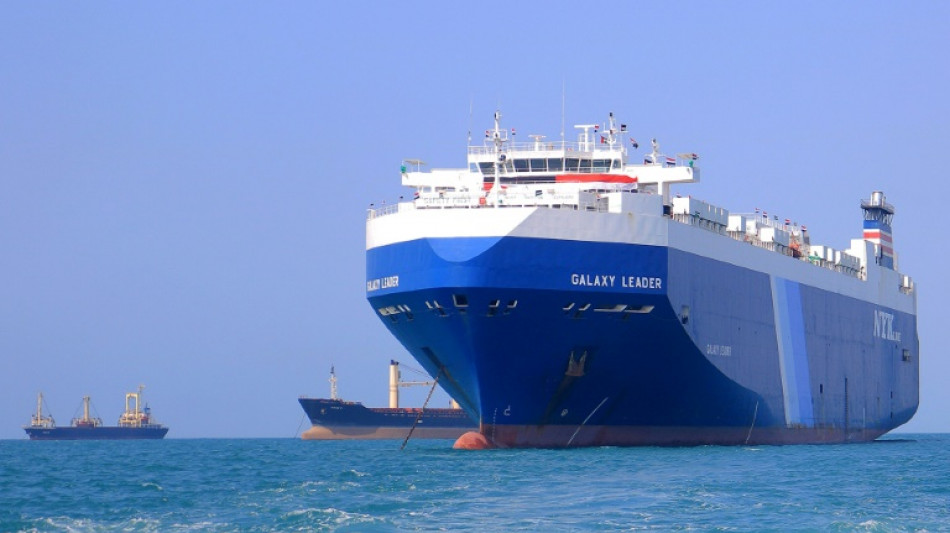
Shipping insurance rates soar on Red Sea missile attacks / Photo: © AFP

Attacks by Yemen's Huthi rebels on commercial ships in the Red Sea have sent insurance premiums surging, exacerbating costs already stretched by soaring freight rates and longer alternative trade routes.
The Huthis have carried out relentless attacks since November on shipping transiting the Red Sea, a maritime hub through which 12 percent of global trade usually passes.
Maritime container transport has sunk by almost one third so far in 2024 compared with a year earlier, according to IMF data.
The Iran-backed Huthis argue the attacks are in solidarity with Palestinians in Gaza during the Israel-Hamas conflict.
The war started when Hamas launched its attack on October 7, which resulted in the deaths of about 1,160 people in Israel, mostly civilians, according to an AFP tally of official Israeli figures.
Hamas militants also took about 250 hostages -- 130 of whom remain in Gaza, including 30 presumed dead, according to Israel.
Israel's retaliatory campaign has killed at least 29,313 people, mostly women and children, according to the latest count by the Hamas-run health ministry in the territory.
- 'Unusual, not exceptional' -
Commercial boats need to obtain three types of insurance. Hull insurance covers damage to the vessel; cargo insurance covers the vessel's load; and protection and indemnity insurance includes coverage for damage caused to third parties.
Premiums for ships and their cargos have "increased significantly" following the Huthi attacks, according to Frederic Denefle, head of Garex, a French firm specialised in marine risk insurance.
And they have increased in proportion to the threat level, he told AFP.
The Red Sea threat is unusual but not exceptional, according to Neil Roberts, head of marine and aviation at the Lloyd's Market Association (LMA), which represents all underwriting businesses on the Lloyd's of London insurance market.
"The Red Sea situation is both dynamic and unusual in the respect that a non-combatant country is targeting commercial shipping to achieve a political aim in a third country," Roberts told AFP.
"It is not exceptional because, unfortunately, commercial shipping regularly comes under threats, whether in West Africa, off Somalia or elsewhere."
The Red Sea is a Listed Area, meaning that vessels planning to enter have to notify their insurers, he noted.
Insurance providers can then review both the vessel and its voyage, and can demand an extra war premium on top of normal coverage.
This war premium however is limited to a short period of time.
- Danger assessment -
The LMA's Joint War Committee gathers regularly to assess security risks to shipping worldwide.
"If you're trading into an area where this committee says that this is a bit dangerous, effectively cover ceases as soon as you go in, and then you have to pay for that period while you're in it, and then it reattaches when you get out," said Marcus Baker, global head of marine, cargo and logistics at Marsh.
Claire Hamonic, general manager of Ascoma International, estimated that the war insurance premium has multiplied by between five and ten times for vessels and cargo crossing the Red Sea.
According to several anonymous industry sources, the current rate of war risk premium stands at between 0.6 percent and 1.0 percent of the value of the ship.
That can equate to a considerable sum when some of the enormous vessels are worth in excess of 100 million euros.
Added to the picture, particular attention is given to the nationality of a ship, according to Munro Anderson, head of operations at war insurance specialist Vessel Protect.
"The Huthis have specifically said that they're targeting US and UK connected vessels," Anderson told AFP.
"There's a number of vessels that are flagged or associated to countries that simply don't carry the same risk profile.
"For example, Chinese connected vessels. Hong Kong Chinese connected vessels, of which there are lots, are trading in that area. Those will be able to add less premium than those connected with Israel, UK and US."
- Coast not yet clear -
The Huthi strikes have also prompted some shipping companies to detour around southern Africa to avoid the Red Sea.
This takes between 10 and 15 more days than the Red Sea route -- and it can take 20 extra days for a slow ship.
Shipowners doing so can avoid paying significant toll fees in the Red Sea, but they also face higher fuel and labour costs for the longer trip.
And the coast is still not clear from other risks like piracy.
The diversion of ships around the Cape of Good Hope could "very possibly lead to a resurgence in piracy in the Indian Ocean", warned Hamonic.
"That risk extends from just below the Red Sea and towards the coast of Somalia," she added.
B.Carter--ThChM



