
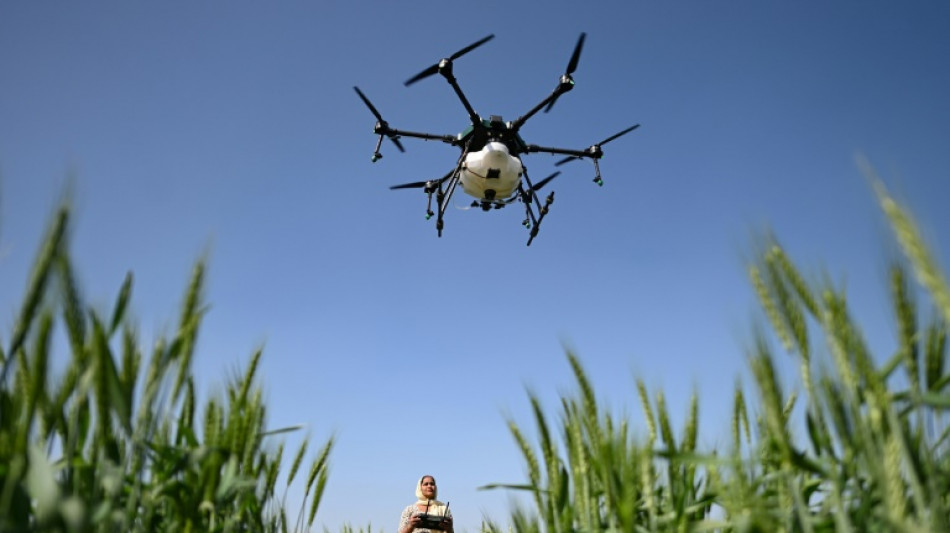
India's 'drone sisters' steer farming and social change / Photo: © AFP

Once a housewife in rural India, Sharmila Yadav always wanted to be a pilot and is now living her dream remotely, flying a heavy-duty drone across the skies to cultivate the country's picturesque farmlands.
Yadav, 35, is among hundreds of women trained to fly fertiliser-spraying aircraft under the government-backed "Drone Sister" programme.
The scheme aims to help modernise Indian farming by reducing labour costs, as well as saving time and water in an industry hamstrung by its reliance on outdated technology and growing climate change challenges.
It is also a portent of rural India's changing attitudes towards working women, who have traditionally found few opportunities to join the labour force and are often stigmatised for doing so.
"Earlier, it was difficult for women to step out of the house. They were supposed to do only household chores and look after the children," mother-of-two Yadav told AFP, after a day's work crisscrossing a drone through the clear blue sky above a lush green field of young wheat stalks.
"Women who went out for work were looked down upon. They were taunted for neglecting their motherly duties. But now mindsets are changing gradually."
Yadav was a homemaker for 16 years after marrying her farmer husband, with few job opportunities for women in her small rural hamlet near the town of Pataudi, a few hours' drive from the capital New Delhi.
She will pocket 50,000 rupees ($600) after spraying 150 acres (60 hectares) of farmland twice over five weeks, a little over double the average monthly income in her native Haryana state.
But she said her new occupation was not just a "source of income" for her."I feel very proud when someone calls me a pilot. I have never sat in a plane, but I feel like I am flying one now," she said.
- Patriarchal attitudes -
Yadav is among the first batch of 300 women trained by the Indian Farmers Fertiliser Cooperative Limited (IFFCO), the largest manufacturer of chemical fertilisers in the country.
The women trained as pilots are given the 30-kilogram (66-pound) drones for free, along with battery-run vehicles to transport them.
Other fertiliser companies have also joined the programme, which aims to train 15,000 "drone sisters" across the country.
"This scheme is not just about employment but also empowerment and rural entrepreneurship," Yogendra Kumar, the marketing director of IFFCO, told AFP.
"Women, who earlier could not step out of their houses owing to deep-rooted patriarchal attitudes and lack of opportunities, are coming forward with enthusiasm to take part," he told AFP.
"They are now able to meet the household expenses on their own without depending on others."
Kumar said that spraying fertiliser by drone was cost-effective, used less water and took a fraction of the time of manual spraying.
"One acre can be sprayed in just five to six minutes," he said.
A little over 41 percent of rural Indian women are in the formal workforce compared to 80 percent of rural men, according to a government survey last year.
Prime Minister Narendra Modi, who has championed the scheme and mentioned it in his annual Independence Day address last August, said he was pleased to see women at the forefront of a revolutionary new farming practice.
"Who would have thought until a few years ago that in our country women living in villages too would fly drones? But today this is becoming possible," he said in a radio programme last month.
- 'My own two feet' -
Women have to pass an interview before they are enrolled in the programme.
They then sit a written test after a weeklong theory course before another week of practical training.
In one of the classrooms welcoming a fresh batch of pilots, 23-year-old Rifat Ara said she was initially apprehensive about enrolling.
But once she learned the ropes, she said there was no looking back.
"I feel I can now earn something and also teach other women how to fly," she told AFP.
"It's a great feeling to be able to stand on my own two feet and be called a drone pilot."
Nisha Bharti, an instructor for training school Drone Destination, said she had been heartened by watching the transformation of her pupils as they mastered their craft.
"When they first come here from the villages, they are so nervous. But by the time they finish the course, they become super confident," she said.
"It is as if they grow wings and want to fly higher and higher."
H.Au--ThChM



