
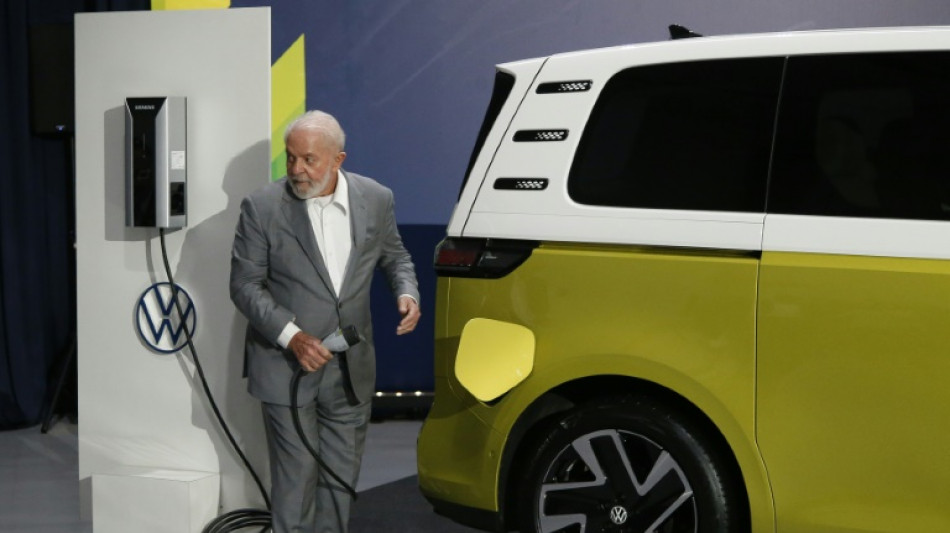
Brazil revs up for jolt of hybrid car investments / Photo: © AFP/File

Brazil is charging up for a hybrid revolution as global car manufacturers race to pump billions of dollars into the development of green vehicles in Latin America's biggest economy.
Globally, hybrid cars sales are booming, offering consumers fuel savings, sustainability, and the assurance that they won't find themselves stranded far from a public charging station in a fully electric vehicle.
Brazil, with its population of over 200 million people, is seeking to incentivize the local production of less polluting vehicles, and automobile giants are raring to go.
This month, Stellantis -- which owns several major car brands, with electrified Jeep, Peugeot, and Fiat products -- vowed "the biggest (investment) in the history of the Brazilian and South American automobile sector."
The company said it would invest $6.1 billion in the region between 2025 and 2030, of which Brazil would be the biggest beneficiary.
Toyota, which has bet bigger on hybrids than fully electric cars, announced it would pump $2.2 billion into Brazil until 2030.
Other big names such as Volkswagen, Renault, Nissan, General Motors, BYD and Hyundai have also announced plans to produce electric and hybrid vehicles in the country.
The National Association of Motor Vehicle Manufacturers (Anfavea) estimates Brazil will receive about $23.4 billion in automobile investment in the coming years.
Anfavea president Marcio de Lima Leite said there was "zero coincidence" that the investments were flowing in and would largely center on hybrids -- which combine a battery-powered electric motor with an internal combustion engine.
The flurry of activity comes after the government announced it would "gradually increase import taxes for these new technologies" to incentivize domestic production of electric or hybrid vehicles.
President Luiz Inacio Lula da Silva also recently created a program granting 3.8 billion dollars in tax credits to automakers that commit to "investing in decarbonization."
- 'A transitional model' -
"These investments mark a turning point, not only in terms of the amounts, but also for all the changes that this will bring about in the sector," Cassio Pagliarini of the Bright Consulting firm told AFP.
According to him, the hybrid is "a transitional model." Brazil cannot yet afford to massively switch to all-electric, "because the batteries are still too expensive."
Furthermore, "the government does not have the means to pay significant subsidies" to consumers as European countries do.
There are also significant logistical challenges to installing public charging stations in the fifth-biggest country in the world.
Instead, Brazil prefers to stimulate the production of hybrid vehicles that run on electricity and the ethanol made from sugarcane that is widely used to fuel cars in the country.
Stellantis, Toyota, Volkswagen and BYD have all said they will invest in hybrids that run on ethanol.
"Brazilian ethanol is a low-carbon fuel, which can be produced in already existing areas, without resorting to deforestation," said David Tsai of the Institute for Energy and Environment, an NGO.
But, he believes, rather than granting tax credits to car manufacturers, "it would be more interesting to invest massively in green public transport."
- Electrified cars gaining ground -
According to the latest census in 2022, there were about 60 million cars on the streets in Brazil. Less than 0.5 percent were electrified in 2023, according to data from Bright Consulting.
However, electrified car sales doubled between 2022 and 2023, according to figures from the Brazilian Electric Vehicle Association (ABVE).
Pagliarini predicts electrified vehicles could "represent more than half of sales by 2029," but only "20 to 25 percent will be 100 percent electric."
Carlos Tavares, CEO of Stellantis, said it was essential that these vehicles be "accessible to the middle class."
"Otherwise, there is no impact on the planet," he told a press conference.
B.Chan--ThChM



