
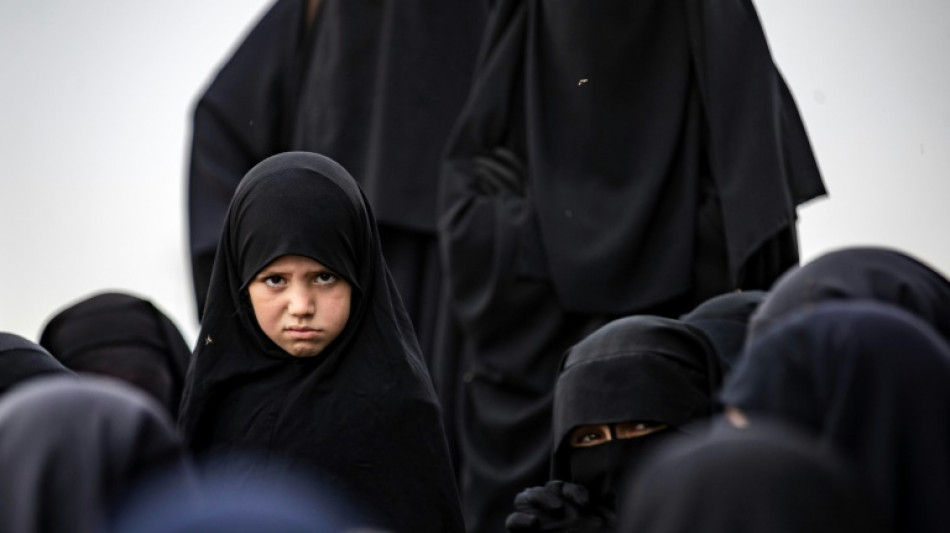
Sins of the fathers: Children of IS left to rot in Syria camp / Photo: © AFP

Ali is 12 and has survived things no child should see, spending half his life in what amounts to a prison camp for jihadist families in an arid corner of northeastern Syria.
He knows not to dream of freedom. Instead he fantasises about having a football. "Can you get me one?" he said, as if he was asking for the Moon.
Five years after the fall of the Islamic State group's brutal "caliphate", tens of thousands of women and children linked to the jihadists are still being held by the US-backed Kurdish forces in camps rife with violence and abuse, with seemingly no clear plan of what to do with them.
More than 40,000 inmates -- half of them children -- are cooped up behind the barbed wire fences and watchtowers of the windswept al-Hol camp run by Washington's Kurdish allies.
The children of the jihadists' failed project live out a grim existence in tattered, tightly packed together tents with little water and limited access to sanitation. Few go to school.
Many have never seen a television or tasted ice cream.
Some boys are taken from their mothers by the guards once they reach 11 in violation of international law, a UN expert found, with the Kurdish authorities claiming it is to stop them being radicalised.
They admit the jihadists still exercise control in parts of the camp through fear, punishments and even murder.
One former inmate told AFP that IS paid pensions to some widows.
Even Ali is old enough to be terrified of them. "They enter tents at night and kill people," he said.
"It's not a life for children... they are paying the price for something they didn't do," an aid worker told AFP.
The al-Hol camp ballooned as the coalition and its allies in the Kurdish-led Syrian Democratic Forces (SDF) closed in on IS's last bastion in eastern Syria, putting an end to their five-year reign of terror marked by beheadings, rapes, massacres and enslavement.
When the extremists were finally defeated in March 2019, families of suspected jihadists were trucked north to al-Hol from the last holdout in Baghouz.
Five years on, dozens of countries are still refusing to take back their nationals with SDF leader Mazloum Abdi -- whose soldiers guard the Western-funded camp -- calling it "a ticking time bomb".
– 'Acute deprivation' -
AFP interviewed IS widows, aid workers, security forces and administration employees in the difficult to access camp, including inside the high-security "annex", the camp within a camp where "foreign" and more radical women and their children from 45 countries are held apart from the "local" Syrians and Iraqis.
Some asked not to be named for fear of what might happen to them.
To complicate matters, some 3,000 men are held with the women and children in the Syrian and Iraqi sector of the camp. Some are ordinary refugees, but suspicion lingers over others detained by Kurdish fighters as the caliphate collapsed.
Not even the guards venture into the rows of tents at night unless they are carrying out a raid.
The huge dusty camp -- first built for refugees fleeing the wars in Iraq and Syria -- dwarfs the nearby town of al-Hol, with its small houses and narrow streets.
Its thousands of white tents are crammed so closely together that it is almost impossible to walk between them without bumping into something.
Privacy is nonexistent, with the communal kitchens and toilets squalid and insufficient, say humanitarian workers who provide some basic services on top of the food aid on which the inmates survive.
Behind the camp's high fences, kids roam dirt roads, bored and frustrated, some throwing stones at visitors. A blond boy blinked at the camera and then drew his finger across his throat to mimic a beheading.
Most children do not go to the makeshift schools. Instead they try to earn a little by carrying water, cleaning or fixing tents for those whose families wire them money.
Others work in the camp's market, or trade their food aid.
"Al-Hol is a suffocating place for children to live and grow-up," said Kathryn Achilles from Save the Children.
They "have endured acute deprivation, bombardment and have now been in the camp for almost five years. They need more," she said.
- 'We'll be left here' -
"How can our children dream if they've never seen the outside world?" a mother of five held in the high-security annex reserved for foreign women and their children told AFP.
Two thirds of the annex's 6,612 inmates are children, according to the camp's administrators.
The 39-year-old gave birth to her youngest child in al-Hol after fleeing Baghouz in 2019 after her husband -- an IS fighter -- was killed there.
Like all of the women in the camp, she was covered head-to-toe in a niqab and black gloves, a thin slit in the face covering showing her wide, dark eyes.
Although the niqab is banned in the smaller Roj camp holding IS members' families close to the Turkish border, women in al-Hol told AFP they would not dare to take it off, fearing punishment from hardliners.
"It is a bitter life, and what's worse, they say we'll be left here," the mother lamented, with the authorities starting to build new sections where each tent will have its own toilet and kitchen.
Jihan Hanan, the head of the camp's civil administration, confirmed that the work was being done "because the camp may be in place for the long term".
She admitted life was "difficult for residents, but it's also difficult for us given the security situation."
- Murder and sexual abuse -
But it is what is happening to the children that most worries humanitarian organisations.
In 2022, two Egyptian girls, aged 12 and 15, were murdered in the annex, their throats cut and their bodies dumped in an open septic tank.
Rana, a Syrian girl, was shot in the face and shoulder in 2022 by armed men who accused her of having a child out of wedlock when she was 18.
"They kidnapped me for 11 days and hit me with chains," she told AFP.
Other children are being sexually abused and harassed, a health worker told AFP. In three months in 2021, she treated 11 cases of child sexual abuse.
Some cases were children abusing other children. "They may not know they are hurting each other," she said, adding that a child who abuses is likely to have been a either a victim of sexual assault or witness to it.
Children in al-Hol have seen or heard murders as well as "shootings, stabbings and strangulations on their way to buy food from the marketplace or while on their way to school," Save the Children said in a 2022 report on the camp.
The trauma triggers sleeping disorders, bed-wetting and aggressive behaviour, it said.
"I try not to let my kids socialise to keep them out of harm, but it is almost impossible because the camp is packed," said Shatha, an Iraqi mother-of-five.
"Every time my kids go out, they come back beaten."
Yet keeping children confined to their tents was tantamount to holding them "in a prison inside a prison", a social worker told AFP.
- 'Coming for my son' -
Every mother AFP spoke to in al-Hol -- particularly those in the annex -- were terrified about their boys being taken from them and sent to "rehabilitation centres" by the guards.
The high-security camp within a camp contains women from 45 countries including France, the Netherlands and Sweden, with large numbers from Turkey, Tunisia, Russia, the Caucasus and the Central Asian republics.
Security forces regularly take boys over 11 from the annex in night raids or sweeps of the marketplace, a policy a UN expert condemned as "forced arbitrary separation".
Zeinab, an Egyptian mother, said her 13-year-old son was taken away from her a year ago. Now she worries it will soon be her 11-year-old's turn.
"I can't sleep at night. When I hear sounds outside, I fear they are coming for my son," she said.
Some mothers hide their boys from the guards in holes and trenches or prevent them from going outside.
"Some boys may have turned 20, but we don't know where they are hiding," a member of the security forces admitted.
Authorities say they take the boys to protect them from "sexual abuse" and a "radicalised" environment.
The Pentagon told AFP that it was aware that some youths were removed "to both youth centres and detention facilities" but said "we keep the well-being of children at the centre of our policies and encourage local authorities to ensure their actions consider the best interests of children."
- IS cells -
Kurdish forces have long warned about IS cells in the camp, with a spike in murders, arson and escape attempts in 2019. Rifles, ammunition and tunnels have also been found in regular security sweeps.
A Syrian woman who fled the camp in mid-2019 recalled how an IS member known as Abu Mohamed would visit widows monthly and pay them $300 to $500.
"He used to come in a security forces uniform and promise that the group will return," she said.
In the annex's squalid marketplace, women pore over the few available pieces of meat through the slits in their niqabs, while others haul away bottles of water and rugs in three-wheeled carts or on makeshift sleds made from cardboard attached to a rope.
Seeing journalists, some raised a gloved index finger to the sky, a gesture frequently used by IS signifying the "oneness of God".
While many women are repentant, others don't hide their continued allegiance to IS.
IS "are still here, and they have a stronger presence in certain sectors of the camp," according to Abou Khodor, a 26-year-old Iraqi man who has been in the camp for seven years.
He complained that diehards from IS's last bastion in Baghouz had "ruined" the camp. But one of the women captured there said it was more complex.
- 'Death does not scare us' -
"There are supporters of IS, and those who have become even worse," she said. Others, however, "don't want anything to do with it anymore."
At a protest over searches in the camp earlier this year, one woman was filmed shouting at the guards, "We are here now but one day it will be you!
"The Islamic State is not going away, even if you kill and beat us... Death does not scare us."
But an Egyptian woman was seen urging calm, saying, "We don't want problems."
Such is the mistrust that some women resist being treated with what they call "Western medicine" leading to outbreaks of disease, most recently of measles.
Women and children in the annex also have to get permission to go to the health centres outside the camp, and it sometimes takes "days, weeks or even months" for less critical cases, according to Liz Harding, head of Doctors Without Borders mission in northeastern Syria.
"Fear, movement restrictions, insecurity and lack of emergency services at night" was cutting them off from care, she added.
Some smuggle in medication and at least one woman performs clandestine dental procedures, which has led to cases of sepsis.
"She doesn't have the tools, but there is no other dental care," a Russian woman complained.
- Huge burden for Kurds -
The grim desperation of the situation weighs heavy on the Syrian Kurds running the camp. Many lost comrades to IS militants whose family members they now have to guard.
"It's a major problem... a burden both financially, politically and morally as well," the head of the Syrian Democratic Forces Mazloum Abdi told AFP.
Humanitarian groups in the camp said children should not have to live in such conditions and insist they should not be defined by their parents' actions.
"Mothers want their children to go to school, to grow up healthily and hope they won't be discriminated against because of all they have experienced," said Save The Children's Achilles.
Kurdish authorities have repeatedly urged countries to repatriate their citizens, but hold out little hope of it happening anytime soon. Hanan, the camp's civilian chief, said many "nationalities have no one asking about them".
Asked by AFP what it plans to do with the women and children, the Pentagon said "the only long-term, durable solution for the residents... is the return or repatriation of displaced persons to their areas or countries of origin."
While Iraq has started slow but successful repatriations, thousands of Syrians are stuck in al-Hol awaiting tribal sponsorship to return to areas under Kurdish control. For now, a return for those from Syrian government-held areas looks impossible.
"We wish everyone could go home," Hanan said. "We don't intend to lock anyone up and leave them."
But it was little comfort to a Russian mother of two who told AFP she felt the world had abandoned her and her children.
"There is no place to go. There is no solution," she said.
I.Ko--ThChM



