
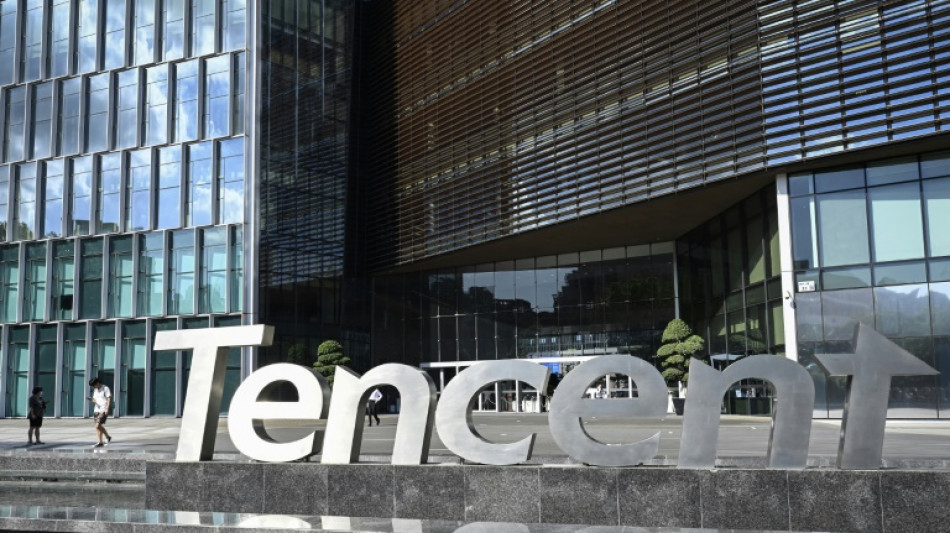
Chinese internet giant Tencent posts lowest annual profit since 2019 / Photo: © AFP/File

Chinese internet giant Tencent on Wednesday posted its lowest annual profit since 2019, despite slight improvements recently in China's economy and a more lenient attitude taken by regulators towards the tech sector.
Tencent's total net profit for 2023 stood at 115.2 billion yuan ($16.0 billion), according to a filing of annual results at the Hong Kong Stock Exchange.
Decades of meteoric growth that turned China's tech industry into one of the most dynamic in the world came to an abrupt halt in 2020, when Beijing introduced more stringent oversight measures.
Authorities have since relaxed their approach to regulating the vital domestic tech sector as broader concerns about the health of China's economy mount.
Tencent -- one of the world's leading gaming firms and developer of China's ubiquitous messaging and services app WeChat -- announced Wednesday 609.0 billion yuan ($84.6 billion) in total revenue in 2023, up 10 percent year-on-year.
The Shenzhen-based firm also announced plans to increase the size of its share repurchasing scheme, more than doubling in 2024 from last year to "over HKD100 billion" ($12.8 billion), the filing said.
In 2022, Tencent saw its annual profit fall 16 percent on the heels of a fresh crackdown by officials on video game addiction among youth.
And despite more recent signs of vigour in the sector, the regulatory hurdle for new games remains "relatively large", Li Chengdong, founder of Beijing-based tech consultancy Dolphin, told AFP.
New games in China must first obtain formal approval from authorities before being released.
The issuance of all new game licences was frozen for nine months in 2021, and approvals have not since returned to the speed and reliability of previous years.
"Even if (Tencent) develops new games, there's no guarantee it can distribute them," Li said.
Tencent and several of its domestic competitors -- including Alibaba, Huawei and Baidu -- are now eyeing the promising field of artificial intelligence (AI).
Last September, Tencent unveiled Hunyuan, an AI-powered chatbot intended to compete with the US's ChatGPT, whose services are not accessible in China.
Wednesday's filing hailed Hunyuan as a "top-tier foundation model with superior performance in numerical reasoning, logical inference, and multi-turn conversations".
But despite the push into AI, gaming still represents Tencent's most important business, Li told AFP, adding that "in the short term, there's not much expectation that the revenue from AI products could cover the costs".
As many Chinese tech giants rush into AI, Tencent remains cautious about making big moves, Beijing-based tech expert Kevin Zhou told AFP.
"(Tencent is) slower in pouring investment and could be up to one or two years behind the first movers," Zhou said.
The firm is seeking to enhance its position in the video games sector by acquiring stakes in emerging studios, particularly in Europe.
Tencent, founded in 1998 in the midst of China's rapid economic development, is a key player in the country's tech sector as the parent of the WeChat "super-app".
WeChat is on most mobile phones in China, where it is used for a wide range of purposes including messaging, calling, digital payment and social media.
I.Ko--ThChM



