
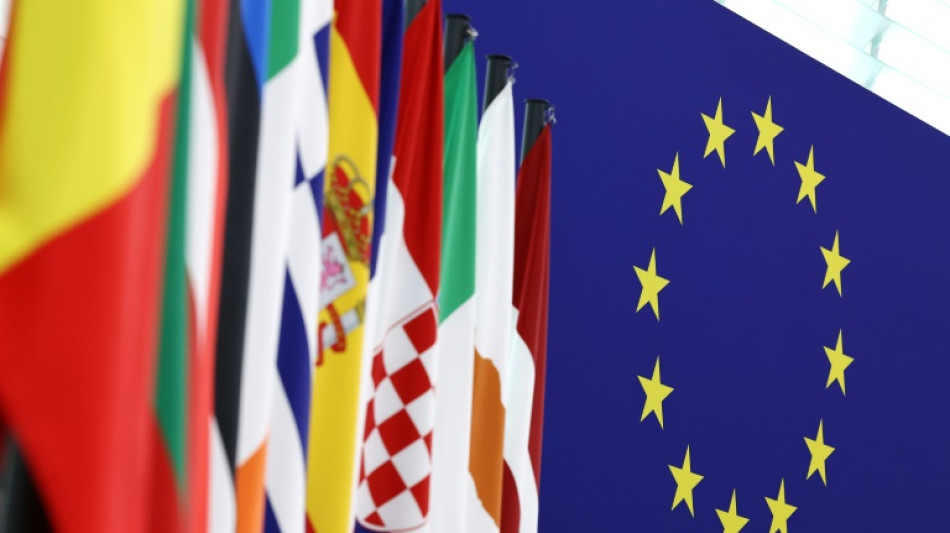
French deficit worsens to 'very rare' level / Photo: © AFP/File

France's budget deficit overshot forecasts in 2023, official figures showed Tuesday, undermining President Emmanuel Macron's pledge to bring national finances back on track within the next four years.
The public deficit jumped to 5.5 percent of gross domestic product, or 154 billion euros ($167 billion), statistics agency INSEE said.
The slippage was "major" and "very, very rare" in French budgetary history, said Pierre Moscovici, the head of the Cour des Comptes (Court of Accounts), France's top audit institution tasked with watching over fiscal responsibility.
The government had already warned over recent weeks that it would not meet its own deficit estimate of 4.9 percent of GDP, citing the global economic slowdown and the war in Ukraine as key factors.
Fiscal receipts had turned out much worse than forecast last year, the government said Tuesday.
France has announced 10 billion euros of spending cuts to meet its deficit target for this year of 4.4 percent of GDP.
"The deficit has gone wild," said Marc Touati, an economist, on X, formerly Twitter, calling the worsening of public finances "dangerous".
French Economy Minister Bruno Le Maire said Tuesday that he was "totally opposed to any tax increase" to reduce the gap.
"We can perfectly make savings on public spending without digging into the pockets of the French," he told RTL radio.
Like all eurozone members, France is committed to keeping its deficit to below three percent of GDP.
That requirement, agreed between European Union members as part of their Stability and Growth Pact, has been suspended since 2020 first to allow countries to deal with the Covid pandemic, and then with the economic fallout of Russia's invasion of Ukraine.
- 'Meltdown' -
Le Maire said Tuesday he stood by France's objective of bringing the deficit back below three percent of GDP by 2027, promising his "total determination" to do so.
But given France's failure to rein in last year's shortfall, cumulative deficits were making obstacles to success "that much bigger", said Mathieu Plane, an economist.
"It's going to be very difficult," he told AFP.
France's public sector debt now stands at 110.6 percent of GDP, making the country the third-most indebted country in the eurozone, outperforming only laggards Greece and Italy.
The political opposition seized on the government's budgetary predicament, with conservative Republicans (LR) opposition leader Eric Ciotti calling Macron "the accountant of this disastrous record".
Jean-Francois Husson, who heads up the Senate's budget commission, said government policy was in a "state of failure", and Le Maire was now "discredited".
"This is a meltdown of France's authority in Europe," Husson said.
"Any private sector company would have sacked Emmanuel Macron for this," far-right National Rally (RN) leader Jordan Bardella told the FranceInfo broadcaster.
Rising deficit and debt levels increase a country's financing costs, already growing because of high current interest rates, push inflation up and weaken the currency.
Budgetary cuts as an attempt to control deficits, meanwhile, can undermine the very economic growth that is needed for higher tax receipts.
K.Leung--ThChM



