
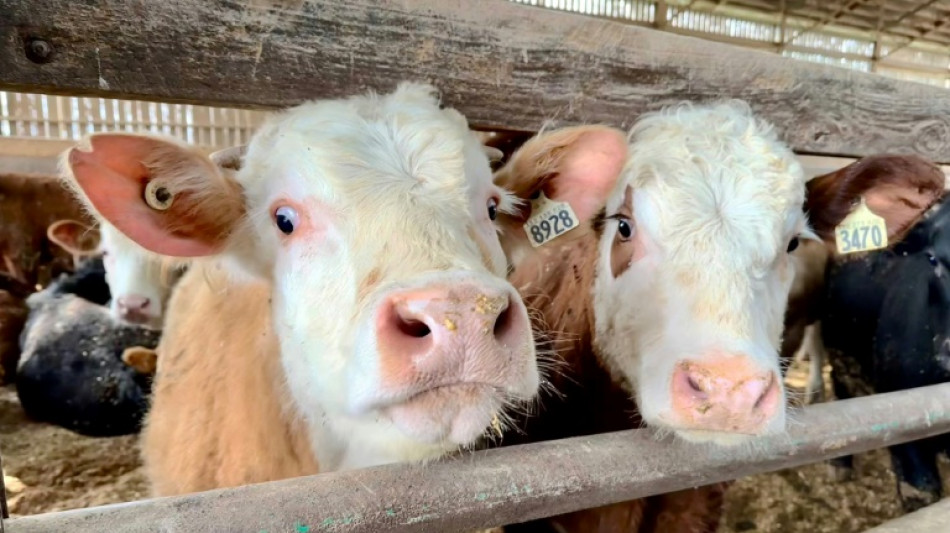
Canadian farmers 'not satisfied' with EU trade deal / Photo: © AFP

Canadian farmers say they are bewildered by the French Senate's rejection last week of the free trade agreement between the EU and Canada -- as agricultural producers and trade experts suggest that the accord mainly benefits Europeans over their North American counterparts.
"We are not satisfied with the agreement either," said Canadian farmer Kirk Jackson.
Following its approval by the European parliament at the start of 2017, the Comprehensive Economic and Trade Agreement (CETA) has been provisionally applied since September of that year.
- European 'fantasies' on Canadian farming -
For Genevieve Dufour, an expert in international trade law at the University of Ottawa, there continues to be a lot of "fantasies" in how Europeans view Canadian agriculture.
In practice, no goods banned in Europe are allowed to pass through EU customs, under rules set out in the CETA pact.
"We often hear about (imports of) beef with hormones, genetically modified organisms." But "in reality, that's not exactly what's happening." Dufour said.
"The French can decide not to import certain products (and) that's what they do," she explained.
- 'Based on science' -
These restrictions are also viewed negatively by Canadian farmers and the agri-food sector, which do not understand Europe's rejection of their practices.
"It was not a good deal for Canada from the start because Europe decided to put technical restrictions," explained Jackson, a farmer and representative of Canadian cattle ranchers who defends the use of hormones in the industry.
He insists that these practices are controlled and "based on science."
"Our food goes through a verification system that is among the best in the world and scientifically there is no risk. So, we should not use lies, unconfirmed information to infringe on trade," said Michael Harvey, executive director of the Canadian Agri-Food Trade Alliance.
Given the restrictions, very few Canadian cattle breeders have chosen to export to the European market. In 2023, 1,360 metric tons of beef were exported to the EU, barely two percent of the volume authorized by the agreement. For France, the figures are even smaller: less than 30 metric tons of Canadian beef were imported in 2023.
- CETA benefits for Europe -
"When we look at the figures, we realize that it is the Europeans who gain the most from this agreement and that the French are really not left out," said Genevieve Dufour. "Canada is an excellent export market for France."
In terms of trade flowing west over the Atlantic, EU beef exports to Canada have increased 1,700 metric tons to 14,000 metric tons over the past seven years.
Among the other big winners in the trade agreement: wines, spirits and cheeses.
"We cannot reduce the free trade agreement to just agriculture," added Dufour.
"France has gained a lot in terms of pharmaceutical protection and companies can respond to (Canadian) public calls for tender, a possibility that has never been granted to any trading partner," added the lawyer.
- Accord's effects likely to increase -
For seven years, Canada has mainly exported to Europe and France transport materials, oil, and minerals such as uranium and lithium, which are essential for environmentally friendly manufacturing.
These shipments between Canada and Europe have taken on new significance since the start of the war in Ukraine and the application of European sanctions against Russian President Vladimir Putin's regime.
Thanks to CETA, Europe was able to substitute Canadian products for Russian products that it no longer imports -- thus Canadian exports of oil, nickel, fertilizers and wheat have increased significantly.
In the future, the accord "could become even more useful," explained a diplomatic source. "Canada is a land of critical minerals and Europeans will need them to continue their energy transition efforts," added the same source.
T.Luo--ThChM



