
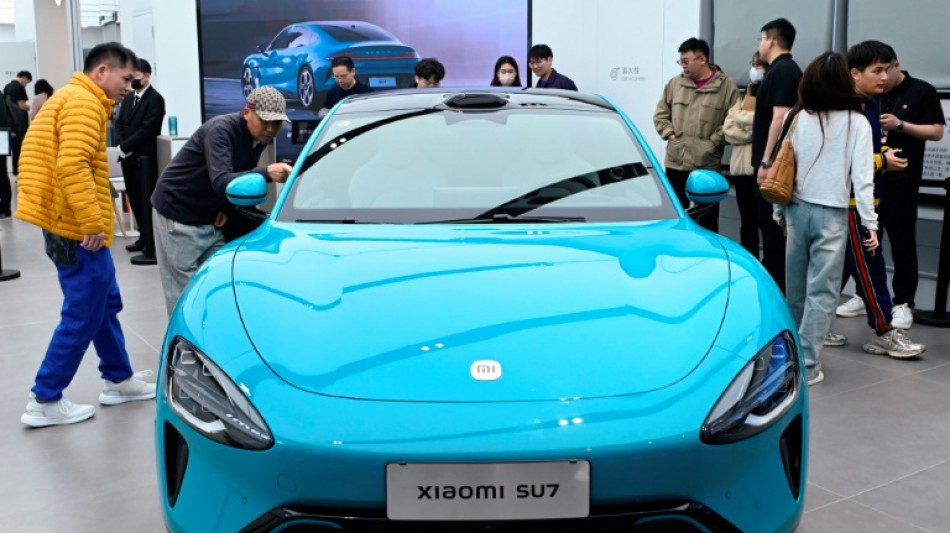
China's Xiaomi enters car market with new electric vehicle / Photo: © AFP

Chinese consumer tech giant Xiaomi launched its first electric vehicle in Beijing on Thursday, injecting itself into a fiercely competitive sector in the world's largest car market.
China's EV sector has grown rapidly in recent years -- propelled by purchasing subsidies that were discontinued in late 2022 -- and dozens of domestic automakers are engaged in a stiff price war to get ahead in a crowded market.
Xiaomi is known for its affordable smartphones and home appliances, and CEO Lei Jun says he is now putting his "reputation on the line" with the SU7 EV, challenging Chinese car giant BYD and Elon Musk's Tesla.
A basic SU7 model will cost 215,900 yuan ($29,868), Lei told a glitzy launch news conference in Beijing on Thursday evening.
The sleek and sporty SU7 will be available in nine colours and includes "sound simulation", Lei said, "to recreate the thrill of driving a sports car".
It also offers plenty of other gimmicks, such as karaoke equipment and a mini-fridge.
Xiaomi has promised it will be "the best-looking, best-driving and smartest car" priced under 500,000 yuan.
"The 200,000 to 250,000 yuan range, that actually is the most competitive segment in the China EV space at the moment," Johnson Wan, an analyst at Jefferies Financial Group Inc, told Bloomberg.
Lei told Thursday's news conference that his company's debut vehicle was comparable to Tesla's Model 3 and surpassed the American maker's sedan in some aspects.
"I think we can provide a better product for Model 3 users," he said.
Xiaomi is the world's third-biggest smartphone maker, and its experience in that sector has helped shape its EV strategy.
Lu Weibing, Xiaomi's president, told CNBC last month that there were around 20 million people who used the company's premium smartphones, a figure that helped it price the SU7.
"I think the initial purchasers will be very overlapped with the smartphone users. So that's our strategy," Lu said.
- Cut-throat market -
"By entering the premium segment, Xiaomi can carve out a niche against established brands like Tesla and Nio," Abhishek Murali, senior electric vehicle analyst at Rystad Energy, told AFP.
"Targeting affluent Chinese consumers with a premium EV allows Xiaomi to potentially offset the high manufacturing costs typically faced by EV startups," Murali said.
China is the world's largest producer of greenhouse gases, but officials plan for most domestic car sales to be made up of electric and hybrid models by 2035.
The launch of the SU7 comes just days after BYD, the world's top seller of EVs, posted record annual profits as it pushes a rapid expansion overseas into countries in Southeast Asia, as well as further afield in Latin America and Europe.
In a note attached to the earnings report, BYD CEO Wang Chuanfu acknowledged the year had not been all smooth sailing.
"At the beginning of the year, the recovery of automobile consumption was relatively lagging behind, affected by the switch in promotional policies and market price fluctuations," he wrote.
XPeng -- one of BYD's top competitors in China -- last week reported a net loss of 10.4 billion yuan in 2023.
Further highlighting the challenges of the sector, Evergrande NEV -- a subsidiary of the debt-ridden real estate group -- said on Wednesday that it had delivered only 1,389 vehicles since its launch.
When it started out in 2019, the firm gave itself "three to five years" to become the world's "most powerful" EV manufacturer.
But it is now fighting for survival, weakened by the setbacks of its parent company and dismal sales.
sbr-qan-oho-tjx/dhw
L.Kwan--ThChM



