
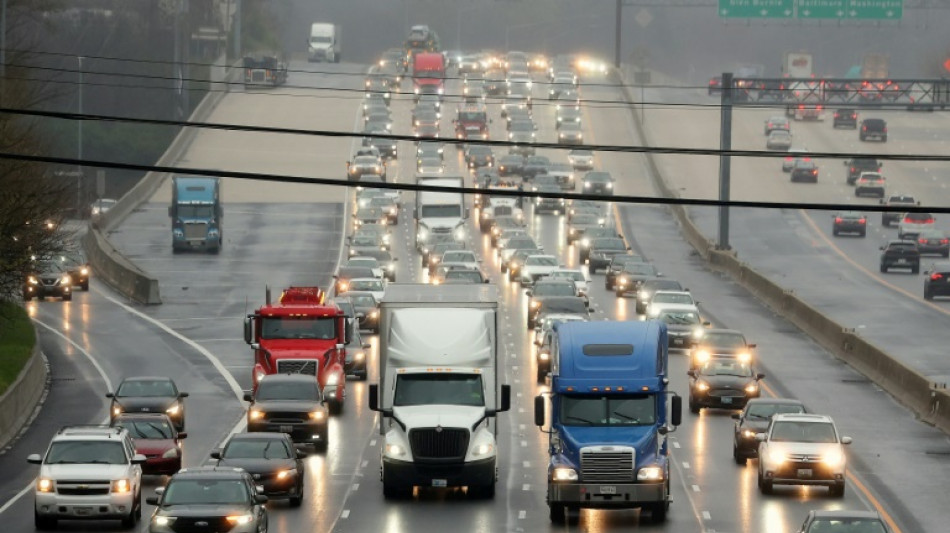
Green truckin': US finalizes new heavy-vehicle pollution standards / Photo: © GETTY IMAGES NORTH AMERICA/AFP

Following last week's crackdown on car emissions, President Joe Biden's administration on Friday unveiled finalized pollution standards for trucks, placing vehicle tailpipes at the forefront of his climate crisis agenda.
The new rules announced by the Environmental Protection Agency (EPA) will apply to vehicles including freight trucks, school buses and waste haulers built between 2027 and 2032, and will prevent around a billion tons of greenhouse gas emissions from entering the atmosphere.
Heavy goods vehicles account for 25 percent of greenhouse gas emissions in the US transport sector, which itself is the main source of emissions in the country, according to the EPA.
The finalized regulations are the "strongest national greenhouse gas standards for heavy-duty vehicles in history," EPA chief Michael Regan said.
Under the measures, vehicle manufacturers will have the flexibility to choose which set of emission control technologies they want to use, with options including hybrid and electric engines.
Regan said heavy-duty vehicles are essential for "keeping our economy moving" but represent "significant contributors to pollution from the transportation sector, emissions that are fueling climate change and creating poor air quality in too many American communities."
Around 72 million people in the United States live next to truck freight routes, and they are more likely to be people of color or from low-income households, the EPA said.
Harmful air pollutants in truck emissions, including nitrogen oxides, particulate matter and more can exacerbate serious heart and respiratory conditions.
"Today's truck rules will improve the air we breathe and curb the pollution that is driving climate change," said Paul Billings, a public policy director at the American Lung Association.
- 'Performance based, technology neutral' -
Last week, the Biden administration announced new standards for automakers, which will require a nearly 50 percent drop in fleet-wide emissions in 2032 compared with 2026 through increased sales of electric vehicles (EVs) and low-emission cars.
The rules dovetail with other Biden programs to incentivize EV sales and build more EV charging stations and manufacturing facilities.
"Like last week's clean car standards, the clean truck standards will be performance based and technology neutral -– so manufacturers will not be required to make any particular type of trucks," said Amanda Leland, executive director of Environmental Defense Fund (EDF), welcoming the move.
"And like the clean car standards before them, the clean truck standards are expected to help supercharge American manufacturing and job creation, especially in the growing market for electric vehicles."
But industry group the American Trucking Associations (ATA) said the sector hadn't been given the tools it required to make the transition.
"ATA opposes this rule in its current form because the post-2030 targets remain entirely unachievable given the current state of zero-emission technology, the lack of charging infrastructure and restrictions on the power grid," said the group's president and CEO, Chris Spear.
"The trucking industry is fully committed to the road to zero emissions, but the path to get there must be paved with commonsense," Spear said.
The total number of trucks on the road is estimated at just under 14 million, according to the ATA. An analysis by the EDF in December revealed that only around 13,000 of these trucks are electric, a mere 0.1 percent of the total fleet, making them a rare sight for now.
T.Wu--ThChM



