
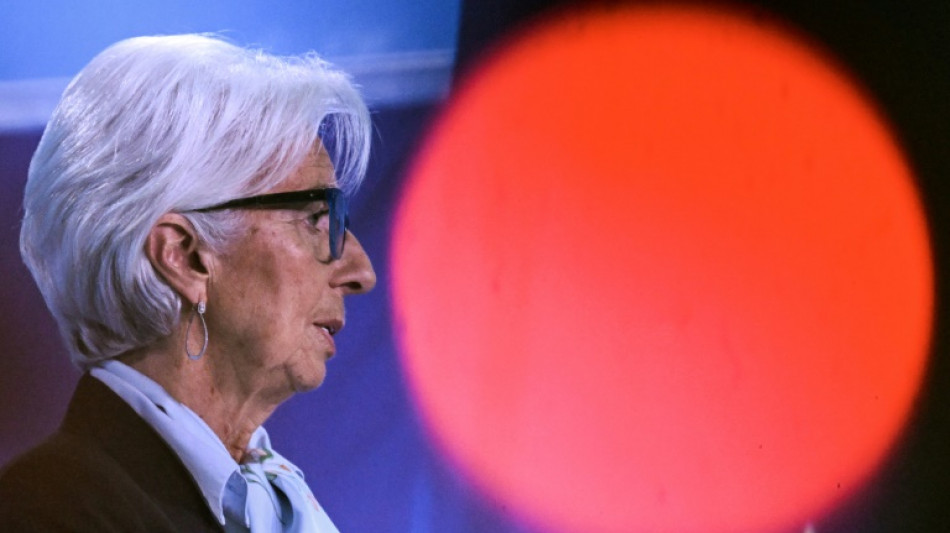
ECB opens door to June rate cut after another pause / Photo: © AFP

The European Central Bank said Thursday slowing inflation could open the door to a loosening of monetary policy, fuelling hopes of a first interest rate cut in June, after holding borrowing costs steady again.
ECB president Christine Lagarde also pushed back at suggestions the bank might follow the lead of the US Federal Reserve, which is now expected to start cutting later due to forecast-busting inflation.
It was the fifth consecutive time the ECB has frozen borrowing costs, with the key deposit rate sitting at a record high of four percent.
The ECB hiked rates at a record pace to tame red-hot price rises, but calls have grown for cuts to begin as inflation falls and higher borrowing costs take their toll on the 20-nation single currency area.
Eurozone inflation slowed more than expected in March to 2.4 percent -- not far off the ECB's two-percent target.
A rate reduction Thursday was widely seen as unlikely with officials having repeatedly stressed they are waiting for more data that will only be available for their meeting in June.
But in their statement, the central bank tweaked its language, saying most measures of underlying inflation were easing and wage growth -- a particular concern in recent months -- was "moderating".
If the ECB's confidence increases "that inflation is converging to the target in a sustained manner, it would be appropriate to reduce the current level of monetary policy restriction," it said.
The central bank insisted that its decisions would continue to be based on incoming data and that it was not committing to a particular path.
- ECB won't 'mirror' Fed -
But Lagarde stressed that "in June, we know that we will get a lot more data and a lot more information", as well as the central bank's own updated projections on inflation and growth.
The comments reinforced analysts' views about when cuts would begin, with Jack Allen-Reynolds from Capital Economics seeing a reduction at the next ECB meeting in June as "very likely".
After inflation data came in hotter than anticipated in the United States on Wednesday, dimming hopes for the Fed to start cutting rates, speculation has mounted that it could impact the ECB's decision-making.
But while inflation in the United States was taken into account in the ECB's calculations, the drivers of price rises in the euro area and the world's biggest economy are different, Lagarde insisted.
People should not assume that "what happens in the euro area will be the mirror of what happens in the United States because we are looking at two different things," she said.
Still, the possibility of the ECB slashing rates before the Fed has worried some observers.
Lower rates in the eurozone could prompt investors to look elsewhere for higher returns, weakening the euro and making imports more expensive -- potentially reigniting inflation.
- 'Soft loosening' expected -
The ECB hiked rates 10 consecutive times from mid-2022 as inflation surged after the Ukraine war pushed up energy prices and on the back of pandemic-related supply chain woes.
Eurozone inflation, which peaked at over 10 percent in late 2022, has steadily declined in recent months and is now expected by the ECB to return to target in 2025.
But the higher borrowing costs have hit the eurozone economy hard, dampening demand as households and businesses feel the squeeze from more expensive loans and mortgages.
The eurozone only narrowly avoided a recession in the second half of 2023, weighed down by a poor performance in its largest economy, Germany.
Like other central banks, the ECB is now weighing the best time to switch gears and support economic growth through lower rates -- without endangering the progress on inflation.
The Swiss National Bank kicked off a rate-cutting cycle last month when it lowered its main rate by 0.25 percentage points -- becoming the first major central bank to do so.
Observers of the ECB will now turn their attention to the pace of reductions, with many pencilling in three to four cuts of 0.25 percentage points each.
ING economist Carsten Brzeski said he did not envisage "a full reversal of the rate hikes since July 2022, but rather a soft loosening of a still restrictive stance".
G.Tsang--ThChM



