
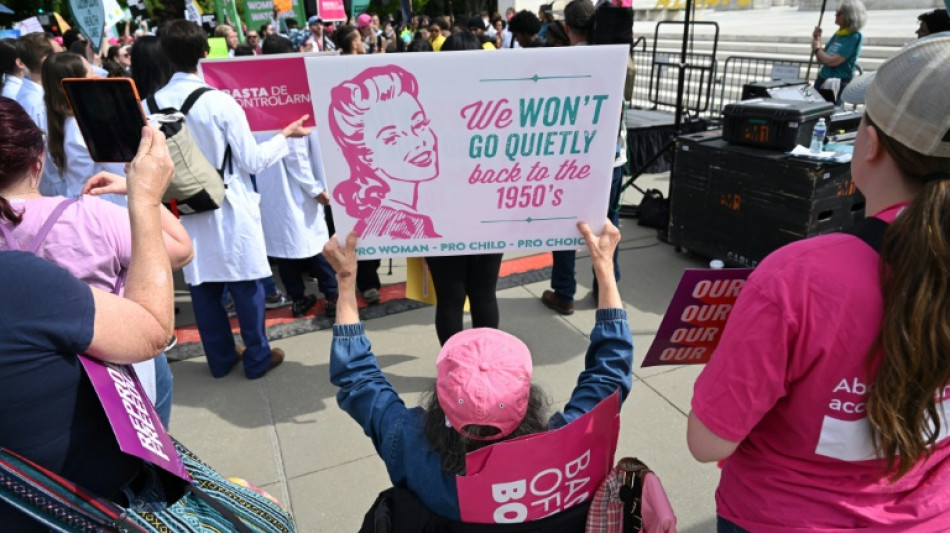
US Supreme Court seems split on Idaho abortion ban / Photo: © AFP

The US Supreme Court appeared divided Wednesday on whether Idaho's near-total ban on abortion conflicts with a federal law requiring hospitals to stabilize patients needing emergency care, in a case that carries potentially sweeping national consequences.
It comes nearly two years after the conservative-majority bench overturned the national right to terminate a pregnancy, making reproductive rights a pivotal issue that could shape the outcome of the November presidential election.
Emotions ran deep outside the courtroom where hundreds of women's rights activists, some draped in red-stained sheets, shouted "Abortion is health care!" Anti-abortion activists also arrived in large numbers and chanted slogans.
After the fall of Roe v. Wade in June 2022, Idaho enacted one of the most stringent anti-abortion laws in the United States, allowing the procedure only in cases of rape, incest and "when necessary to prevent the death of the pregnant woman." Someone who carries out an abortion may be jailed for five years.
President Joe Biden's administration then sued the northwestern state, arguing that its Defense of Life Act violated a federal law that requires hospitals that receive government Medicare funding to provide emergency room care, including abortion, in situations that are serious but not necessarily life-threatening.
A federal judge in Boise, the Idaho capital, issued a preliminary injunction in August 2022 blocking the state law on the grounds it put doctors in a difficult position. But in January the Supreme Court put the Idaho ban back in place while it took up the matter.
- Barrett could be key vote -
During Wednesday's hearing, the court's progressive judges Elena Kagan, Ketanji Brown Jackson and Sonia Sotomayor grilled Idaho's attorney Josh Turner on grisly instances of where a woman might not be at risk of death if she didn't receive an abortion -- but could still face severe health consequences including loss of fertility through a hysterectomy.
Amy Coney Barrett -- who was appointed when Donald Trump was president -- seemed to side with the liberal wing, expressing "shock" at Turner's response that such examples would be decided on a case-by-case basis.
Barrett asked what would happen if a doctor reached a decision that an abortion was medically indicated but a "prosecutor thought differently?" Chief Justice John Roberts likewise asked probing questions on who decides whether a doctor had a "good faith" reason to perform an abortion under Idaho law.
Turner, for his part, sought to portray the government's case as an attempt to circumvent Idaho's policy choices, expanding the exemptions to the abortion ban to include feelings of depression.
The court's archconservatives Samuel Alito and Clarence Thomas appeared strongly receptive to Idaho's case.
- Airlifts for abortions -
Arguing for the Biden administration, US Solicitor General Elizabeth Prelogar said the dire situation for doctors and women on the ground in Idaho proved the government's case.
"If a woman comes to an emergency room facing a grave threat to her health, but she isn't yet facing death, doctors either have to delay treatment and allow her condition to materially deteriorate, or they're airlifting her and getting emergency care."
Prelogar shared a tense exchange with Alito over wording within the federal law, the Emergency Medical Treatment and Active Labor Act (EMTALA), which was passed in 1986.
Alito argued that if Congress had originally meant for the law to preserve access for emergency abortions, it wouldn't have made multiple references to the term "unborn child."
Prelogar said it was written this way to ensure hospitals don't turn away uninsured women facing pregnancy complications that affect only the health of their fetuses, such as when the umbilical cord prolapses.
"But to suggest that in doing so, Congress suggested that the woman herself isn't an individual, that she doesn't deserve stabilization —- I think that that is an erroneous reading of this," said Prelogar.
"Nobody's suggesting that a woman is not an individual and she doesn't deserve stabilization," Alito fired back.
A decision in the Idaho case -- expected by early summer -- could have far-reaching consequences for hospitals across the country, especially in half a dozen other states where medical exemptions are defined very narrowly.
W.Tam--ThChM



