The China Mail - Boeing's Starliner set for first crewed mission to ISS

USD -
AED 3.673042
AFN 65.000368
ALL 81.503989
AMD 360.340403
ANG 1.789785
AOA 918.000367
ARS 1544.046724
AUD 1.454757
AWG 1.8
AZN 1.70397
BAM 1.75029
BBD 2.013844
BDT 124.537437
BGN 1.747831
BHD 0.37735
BIF 3010
BMD 1
BND 1.281347
BOB 11.99429
BRL 5.504904
BSD 0.999897
BTN 93.858629
BWP 13.774679
BYN 2.994523
BYR 19600
BZD 2.011053
CAD 1.41135
CDF 2320.000362
CHF 0.820469
CLF 0.02484
CLP 977.630396
CNY 6.676504
CNH 6.67282
COP 3251.53
CRC 453.465426
CUC 1
CUP 23.998962
CVE 99.403894
CZK 21.83445
DJF 177.720393
DKK 6.708504
DOP 60.750393
DZD 136.38704
EGP 53.769786
ERN 15
ETB 161.203874
EUR 0.896804
FJD 2.25525
FKP 0.7479
GBP 0.748671
GEL 2.59504
GGP 0.7479
GHS 11.68504
GIP 0.7479
GMD 74.503851
GNF 8857.503848
GTQ 7.64085
GYD 209.627114
HKD 7.84215
HNL 27.07504
HRK 6.76901
HTG 131.052321
HUF 326.000354
IDR 18108.5
ILS 3.18593
IMP 0.7479
INR 94.04725
IQD 1514
IRR 1891353.000352
ISK 122.790386
JEP 0.7479
JMD 158.687685
JOD 0.70904
JPY 158.50504
KES 129.950385
KGS 87.447804
KHR 4080.00035
KMF 442.00035
KPW 899.999961
KRW 1363.803789
KWD 0.31098
KYD 0.833408
KZT 448.201333
LAK 22505.000349
LBP 89550.000349
LKR 332.502562
LRD 170.303772
LSL 16.560381
LTL 2.95274
LVL 0.60489
LYD 6.430381
MAD 9.757504
MDL 17.8737
MGA 4595.000347
MKD 55.203803
MMK 2099.697346
MNT 3600.739032
MOP 8.072028
MRU 40.250379
MUR 47.030378
MVR 15.403739
MWK 1737.000345
MXN 18.62534
MYR 4.061504
MZN 63.903729
NAD 16.560377
NGN 1347.210377
NIO 36.610377
NOK 9.459904
NPR 150.173627
NZD 1.803102
OMR 0.384144
PAB 0.999964
PEN 3.442504
PGK 4.492039
PHP 63.108038
PKR 276.625038
PLN 3.94555
PYG 6249.384815
QAR 3.643038
RON 4.792204
RSD 105.586038
RUB 81.925564
RWF 1475
SAR 3.754695
SBD 8.048583
SCR 14.018084
SDG 601.503676
SEK 9.894504
SGD 1.282604
SHP 0.748923
SLE 22.950371
SLL 20969.504398
SOS 571.503662
SRD 37.583504
STD 20697.981008
STN 22.275
SVC 8.748764
SYP 13001.999685
SZL 16.560369
THB 33.550369
TJS 9.224126
TMT 3.5
TND 2.985504
TOP 2.40776
TRY 50.141304
TTD 6.780829
TWD 32.775304
TZS 2642.503628
UAH 45.297
UGX 4089.81484
UYU 40.226773
UZS 12000.000334
VES 896.316404
VND 25582.5
VUV 119.504303
WST 2.787821
XAF 588.264929
XAG 0.019249
XAU 0.00024594347
XCD 2.70255
XCG 1.801976
XDR 0.707052
XOF 588.264929
XPF 107.450363
YER 236.625037
ZAR 16.51847
ZMK 9001.203584
ZMW 20.318702
ZWL 321.999592
SSP 5745.505339
MXV 2.095424
  • RYCEF

    0.4000

    19.71

    +2.03%

  • CMSC

    0.0000

    20.4

    0%

  • BTI

    0.4200

    56.05

    +0.75%

  • BP

    0.2800

    44.43

    +0.63%

  • RBGPF

    1.6000

    67

    +2.39%

  • RIO

    -0.1500

    94.41

    -0.16%

  • AZN

    -0.4300

    166.15

    -0.26%

  • GSK

    0.4600

    49.7

    +0.93%

  • BCE

    -0.4100

    20.56

    -1.99%

  • NGG

    -0.2500

    75.24

    -0.33%

  • VOD

    -0.0400

    16.58

    -0.24%

  • RELX

    -0.4500

    33.07

    -1.36%

  • BCC

    -0.5500

    76.59

    -0.72%

  • CMSD

    -0.0300

    20.27

    -0.15%

  • JRI

    -0.2500

    10.77

    -2.32%

Boeing's Starliner set for first crewed mission to ISS
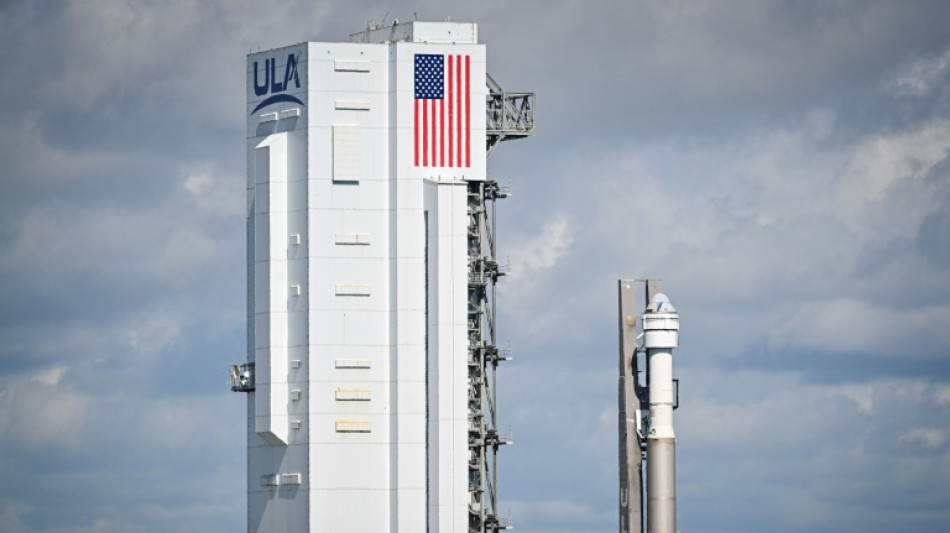
Boeing's Starliner set for first crewed mission to ISS / Photo: © AFP

Boeing's Starliner set for first crewed mission to ISS

After years of delays, Boeing's Starliner capsule is set to ferry astronauts to the International Space Station (ISS) Monday, a milestone for the US aerospace giant and NASA.

Text size:

The flight, a final test before Starliner takes up regular service for the space agency, is critical for Boeing, whose reputation has suffered of late due to safety issues with its passenger jets.

For NASA, the stakes are also high: Having a second option for human space flight in addition to SpaceX's Dragon vehicles is "really important," said Dana Weigel, manager of the agency's International Space Station program.

Astronauts Butch Wilmore and Suni Williams are set to take off from Cape Canaveral at 10:34 pm Monday (0234 GMT Tuesday), if favorable weather predicted for the launch continues to hold.

Starliner will be propelled into orbit by an Atlas V rocket made by United Launch Alliance, a Boeing-Lockheed Martin joint venture.

Once in space, one of Wilmore and Williams's tasks will be to temporarily pilot the craft manually, in a test.

The astronauts, both Navy-trained space program veterans, have each been to the ISS twice, traveling once on a shuttle and then aboard a Russian Soyuz vessel.

"It's going to be like going back home," Williams said ahead of the launch.

As for the Boeing spacecraft, Wilmore said: "Everything is new."

- Hiccups expected -

Starliner is scheduled to arrive at the ISS at about 0500 GMT Wednesday, and remain there for a little over a week. Tests will be performed to check it is working properly, and then Williams and Wilmore will reboard the capsule to return home.

A successful mission would help dispel the bitter taste left by the numerous setbacks in the Starliner program.

In 2019, during a first uncrewed test flight, the capsule was not placed on the right trajectory and returned without reaching the ISS.

Then in 2021, with the rocket on the launchpad for a new flight, blocked valves forced another postponement.

The empty vessel finally reached the ISS in May 2022. But problems since then have delayed Monday's crewed test flight, necessary for the capsule to be certified for NASA's use on regular ISS missions.

NASA associate administrator Jim Free had predicted the mission would not be hiccup-free.

"We certainly have some unknowns in this mission, things we expect to learn, being a test mission. We may encounter things we don't expect," Free said, noting that Starliner is just the sixth US-built class of vessel for NASA astronauts.

SpaceX's Dragon capsule joined that exclusive club in 2020, following the Mercury, Gemini, Apollo and space shuttle programs.

In 2014, the agency awarded fixed-price contracts of $4.2 billion to Boeing and $2.6 billion to SpaceX to develop the capsules.

Once Starliner is fully operational, NASA hopes to alternate between SpaceX and Boeing vessels to ferry astronauts to the ISS.

Even though the ISS is due to be mothballed in 2030, both Starliner and Dragon could be used to taxi humans to future private space stations, which several companies are planning to build.

G.Fung--ThChM



