
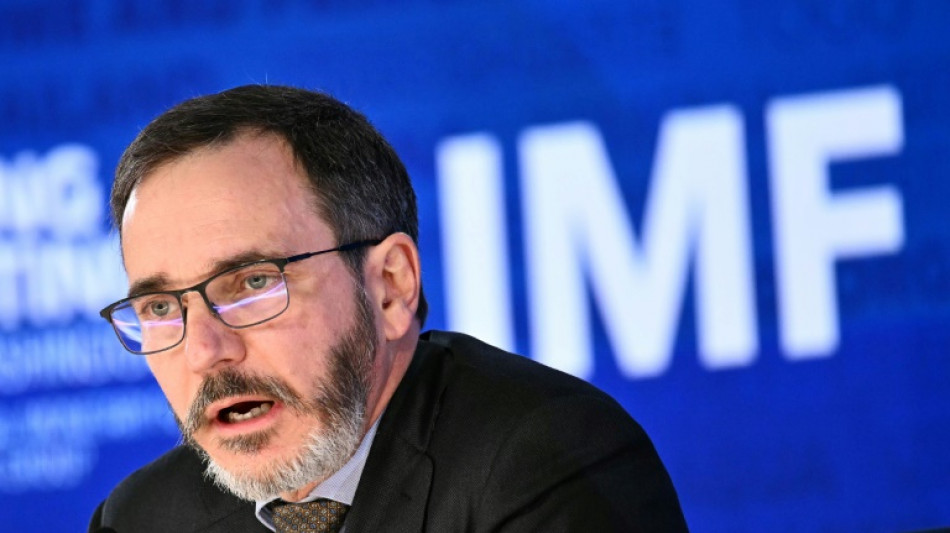
IMF maintains 2024 global growth forecast, warns of inflation risk / Photo: © AFP/File

The IMF held global growth expectations for 2024 steady in a report Tuesday even as it cut forecasts for the United States and Japan, while warning of inflation risks and trade tensions ahead.
The International Monetary Fund expects the world economy to grow 3.2 percent this year, unchanged from its April forecast, according to its World Economic Outlook update.
"Global activity and world trade firmed up at the turn of the year, with trade spurred by strong exports from Asia," said the fund.
For 2025, it expects global growth of 3.3 percent.
But even as many countries saw better growth than anticipated early this year, the IMF flagged surprises in Japan and the United States.
The Washington-based lender also cautioned that risks to inflation have increased, with services prices holding up disinflation.
This increases the prospect of interest rates staying elevated for longer, "in the context of escalating trade tensions and increased policy uncertainty."
- Trade measures surged -
"We see an explosion in the number of trade restrictive measures," IMF chief economist Pierre-Olivier Gourinchas told a press briefing Tuesday.
Over 3,000 such moves were implemented last year, up from an already-high level of 1,000 in 2019.
These take the form of export restrictions and industrial policies, leading to retaliation, he said.
"One concern we have is that going forward, this will weigh down on global activity," he noted.
The IMF's report warned that a resurgence of tariffs can trigger retaliation and a "costly race to the bottom."
On whether risk assessments shifted after the attempted assassination of former US president Donald Trump, the Republican Party's nominee in November's election, Gourinchas earlier told AFP the fund will consider its implications.
On Tuesday, he said 2024 is an election-heavy year, adding "there could be some increase in in trade measures" and distortions on industrial policy which could spill over to other countries.
- China concerns -
While world growth appears stable, the IMF lowered projections for the United States and Japan.
US growth in 2024 was downgraded to 2.6 percent, 0.1 percentage points below April's forecast, due to a "slower-than-expected start to the year."
Japan's economy was seen expanding 0.2 percentage points less than expected, by 0.7 percent this year, mainly thanks to temporary supply disruptions and weak private investment in the first quarter.
The euro area meanwhile is showing signs of recovery with relatively strong services activity, Gourinchas said, although manufacturing shows weakness.
China and India are expected to power activity in Asia -- with China's 2024 forecast revised up to 5.0 percent on a private consumption rebound and strong exports.
But Gourinchas flagged risks to the world's second biggest economy stemming from weak confidence and unresolved property sector problems.
Should domestic demand weaken, China would rely more on the external sector -- a situation countries like the United States are pushing back against.
"An increase in the trade surplus might be small from (China's) perspective. It could be big from the perspective of the rest of the world," he said.
- Inflation risks -
There also remain risks of sticky inflation amid renewed trade or geopolitical tensions, the IMF cautioned, even as it expects inflation to return to target by end-2025.
Wage growth, if accompanied by weak productivity, could make it tough for firms to ease price increases.
An escalation of trade tensions could also raise near-term inflation risks, by lifting costs of imported goods, IMF said.
Higher inflation could heighten the chances that interest rates stay elevated for longer, increasing financial risks.
The IMF called for careful monetary policy adjustments.
C.Fong--ThChM



