
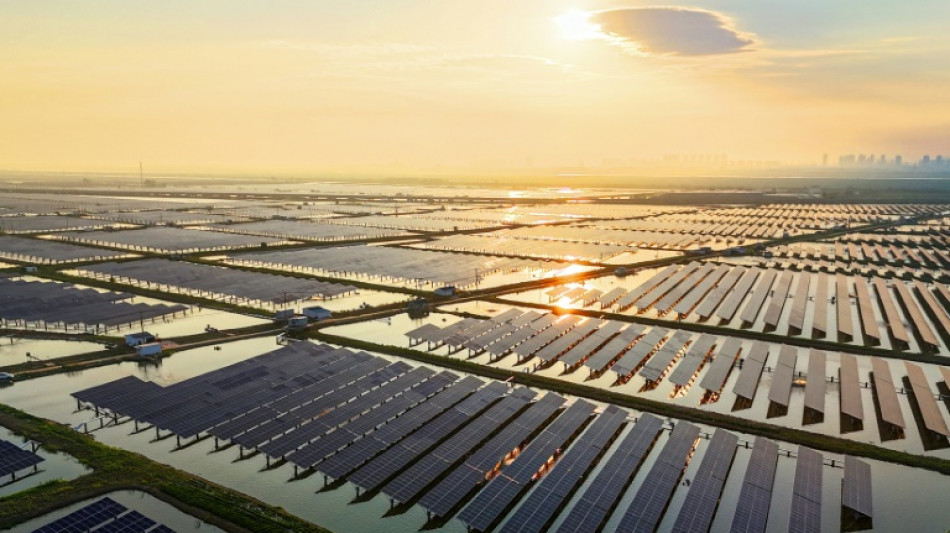
Australia greenlights world's 'largest' solar hub / Photo: © AFP/File

Australia on Wednesday approved plans for a massive solar and battery farm that would export energy to Singapore, a project billed as the "largest solar precinct in the world".
Authorities announced environmental approvals for SunCable's US$24 billion project in Australia's remote north that is slated to power three million homes.
The project, which will include an array of panels, batteries and, eventually, a cable linking Australia with Singapore, is backed by tech billionaire and green activist Mike Cannon-Brookes.
"It will be the largest solar precinct in the world –- and heralds Australia as the world leader in green energy," said Environment Minister Tanya Plibersek.
It is hoped that energy production will begin in 2030, providing four gigawatts of energy for domestic use.
Two more gigawatts would be sent to Singapore via undersea cable, supplying about 15 percent of the city-state's needs.
SunCable Australia's managing director Cameron Garnsworthy said the approval was "a landmark moment in the project's journey".
Despite Wednesday's green light, numerous approval processes and other hurdles remain.
The project depends on sign off from Singapore's energy market authority, Indonesia's government and Australian Indigenous communities.
"SunCable will now focus its efforts on the next stage of planning to advance the project towards a final investment decision targeted by 2027," said Garnsworthy.
- 'Clean energy powerhouse' -
Countries around the world are racing to bring major solar projects online to ease the transition away from polluting fossil fuels.
China leads the way, and is building almost twice as much wind and solar capacity as every country combined.
Earlier this year it brought online the 3.5 gigawatt Midong solar farm, its largest facility so far.
In contrast, Australia remains one of the world's leading exporters of coal and gas, despite being ravaged by the effects of climate change -- from intense heat to floods and bushfires.
And although Australians are among the world's most enthusiastic adopters of household solar panels, a string of governments have been hesitant to embrace renewables.
In 2022, renewables made up 32 percent of Australia's total electricity generation -- compared to coal, which contributed 47 percent, according to the latest government data.
Plibersek hailed the project as a way of meeting Australia's projected energy shortfall, and creating "14,300 new jobs in northern Australia".
Director of the Energy Change Institute at the Australian National University Ken Baldwin said the project was a "world first" for exporting renewable electricity from solar and wind on such a scale.
"Australia has some of the best solar and wind resources of any country, and as a result, is installing solar and wind at one of the fastest rates of any country in the world on a per capita basis," he told AFP.
But this momentum must continue, particularly if Australia is to meet its net zero targets by 2050, Baldwin said.
"Australia has, over the last five years, invested heavily in solar and wind, but it needs to double and triple that investment in order to reach its climate trajectory towards a net zero future by 2050."
He added that by the 2030s, Australia will need about 100 gigawatts of solar and wind capacity -- the SunCable project will only provide four gigawatts of that need.
Climate Council chief executive Amanda McKenzie said the new solar hub was a bold step in making Australia a "clean energy powerhouse" and that such projects were essential in "delivering affordable energy and slashing climate pollution".
"With the closure of coal-fired power stations on the horizon, Australia needs to accelerate the roll-out of solar and storage at every level—rooftops, large-scale projects, and everything in between," she said.
The project would also be a significant step for Cannon-Brookes, who once described the project as "insane" before becoming an enthusiastic investor.
N.Wan--ThChM



