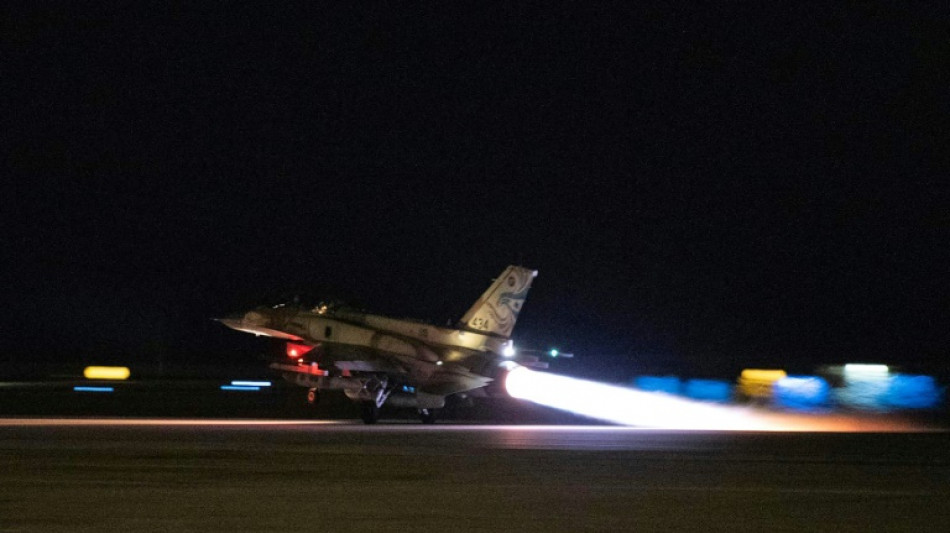
Israel-Hezbollah exchanges intensify on Lebanon border / Photo: © Israel Defense Forces (IDF)/AFP

Israel said Hezbollah fired dozens of rockets from Lebanon on Friday following overnight air strikes which destroyed dozens of launchers after its leader vowed retribution for deadly sabotage attacks on its communications.
The intensifying exchanges came as the UN Security Council prepared to discuss this week's attacks on Hezbollah pagers and two-way radios, which killed 37 people and wounded thousands over two days.
Hezbollah said it targeted at least six Israeli military bases with salvos of rocket fire in response to overnight bombardment which people in south Lebanon described as among the fiercest so far.
"Some 140 rockets were fired from Lebanon within an hour," an Israeli military spokeswoman said.
The military said that overnight its jets hit infrastructure and "approximately 100 launchers" ready to be fired.
Hezbollah said two of its fighters were killed, without elaborating.
Residents of Marjayoun, a Lebanese town close to the border, said the bombardment was among the heaviest since the border exchanges began in October last year.
"We were very scared, especially for my grandchildren," said Nuha Abdo, 62. "We were moving them from one room to another."
Clothing store owner Elie Rmeih, 45, said he counted more than 50 strikes.
"It was a terrifying scene and unlike anything we have experienced since the escalation began.
"We live in fear of a wider war, you don't know where to go."
The communications device explosions and intensifying air strikes came after Israel announced it was shifting its war objectives to its northern border with Lebanon.
For nearly a year, Israel's firepower has been focused on Palestinian militant group Hamas in Gaza, but its troops have also been engaged in near-daily exchanges with Hezbollah militants.
International mediators have repeatedly tried to avert a full-blown war between Israel and Hezbollah and staunch the regional fallout of the Gaza war started by Hamas's October 7 attack on Israel.
Hezbollah maintains its fight is in support of Hamas, and its leader Hassan Nasrallah vowed on Thursday that the attacks on Israel would continue as long as the war in Gaza lasts.
Speaking for the first time since the device blasts, Nasrallah warned Israel would face retribution.
Describing the attacks as a "massacre" and a possible "act of war", Nasrallah said Israel would face "just punishment, where it expects it and where it does not".
The cross-border exchanges have killed hundreds in Lebanon, mostly fighters, and dozens in Israel, including soldiers. Tens of thousands of people on both sides of the border have fled their homes.
Speaking to troops on Wednesday, Israeli Defence Minister Yoav Gallant said: "Hezbollah will pay an increasing price" as Israel tries to "ensure the safe return" of its citizens to border areas.
"We are at the start of a new phase in the war," he said.
- 'Wider war' -
Foreign Minister Abdallah Bou Habib said the "blatant assault on Lebanon's sovereignty and security" was a dangerous development that could "signal a wider war".
Speaking ahead of a UN Security Council meeting on the attacks set for Friday, he said Lebanon had filed a complaint against "Israel's cyber-terrorist aggression that amounts to a war crime".
Senior UN officials have also expressed concern about the legality of the Israeli sabotage.
UN human rights chief Volker Turk called the blasts "shocking", and said their impact on civilians was "unacceptable".
UN chief Antonio Guterres said it was "very important... not to weaponize civilian objects".
US Secretary of State Antony Blinken, who has been scrambling to salvage efforts for a Gaza ceasefire and hostage release deal, called for restraint by everyone.
"We don't want to see any escalatory actions by any party" that would endanger the goal of a Gaza ceasefire, he said.
British Foreign Secretary David Lammy expressed "deep concern" over the rising tensions and renewed a call for Britons to leave Lebanon, saying the "situation could deteriorate rapidly".
Hamas's October 7 attacks that sparked the Gaza war resulted in the deaths of 1,205 people, mostly civilians, on the Israeli side, according to an AFP tally based on Israeli official figures that include hostages killed in captivity.
Israel's retaliatory military offensive has killed at least 41,272 people in Gaza, most of them civilians, according to figures provided by the Hamas-run territory's health ministry. The United Nations has acknowledged the figures as reliable.
In the latest Gaza violence, the territory's civil defence agency said an air strike on a house in Nuseirat refugee camp killed eight people. Another six people, including children, were killed in a separate strike on an apartment in Gaza City, it added.
- 'Sabotaged at source' -
The preliminary findings of a Lebanese investigation found the pagers that exploded had been booby-trapped, a security official said.
Lebanon's UN mission concurred, saying in a letter that the probe showed "the targeted devices were professionally booby-trapped... before arriving in Lebanon, and were detonated by sending emails to the devices".
The New York Times reported Wednesday that the pagers that exploded were produced by the Hungary-based BAC Consulting on behalf of Taiwanese manufacturer Gold Apollo. It cited intelligence officers as saying BAC was part of an Israeli front.
A government spokesman in Budapest said the company was "a trading intermediary, with no manufacturing or operational site in Hungary".
burs-dv/kir/srm
F.Brown--ThChM