Indonesia bets on SE Asia's first battery plant to become EV hub / Photo: © AFP

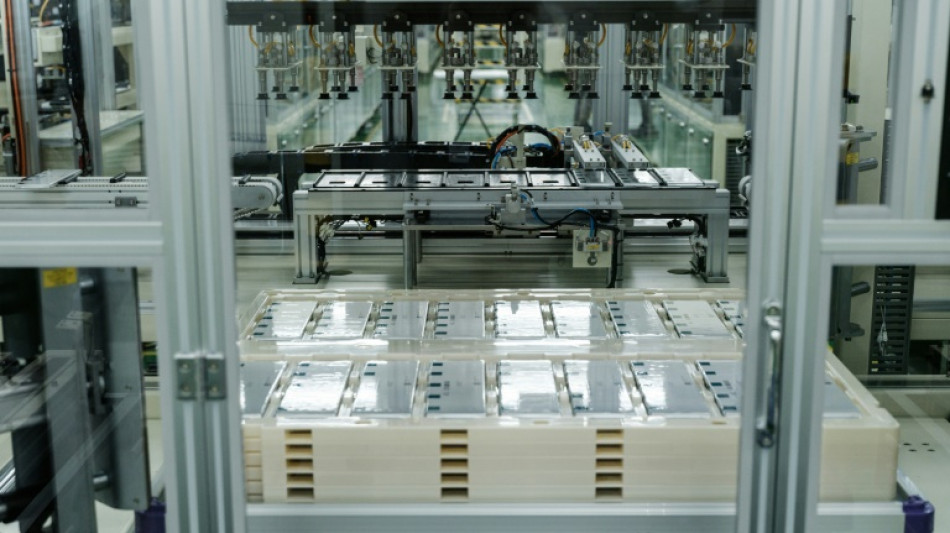
Rows of robotic arms move with precision to assemble nickel-based battery cells on the production line at Indonesia's inaugural electric vehicle battery plant, the first in Southeast Asia.
After being chosen by a joint venture of South Korea's Hyundai and LG for the $1.1 billion factory, Indonesia is now looking to boost investment to give it an edge in the race to become a regional EV hub.
When he opened the West Java plant in July then-president Joko Widodo said such investments would make Southeast Asia's biggest economy an "important global player" in the EV supply chain.
But while the country boasts the world's largest nickel reserves, analysts pointed out that it still faces a battle owing to its poor processing and refining capacity, environmental worries and the rise in other types of batteries.
It also has some way to go to rival Thailand, which Krungsri bank said had market share of 78.7 percent of Southeast Asia's EV sales as of early 2023, with Indonesia following with eight percent.
AFP was given rare access to the factory floor to get a glimpse of the plant's complex battery cell production, most of which will be shipped to Hyundai subsidiaries in South Korea and India.
Hyundai said the new factory was a commitment to helping the archipelago become a supercharged Southeast Asian EV maker.
"It shows we are ready to support the government's desire to become a hub for Southeast Asia," Fransiscus Soerjopranoto, chief operating officer of Hyundai's Indonesian subsidiary, said.
- Incentives -
The government has unveiled a number of incentives to boost the EV market, including a luxury goods tax exemption that has boosted sales and seen a flurry of key brands entering Indonesia's 280 million-strong market, including China's BYD and Vietnam's VinFast.
More than 23,000 battery-powered cars were sold to dealers between January and August this year, compared with 17,000 in all of 2023, Indonesian automotive association data showed.
Under the regulations unveiled last year, EVs imported to Indonesia are free of duties until 2025 if companies commit to building production facilities and producing as many cars in the country as they import by the end of 2027.
And Chinese automaker Wuling announced a plan last month to produce EV batteries at its Indonesia factory by the end of 2024, local media reported.
"We see a huge potential for EV purchase in Indonesia compared to other countries in Asia," said BYD Indonesia official Luther Panjaitan.
Key to Jakarta's strategy has been luring automakers before they establish plants elsewhere, said Rachmat Kaimuddin, a government official who left in the transition to President Prabowo Subianto's administration last week.
"If they have already established factories in some countries, maybe they don't need to build in Indonesia," he said.
Rachmat also pointed to Indonesia's nickel reserves as a difference-maker.
"It is possible to make a battery industry in Indonesia. That is what Thailand, Vietnam don't have," he said.
However, the burgeoning industry faces challenges.
- Challenges -
While Indonesia aims to become one of the world's top three producers of EV batteries, investment in the sector remains relatively small.
Realised nickel sector investment between 2020 and September 2024 was 514.8 trillion rupiah ($33.3 billion) and 19.14 trillion in the EV battery sector, investment ministry data showed.
While Indonesia is number one for nickel reserves, it will be importing materials for the new factory including processed nickel from South Korea and China owing to its lack of related industries, said Hong Woo-pyoung, president director of the joint venture, PT HLI Green Power.
And environmentalists warn nickel mining is one of the key drivers of Indonesian deforestation, while analysts added that the rise of cheaper lithium iron phosphate (LFP) batteries, widely adopted in China, could hurt demand.
Andry Satrio Nugroho, researcher at the Institute for Development of Economics and Finance, said the policies were "not pro-nickel" because all carmakers got the same incentives.
But Rachmat said Indonesia has raw materials to make LFP batteries as well.
A global oversupply of batteries could make it harder for Indonesia to attract more investment, said Putra Adhiguna, managing director of think tank Energy Shift Institute.
Yet as boxes of packed battery cells towered behind him, Hong was unfazed about the future.
"This factory and ecosystem is very important for Indonesia's future," he said, adding that in the "near future, the material will come from Indonesia to make a battery cell, to make EVs".
"Indonesia is growing and growing every year about five percent," he said.
"The automotive market will be growing as well."
P.Deng--ThChM