The China Mail - Resilient but threatened, Kenya celebrates Maa culture

USD -
AED 3.673042
AFN 64.000368
ALL 81.264432
AMD 360.340403
ANG 1.789785
AOA 917.000367
ARS 1545.506907
AUD 1.457418
AWG 1.8025
AZN 1.70397
BAM 1.75029
BBD 2.013844
BDT 124.537437
BGN 1.747831
BHD 0.377772
BIF 2991.837758
BMD 1
BND 1.281347
BOB 11.99429
BRL 5.497604
BSD 0.999897
BTN 93.858629
BWP 13.774679
BYN 2.994523
BYR 19600
BZD 2.011053
CAD 1.41288
CDF 2315.000362
CHF 0.820095
CLF 0.024862
CLP 978.510396
CNY 6.688504
CNH 6.67222
COP 3244.78
CRC 453.465426
CUC 1
CUP 23.998962
CVE 98.678647
CZK 21.83704
DJF 177.720393
DKK 6.70758
DOP 60.760377
DZD 136.369631
EGP 53.824304
ERN 15
ETB 164.116992
EUR 0.89729
FJD 2.265604
FKP 0.741654
GBP 0.748912
GEL 2.60504
GGP 0.741654
GHS 11.683738
GIP 0.741654
GMD 74.503851
GNF 8856.154607
GTQ 7.64085
GYD 209.627114
HKD 7.839565
HNL 26.875436
HRK 6.76901
HTG 131.052321
HUF 326.029504
IDR 18109.35
ILS 3.18593
IMP 0.741654
INR 93.95675
IQD 1515.921743
IRR 1891353.000352
ISK 122.730386
JEP 0.741654
JMD 158.687685
JOD 0.70904
JPY 158.23504
KES 129.880385
KGS 87.447804
KHR 4073.961373
KMF 441.00035
KPW 899.999961
KRW 1362.590383
KWD 0.31094
KYD 0.833408
KZT 448.201333
LAK 22494.272623
LBP 89542.808303
LKR 332.502562
LRD 169.993019
LSL 16.535754
LTL 2.95274
LVL 0.60489
LYD 6.398697
MAD 9.7739
MDL 17.8737
MGA 4543.684976
MKD 55.217614
MMK 2099.952938
MNT 3601.972253
MOP 8.072028
MRU 40.368171
MUR 47.030378
MVR 15.455039
MWK 1733.939535
MXN 18.634185
MYR 4.058704
MZN 63.910377
NAD 16.536864
NGN 1347.090377
NIO 36.79922
NOK 9.46256
NPR 150.173627
NZD 1.804645
OMR 0.384498
PAB 0.999964
PEN 3.444468
PGK 4.556905
PHP 63.100504
PKR 276.535369
PLN 3.940875
PYG 6249.384815
QAR 3.654602
RON 4.789804
RSD 105.542038
RUB 82.000386
RWF 1475.916015
SAR 3.754695
SBD 8.051718
SCR 14.047318
SDG 601.503676
SEK 9.893265
SGD 1.28278
SHP 0.745545
SLE 22.910371
SLL 20969.504398
SOS 571.446471
SRD 37.583504
STD 20697.981008
STN 21.925605
SVC 8.748764
SYP 13001.999685
SZL 16.531226
THB 33.545038
TJS 9.224126
TMT 3.51
TND 2.991995
TOP 2.40776
TRY 50.15585
TTD 6.780829
TWD 32.784204
TZS 2642.503628
UAH 45.297
UGX 4089.81484
UYU 40.226773
UZS 11931.108854
VES 893.769038
VND 25582.5
VUV 119.513361
WST 2.778515
XAF 588.583931
XAG 0.01927
XAU 0.00024634941
XCD 2.70255
XCG 1.801976
XDR 0.707052
XOF 588.583931
XPF 106.728476
YER 236.175037
ZAR 16.54567
ZMK 9001.203584
ZMW 20.318702
ZWL 321.999592
SSP 5745.196153
MXV 2.096419
  • RYCEF

    0.4000

    19.71

    +2.03%

  • CMSC

    0.0000

    20.4

    0%

  • BTI

    0.4200

    56.05

    +0.75%

  • BP

    0.2800

    44.43

    +0.63%

  • RBGPF

    1.6000

    67

    +2.39%

  • RIO

    -0.1500

    94.41

    -0.16%

  • AZN

    -0.4300

    166.15

    -0.26%

  • GSK

    0.4600

    49.7

    +0.93%

  • BCE

    -0.4100

    20.56

    -1.99%

  • NGG

    -0.2500

    75.24

    -0.33%

  • VOD

    -0.0400

    16.58

    -0.24%

  • RELX

    -0.4500

    33.07

    -1.36%

  • BCC

    -0.5500

    76.59

    -0.72%

  • CMSD

    -0.0300

    20.27

    -0.15%

  • JRI

    -0.2500

    10.77

    -2.32%

Resilient but threatened, Kenya celebrates Maa culture
Resilient but threatened, Kenya celebrates Maa culture / Photo: © AFP/File

Resilient but threatened, Kenya celebrates Maa culture

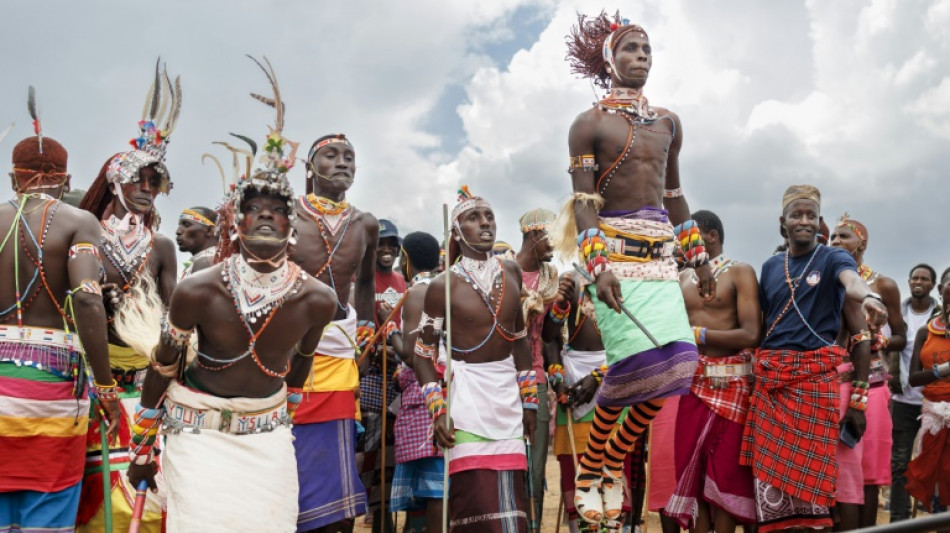
The Maa Festival celebrates one of the best-known parts of Kenya's culture, which has been remarkably resilient even as it is strained by modernisation and climate change.

Text size:

At this week's festival, which brought members of Maa tribes from across Kenya to the Samburu national reserve in the north of the country, modern technology sits comfortably alongside ancient culture.

In a straw-topped dung-walled hut, a group of women pass around smartphones and a tablet to share pictures of members of other sub-tribes they have met.

On a main stage, groups combine contemporary beats with the hypnotic guttural throb of Maa chants, while elsewhere people in dazzling beads and headdresses leap and dance in circles that speak of much older traditions.

Kenya has dozens of tribes, but it is the pastoralist Maa communities -- named after the language they share -- that have held on to ancient dress and customs the longest, becoming beloved symbols of the country as a result.

- 'A disconnect' -

The Maasai are the best-known to tourists, but the family includes the Samburu, Laikipiak, Njemps and many others.

"The Maa lived very communally," said Stella Napanu of the Northern Rangelands Trust, a conservation group run by local indigenous communities.

"That strengthened them and helped protect their culture from outside influences."

Climate change is a threat to the Maa, however.

Dwindling water resources have forced herders to travel further from their families, straining community ties.

"There's a disconnect between elders and young people because of this and it has weakened our government structures," said Napanu.

Other changes have been more positive.

Maa musicians have new outlets like YouTube to foster pride in their culture. Some travel as far as France and Australia to perform.

"God has given us this culture, so we must preserve it for our children," said a woman who recently travelled to Germany to show off her beadwork.

But communal living is unlikely to survive the lure of the city.

"Some parts of our culture will not last much longer," said Nasieku Letipila, 42, who runs Samburu county's culture department.

"For the Maa, if I have 10 cows and my neighbour has none, I have to share -- I cannot eat if they cannot eat -- that is the most beautiful part of our culture," she said.

"It sustained us, but it is the most difficult part to maintain. Now I live in a city in a gated community and I don't know my neighbours."

The Maa festival, which is becoming an annual affair since its launch last year, is a chance to reconnect with that older way of being.

"I always have to go back to the village and live like that for a while," said Letipila.

"Our culture is the strongest in Kenya. It's a religion to us, we cannot live without it."

L.Kwan--ThChM