Trump set to drastically loosen oil and gas sector's methane rules / Photo: © GETTY IMAGES NORTH AMERICA/AFP/File

President Donald Trump is set to announce Tuesday a sweeping rollback of rules that stop oil and gas producers from emitting methane, a greenhouse gas super pollutant.
Trump will make the announcement at a rally in support of Texas Attorney General Ken Paxton, who is running for Senate, a White House official said. Texas is by far the country's leading fossil fuel producing state.
An Environmental Protection Agency statement earlier this month said undoing regulations put in place by Republican Trump's Democratic predecessor Joe Biden would result in $45 billion in cost savings, without offering a detailed breakdown of the figure.
"Americans must be able to afford to heat their homes in the winter and fill up their car and drive to work. They can't do that when the people producing the energy are weighed down by unnecessary burdens," said EPA administrator Lee Zeldin.
Methane, the main component of natural gas, is the second-largest cause of global warming behind carbon dioxide -- responsible for about a third, or 0.5C, of total planetary heating since the pre-industrial era.
A molecule of methane traps far more heat than carbon dioxide, but persists in the atmosphere for only seven to 12 years, whereas carbon dioxide can last for hundreds of years.
The changes take aim at rules to curb methane emissions from oil and gas operations. Emissions occur at every stage, from extracting gas held underground, to processing, transmission and distribution.
"Lee Zeldin's EPA is giving oil and gas corporations exactly what they've long wanted: a toothless methane standard they can use to pretend they're well-regulated, all while they continue to knowingly leak and flare dangerous amounts of the heat-trapping gas," said Julia Kane, a researcher at oil and gas watchdog Fieldnotes.
The United States is the world's leading emitter of methane from its oil and gas sector, followed by Russia, according to the International Energy Agency.
The new changes include proposing to kill off the "Super Emitter Program," a provision that allows EPA-approved observers to report major leaks with a rate of over 100 kilograms (220 pounds) per hour.
Another will weaken regulation against so-called "marginal wells" that produce 15 barrels or less of oil equivalent a day.
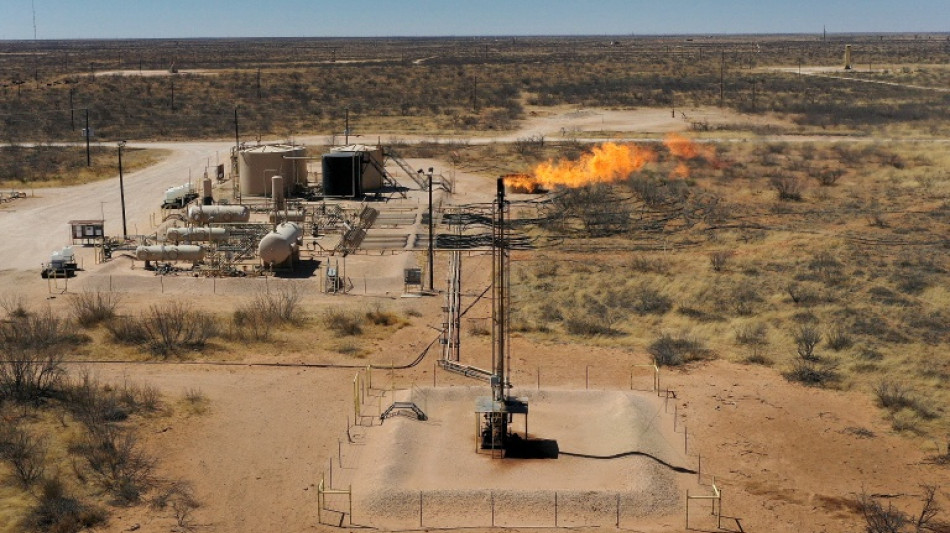
Yet another will relax rules around the routine flaring of "associated gas."
In places like the Permian Basin where oil is the main product, the associated gas that comes up is considered a byproduct, with the cost of capture exceeding its market value, leading operators to often burn it off, or flare it.
Y.Parker--ThChM