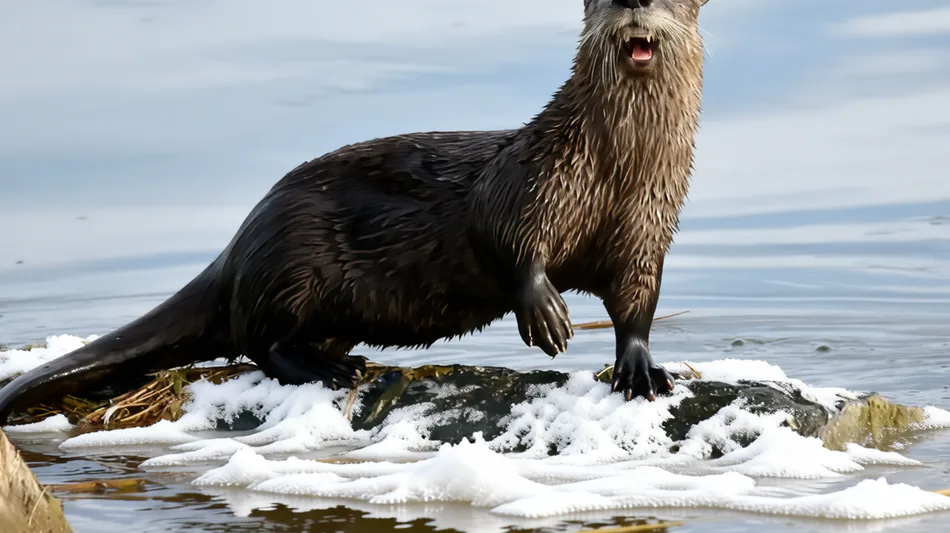
The China Mail - Indiana River Otters Make Comeback After Decades of Conservation Efforts

USD -
AED 3.672504
AFN 65.000368
ALL 82.324126
AMD 360.540403
ANG 1.790403
AOA 918.000367
ARS 1546.131265
AUD 1.468645
AWG 1.8
AZN 1.70397
BAM 1.769883
BBD 2.014669
BDT 124.715381
BGN 1.77347
BHD 0.378283
BIF 3011.021908
BMD 1
BND 1.291151
BOB 11.678099
BRL 5.666304
BSD 1.000231
BTN 94.44641
BWP 14.015512
BYN 3.004037
BYR 19600
BZD 2.016692
CAD 1.42705
CDF 2315.000362
CHF 0.837483
CLF 0.025469
CLP 1002.376741
CNY 6.67175
CNH 6.676604
COP 3319.97
CRC 449.312832
CUC 1
CUP 24.064952
CVE 100.150394
CZK 22.139304
DJF 178.554905
DKK 6.782304
DOP 60.996961
DZD 137.215041
EGP 53.502064
ERN 15
ETB 164.576405
EUR 0.90715
FJD 2.27435
FKP 0.756889
GBP 0.755715
GEL 2.590391
GGP 0.756889
GHS 11.72504
GIP 0.756889
GMD 74.000355
GNF 8883.748356
GTQ 7.646644
GYD 209.264655
HKD 7.845704
HNL 26.963306
HRK 6.831965
HTG 131.491813
HUF 331.003504
IDR 18235.4
ILS 3.216704
IMP 0.756889
INR 94.245504
IQD 1520.116116
IRR 1913737.503816
ISK 123.930386
JEP 0.756889
JMD 158.434254
JOD 0.70904
JPY 159.73504
KES 130.050385
KGS 87.435504
KHR 4080.00035
KMF 447.00035
KPW 900.00035
KRW 1335.320383
KWD 0.31147
KYD 0.835579
KZT 446.945163
LAK 22570.87132
LBP 89792.715562
LKR 333.505692
LRD 170.463102
LSL 16.951422
LTL 2.95274
LVL 0.60489
LYD 6.463464
MAD 9.936862
MDL 18.213816
MGA 4555.721867
MKD 55.830725
MMK 2100.274506
MNT 3605.662913
MOP 8.103688
MRU 40.552456
MUR 47.620378
MVR 15.403739
MWK 1738.739965
MXN 18.536504
MYR 4.086104
MZN 63.903729
NAD 16.951422
NGN 1343.570377
NIO 36.90298
NOK 9.57248
NPR 151.114437
NZD 1.809464
OMR 0.385095
PAB 1.000231
PEN 3.411802
PGK 4.575679
PHP 63.960375
PKR 277.274459
PLN 3.996535
PYG 6207.891986
QAR 3.64425
RON 4.851904
RSD 106.559038
RUB 82.829047
RWF 1483.467138
SAR 3.82571
SBD 8.097697
SCR 13.874904
SDG 601.503676
SEK 10.075038
SGD 1.287304
SHP 0.752984
SLE 23.050371
SLL 20969.503664
SOS 573.048487
SRD 37.49037
STD 20697.981008
STN 22.225246
SVC 8.773983
SYP 13002.000337
SZL 16.946523
THB 33.875038
TJS 9.249966
TMT 3.5
TND 3.008504
TOP 2.40776
TRY 50.333804
TTD 6.806368
TWD 32.891404
TZS 2655.145825
UAH 45.588969
UGX 4131.053487
UYU 40.541335
UZS 12057.876355
VES 912.87925
VND 25725.5
VUV 120.320092
WST 2.810586
XAF 595.051667
XAG 0.020459
XAU 0.00025782798
XCD 2.70255
XCG 1.807139
XDR 0.707052
XOF 595.051667
XPF 108.325037
YER 236.550363
ZAR 16.976255
ZMK 9001.203584
ZMW 20.500748
ZWL 321.999592
SSP 5945.381189
MXV 2.081672
  • RYCEF

    0.4000

    19.71

    +2.03%

  • CMSC

    0.0000

    20.4

    0%

  • BTI

    0.4200

    56.05

    +0.75%

  • BP

    0.2800

    44.43

    +0.63%

  • RBGPF

    1.6000

    67

    +2.39%

  • RIO

    -0.1500

    94.41

    -0.16%

  • AZN

    -0.4300

    166.15

    -0.26%

  • GSK

    0.4600

    49.7

    +0.93%

  • BCE

    -0.4100

    20.56

    -1.99%

  • NGG

    -0.2500

    75.24

    -0.33%

  • VOD

    -0.0400

    16.58

    -0.24%

  • RELX

    -0.4500

    33.07

    -1.36%

  • BCC

    -0.5500

    76.59

    -0.72%

  • CMSD

    -0.0300

    20.27

    -0.15%

  • JRI

    -0.2500

    10.77

    -2.32%

Indiana River Otters Make Comeback After Decades of Conservation Efforts

Indiana River Otters Make Comeback After Decades of Conservation Efforts

River otters, once nearly extinct in Indiana, have successfully recolonized every county in the state following a targeted wildlife management initiative. Starting in 1995, officials released 303 otters into local waterways to restore the population that had disappeared due to historical hunting and habitat loss.

Text size:

River otters, a species once nearly extinct in Indiana, have successfully recolonized every county in the state following a decades-long wildlife management initiative. The comeback of the North American river otter marks one of the most significant conservation successes in Indiana's history, reversing a population collapse caused by unregulated hunting and habitat degradation throughout the 20th century.

The recovery effort began in earnest in 1995, when state wildlife officials launched a targeted reintroduction program. Over the course of several years, biologists captured otters from healthy populations in other regions and released 303 individuals into Indiana’s rivers and streams. The goal was to establish breeding populations that could naturally expand and repopulate the state’s waterways.

The strategy proved effective. Within a few decades, the released otters not only survived but thrived, expanding their range across the state. Today, river otters are no longer considered endangered or threatened in Indiana; they are present in all 92 counties, utilizing rivers, lakes, and even urban waterways.

The White River in Indianapolis serves as a prime example of this ecological shift. Once devoid of the species, the river now supports healthy otter populations, with residents frequently reporting sightings of the animals swimming in the water or leaving distinctive tracks in the snow along the banks. The presence of otters is often viewed as an indicator of water quality, as they require clean, fish-rich environments to survive.

Historically, river otters were abundant in Indiana but faced severe declines due to fur trapping and the loss of wetlands. By the mid-20th century, the species had vanished from much of its former range. The 1995 reintroduction program was a critical intervention that halted the decline and set the stage for the current widespread presence.

Wildlife officials continue to monitor otter populations to ensure the species remains stable. The success in Indiana serves as a model for other states dealing with similar conservation challenges, demonstrating that targeted reintroduction efforts can restore native wildlife even after long periods of absence.

E.Lau--ThChM