The China Mail - From 1800s to modern pharma: a Nobel-winning chemistry quest

USD -
AED 3.672498
AFN 63.999915
ALL 81.992851
AMD 362.320446
ANG 1.790365
AOA 916.999409
ARS 1522.249818
AUD 1.43672
AWG 1.8025
AZN 1.701071
BAM 1.747811
BBD 2.014182
BDT 123.181412
BGN 1.683441
BHD 0.377117
BIF 3003.57462
BMD 1
BND 1.28025
BOB 11.999747
BRL 4.995805
BSD 0.999987
BTN 96.714521
BWP 13.824844
BYN 3.066935
BYR 19600
BZD 2.01126
CAD 1.425496
CDF 2317.501389
CHF 0.83283
CLF 0.02477
CLP 978.050074
CNY 6.704597
CNH 6.704855
COP 3242.89
CRC 456.562244
CUC 1
CUP 24.000894
CVE 98.537993
CZK 21.823399
DJF 178.074663
DKK 6.678175
DOP 60.28597
DZD 134.575706
EGP 52.367197
ERN 15
ETB 162.472475
EUR 0.89348
FJD 2.2513
FKP 0.753189
GBP 0.756595
GEL 2.575028
GGP 0.753189
GHS 11.820534
GIP 0.753189
GMD 74.000148
GNF 8798.033959
GTQ 7.637967
GYD 209.155291
HKD 7.848225
HNL 26.845398
HRK 6.730196
HTG 130.956211
HUF 327.037047
IDR 17909
ILS 3.072198
IMP 0.753189
INR 96.76625
IQD 1310.008937
IRR 1732149.999813
ISK 122.409852
JEP 0.753189
JMD 158.865058
JOD 0.708993
JPY 158.083503
KES 129.949684
KGS 87.448504
KHR 4071.546982
KMF 438.00005
KPW 900.000318
KRW 1339.130288
KWD 0.310405
KYD 0.833423
KZT 447.018136
LAK 22425.379803
LBP 89552.993744
LKR 330.857909
LRD 171.00983
LSL 16.693431
LTL 2.95274
LVL 0.60489
LYD 6.424486
MAD 9.972833
MDL 17.810545
MGA 4459.338695
MKD 55.022341
MMK 2099.693644
MNT 3596.990612
MOP 8.084004
MRU 40.04075
MUR 47.379747
MVR 15.410284
MWK 1734.071502
MXN 18.008499
MYR 4.086904
MZN 63.89771
NAD 16.693655
NGN 1326.940141
NIO 36.800222
NOK 9.57701
NPR 154.747383
NZD 1.78726
OMR 0.384516
PAB 1
PEN 3.442492
PGK 4.532618
PHP 62.732499
PKR 276.934316
PLN 3.91215
PYG 5834.699887
QAR 3.64604
RON 4.784301
RSD 104.879036
RUB 85.498832
RWF 1477.033065
SAR 3.750854
SBD 8.065041
SCR 13.903218
SDG 601.497165
SEK 10.016835
SGD 1.279805
SHP 0.754461
SLE 24.679784
SLL 20969.491881
SOS 571.492404
SRD 37.650193
STD 20697.981008
STN 21.894255
SVC 8.750592
SYP 13002.000254
SZL 16.688114
THB 33.674054
TJS 9.230295
TMT 3.5
TND 2.987578
TOP 2.40776
TRY 49.197298
TTD 6.783645
TWD 31.868032
TZS 2635.003044
UAH 44.87185
UGX 4075.012399
UYU 40.10688
UZS 11795.247585
VES 872.77465
VND 25980.5
VUV 120.182413
WST 2.784712
XAF 586.084608
XAG 0.016728
XAU 0.000243619306
XCD 2.70255
XCG 1.802299
XDR 0.707052
XOF 586.084608
XPF 106.577301
YER 236.225002
ZAR 16.645891
ZMK 9001.196871
ZMW 19.890974
ZWL 321.999592
SSP 5747.740458
MXV 2.035399
  • RYCEF

    0.4000

    19.71

    +2.03%

  • CMSC

    0.0000

    20.4

    0%

  • BTI

    0.4200

    56.05

    +0.75%

  • BP

    0.2800

    44.43

    +0.63%

  • RBGPF

    1.6000

    67

    +2.39%

  • RIO

    -0.1500

    94.41

    -0.16%

  • AZN

    -0.4300

    166.15

    -0.26%

  • GSK

    0.4600

    49.7

    +0.93%

  • BCE

    -0.4100

    20.56

    -1.99%

  • NGG

    -0.2500

    75.24

    -0.33%

  • VOD

    -0.0400

    16.58

    -0.24%

  • RELX

    -0.4500

    33.07

    -1.36%

  • BCC

    -0.5500

    76.59

    -0.72%

  • CMSD

    -0.0300

    20.27

    -0.15%

  • JRI

    -0.2500

    10.77

    -2.32%

From 1800s to modern pharma: a Nobel-winning chemistry quest
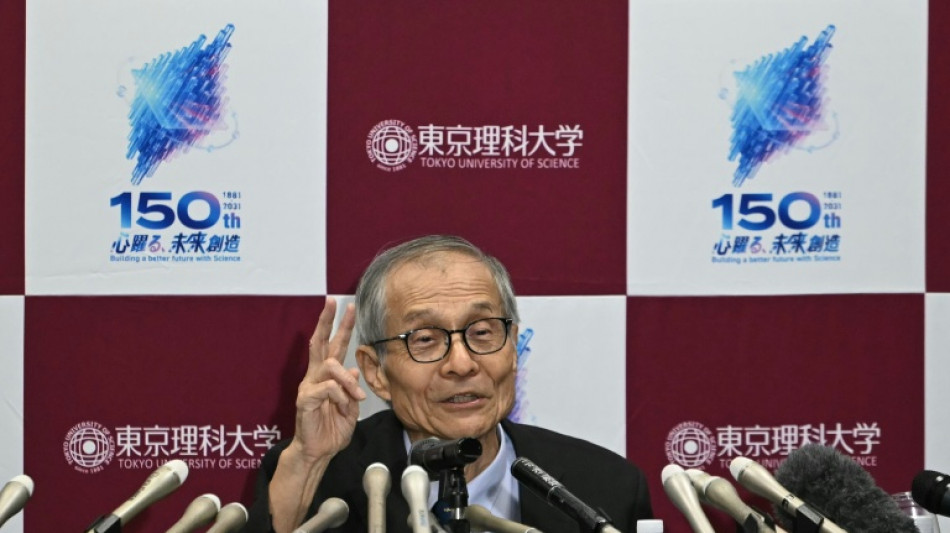
From 1800s to modern pharma: a Nobel-winning chemistry quest / Photo: © AFP

From 1800s to modern pharma: a Nobel-winning chemistry quest

Wednesday's Nobel chemistry prize crowned a series of advances that started in the 19th century and led to breakthroughs for modern pharmaceutical manufacturing.

Text size:

The work taught scientists how to produce a chosen form of certain molecules, "crucial for making things like drugs or even flavours and fragrances," said Phillip Broadwith, an editor at the Royal Society of Chemistry's magazine Chemistry World.

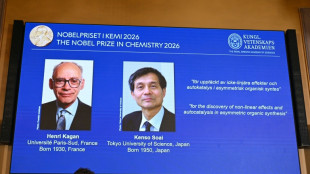
Here are the steps that led France's Henri Kagan and Japan's Kenso Soai to solve a "chemical mystery", according to the Nobel committee.

- Louis Pasteur -

In 1848 French chemist Louis Pasteur shone polarised light on tartaric acid. Some molecules bent the light to the left, others to the right.

This two-handed form was dubbed "chirality" and the two opposite mirror forms "enantiomers".

Later discoveries revealed that in living organisms, amino acids and sugars are present in just one of these two mirror forms -- but when produced in a test tube, both forms occurred.

"Incredibly, molecules that are mirror images of each other can have completely different effects on biological systems," said Broadwith.

The Nobel committee noted that among many drug molecules, "one has the therapeutic effect, while the other can cause unnecessary and sometimes harmful side effects."

- 'Asymmetric' reaction -

Building on Pasteur's findings, in 1904 German chemist Willy Marckwald performed the first "asymmetric" chemical reaction.

Using a one-handed molecule as a catalyst, he found that this generated slightly more of one enantiomer than the other.

If this effect could be amplified, it could be possible for just one of the mirror-image forms to be produced from an artificial reaction -- just as it occurs in a living being.

- Maths basis -

Next, British physicist Charles Frank in 1953 proposed a mathematical explanation for homochirality.

His model suggested a tiny initial imbalance of one "hand" over the other could lead to that form predominating in a chemical reaction under certain conditions.

The challenge was on to stage a reaction that met all his conditions.

- Enter Kagan -

In the 1980s Kagan discovered how to greatly amplify the production of one of the molecules by manipulating the composition of a "chiral" catalyst.

His breakthrough "non-linear" process enabled the production of purer chemicals.

In 2001, US scientists William Knowles and Barry Sharpless and Japan's Ryoji Noyori won the Nobel chemistry prize for work on "asymmetric catalysis".

Kagan was not included in the award.

- Soai: 'autocatalysis' -

Inspired by Kagan's findings, Kenso Soai in 1995 honed the process.

He identified a molecule that could trigger the catalyst to reproduce and yield yet more of the chosen molecule in a process called "autocatalysis".

In 2003 Soai developed a reaction yielding a chemical that was 99.99 percent composed of one single enantiomer.

"Other than life itself, no one had ever achieved this feat," the Nobel committee said.

"The Soai reaction is one of the most spectacular chemical experiments ever conducted."

L.Kwan--ThChM